Tuesday, March 14, 2006

Hear no evil

I kind of wish I wasn't writing a blog right now. I think if I wasn't writing a blog I'd pay less attention to the news media, and I probably would have taken an "I can't cope with knowing this" position on the Louise Nicholas case. As it is I've been reading the papers, and listening to morning report and checkpoint on-line (talking of which, Radio New Zealand's headline for the story is: "Alleged rape victim Louise Nicholas breaks down in court" - fuck off radio New Zealand).

I feel almost invasive writing about it, at this point. They cleared the court while she gave evidence today, but the newspapers are reporting her testimony as if they're enjoying the salacious side of it.

What I'm scared of is the cross-examination. There are three defendants, and each of their lawyers will be able to try and rip her apart, one after another, with 20 people from the media, and the men who raped her watching. I'm sure I'll write more about this in the next few days.

I just wish I could offer some form of support to Louise Nicholas. By giving testimony, even though she's going to be treated like shit, then she may be able to show that even the powerful are not immune.

Also posted on Alas

Sulking

Tony Blair is coming to New Zealand, but he's staying in Auckland and not coming down to Wellington.

How am I supposed to yell at him?

Monday, March 13, 2006

Representative Charges

Today the trial for Clinton Rickards, Bradley Shipton and Robert Schollum began. They are all police officers (Clint Rickards is now an Assistant Police Commissioner) at the time they raped Louise Nicholas.

Until now the charges they faced had been suppressed:

The three men face a total of 20 charges relating to a period between 1985 and 1986 when the complainant was 18-years-old.

They are accused of indecent assault, rape and unlawful sexual connection and the charges include two counts of indecent assault using a baton.
I expect I'll be blogging a lot about the trial (and its media coverage), over the next three weeks or so.

Right now the only thing I can think to do is to link to Flea's letter to her sons, and ask everyone to please read it, and work for a world where it's not necessary.

Also posted at Alas.

Up Your Productivity

That's the title of a campaign from the Engineers (just for a tiny bit of context they're affiliated to the Labour party and are the most right-wing private sector union). Increases in productivity over and above increases in wages is just increasing the amount the bosses get from the workers' labour.

From the press release:

The EPMU will support employers who develop genuine productivity initiatives.
Because the union's job is to support employers, but only those who are genuinely trying to get more money out of workers.

The nearest I have come to a Marxist conversion came during a discussion about productivity in the union movement. Marxist economics made so much sense right then (which is strange because 90% of the conversations I've had about Marxist economics have been about the fact that they ignore unpaid labour).

Also posted at Alas

Working Mothers

There was an article in today's Sunday Star Times Sunday magazine that was interesting and not completely misogynist. I almost died of shock (for non-New Zealanders Sunday's speciality is that it no longer calls it's 'beauty' section 'beauty' or even 'health', but maintenance. I've no idea what you're supposed to be maintaining with blue eye-shadow).

The article was looking at rates of depression in parents, and particularly among mothers. What I really liked about the article is that it showed how depressing and isolating the work of child rearing can be in our society, and that saying that the work is hard wasn't an attempt to devalue it.

Too often feminists are blamed for devaluing the work of raising children. All they said was that society didn't value the work, and that the way child-rearing was done was extremely isolating and hard.

Unfortuantely it's as true now as it was then. I like a lot of Betty Freidan's analysis in The Feminine Mystique, but disagree with her conclusions. While increased access to childcare, and the opportunity to do paid employment has helped some children, it doesn't solve the problem. Those who stay out of the paid workforce are still isolated, and those who work outside the home are still doing all the unpaid work they would before, only with less time.

Earlier last century children were seen as a duty, now they're seen as a luxury, I think we could do better. I don't often imagine the world that I'm trying create, maybe I don't do it enough. But I do know how raising children would be resourced (and I'm not talking about money, because I think a first step to the world I'm talking about would be ending capitalism).

I believe that all the resources required to raise children should be provided collectively, not individually by the parents. Raising children should be recognised as important work, and whether it's done collectively or individually, it should be seen as a contribution to society as important as any other. At the same time anyone in a parental role should be able to do other work that they enjoy, or are good at, or see as important, and in then their children would be looked after collectively.

This is why I find arguments about staying at home vs. working very frustrating. Neither individual choice is going to make a slightest bit of difference, and it's stupid to fight over the limited resources available when what we actually need to do is smash the whole pie (or something).

Also posted on Alas.

Sunday Protest Blogging: 1981

I wrote about The Tour (it was late, I didn't want to do any research). You can go read it on Alas, because I wrote it for an audience who don't know what the All Blacks are.

Saturday, March 11, 2006

Obviously, some hairy-legged feminist.

I always enjoy Ampersand's link threads, but when I see the word 'Buffy' I start making squeals of geeker joy (that's supposed to be a quote from Ted, but it may not be accurate). So I was really interested in Emma's Raping the Slayer, which analyses the portrayal of sexual violence on Buffy. The only thing more fun than watching Buffy is talking about your feminist analysis of Buffy (one day I might write a very long post about my theory on the portrayal of teenage girl's sexuality on Buffy, but you're spared that - for now). I disagreed with some of the smaller points she was making, for instance, I may being over-defensive on behalf of my secret-TV-Boyfriend, but I just don't think this is true:

Joss has always been clear that he resents some feminist analyses of it, and what he sees as an imposition of subtext.


But generally I really liked her analysis, particularly when it came to Spike's attempted rape of Buffy in Seeing Red, and the complete lack of follow-up in season 7. There were two things that most disturbed me about that plot-line, the first was that it was All About Spike. They wrote a rape plot that was all about the rapist and his quest for redemption, to the extent that the attempted rape had almost no affect on Buffy, and certainly none that was important to the plot.

The other was that getting a soul is a plot there is no real world equivalent for. This meant they could weasel out of the real world implications of what they were saying. While they were basically telling the story of a rapist who went away and came back a better person who could earn trust.

I like to believe that people can change, I'm not going to reject the possibility that once you've tried to rape someone there's no chance of you becoming a person who values women's autonomy. I wouldn't necessarily reject a fictional story that tried to talk about that possibility. But no-one who ever tried to rape a friend of mine could be anything but a rapist to me. If Spike had wandered off somewhere else entirely and played out his story of redemption there (preferably somewhere that wasn't on my TV screen), then maybe I could have stomached it. But the idea that you can achieve redemption and forgiveness from the person you tried to rape, is not a story I have any interest in.

That isn't actually what I wanted to talk about. On the comments of Emma's post someone brought up a planned Firefly episode, that I'd wanted to talk about for a while. The original source is here:
[Tim Minear, asked about eps of Firefly they didn’t get to make] hemmed and hawed and said, “Should I tell you this?… Oh well, what’s he going to do, fire me?” The original show was darker and this story was more in keeping with that tone.

It opens with Mal and Inara fighting (as they do). Mal tells her she pretends to be a lady and wants everyone to bow before her and kiss her hand but she’s just a whore. Then the Reavers attack and take Inara. While trying to get her back they learn that she had something that would make anyone who had sex with her die.

When they finally track down and board the ship they find all of the Reavers dead and Inara shaking and traumatized. They take her back to the ship and Zoe guards her room. Mal tries to get in to see her and Zoe tells him he’s the last person Inara needs to see. He pushes past her, kneels before Inara and kisses her hand.
I'd never heard of a plot like that before, so I didn't have a feminist analysis at first, just a general feeling of disgust.

My most immediate feeling of repulsion was definately at the execution of the idea. I have written about the Mal/Inara relationship before, and I'm not a fan, this just underscored all the reasons why. The most basic reason was that he did not respect the work that she did, and that seemed to me a really shitty basis for a relationship. This plotline seems to be about her earning his respect for what she does by using it to do something that he does respect (fighting). That she has to be violated and traumatised to earn his respect is so gross and repulsive, that I imagine I would never be able to watch the show again after seeing that episode. The fact that he ignores her wishes, underscores how little he actually cares about her.

But what I do find interesting is the wider question. What do other feminist think of a piece of flabotinum that means women can kill their rapists through having sex? It's not something I'd ever come accross before (although for all I know it could be a common idea in some genre I'm unfamiliar with). One of the things it reminded me of was the rape condom - but as a fictional device I think it needs to be analysed completely differently. I was particularly uncomfortable that this idea came from two men. When men write about rape, I always wonder why. What are they getting from it? What are they trying to say? But I'm not convinced that a woman could write a feminist story about it either. Because ultimately it's about suffering oppression in order to get revenge.

Also posted on Alas

Louise Nicholas

In 1986 Louise Nicholas was raped by three policeman. She has tried to get justice since, and had been unable to. Finally, almost 20 years later, those were charged.

The trial is currently taking place in Auckland. Most details of the case have been suppressed, so I can't really talk about it (but you can bet I'll have something to say when the verdict comes out).

I just wanted to commend her strength and courage.

This post was also published at Alas

Just in case you thought it was safe to be a woman

Abortion has been in the news again here. Staff at the Waitemata District Health Board refuse to do late second trimester abortions on mental health grounds, so the District Health Board is subsidising women who are going to Australia to have the procedure done there.

Of course there are a number of issues here, first of all that staff can say "I'll do an abortion if there's signs of fetal abnormality, but not under other grounds, because the woman should just suck it up and go through pregnancy." I actually don't think that's compatible with the law, which allows people to refuse to perform abortions on 'moral' grounds. I don't see that sort of judgement as a moral one (of course I think that if you don't want anything to do with abortions you should choose a speciality like geriatric care, if your morals interfere with your job choose a new job).

But it has also really drawn attention to how patchy New Zealand's abortion provision is, among the different District Health Boards (This website has information about access in the different DHBs - although it is funded by the drug company which makes the abortion drugs). Almost all the abortions in the South Island are done in Christchurch (which in a way is a good thing because in Dunedin you have to go to the clinic four times, and in Ashburton you have to wait 1-2 weeks for an appointment). In Taranaki abortions are usually performed under general anesthetic (to give them a greater opportunity to kill the woman involved, I guess).

It doesn't have to be like this, first trimester abortions is the safest procedure that is only done in hospitals. There's no reason why first trimester abortions couldn't be performed in your home.

Finally Family Planning pissed me right off in the interview with National Radio:

I think the whole area of abortion is a sensitive and contentious issue, and as I say the real answer is to say 'why is it occurring?' lets invest in health promotion and prevention to make sure that women don't have unplanned pregnancy.
She went to say that if people are objecting to late stage abortions then it shows that late stage abortions are happening too often, and effort needs to be put into prevention.

She can go complain about women's choices with her fellow Labour Party candidate George Hawkins.

I'm more and more convinced that the rest of us need to do something.

This post was also posted at Alas

Thursday, March 09, 2006

Many Stones Can Build An Arch; Singly None

Audra Williams has a really interesting piece about feminists in their 20s and early 30s on Rabble. I felt a little anxious about writing about it first, because I disagreed with her to the point where I was highly annoyed by what she was saying. But then I re-read it, and I realised that I agreed with her argument.

I'm not doing this to be adorable; this is what it's like in my brain. I have Feminist Insecurity. In fact, if I didn't repeat those first two points to myself, I'd never have the guts to say the third. And it's not just me. So many feminists in their 20s and 30s are like this. We apologize, we disclaim and, worst of all, we don't reach out to other young feminists for fear of being called out as the frauds we feel we are.

One of the ways this isolation manifests itself is that we don't organize in the ways of the generations of feminists before us. We don't join. We're not sure if we should, and we can't seem to navigate the movement as it is.
This is an incredibly important question. What is it that makes feminism an individual enterprise for some people, rather than a collective experience?

Audra presents this problem as a generational one: second-wave feminists organised, third-wave feminists generally do not (I do have a rant about the term third-wave, and what it ignores, but I'll save that for another time). She describes third-wave achievements as follows:
That isn't to say there isn't a great deal of amazing energy and teamwork happening with younger women right now. We have Shameless magazine. We have independent women's businesses like Venus Envy and Peach Berserk. We have menstrual experts like Blood Sisters. We have bands like Pony Da Look, Bontempi and the Maynards. We've got body-positive troupe Big Dance.

While our achievements are not the sort of feminism that older women hope to see, one thing that we've done well is dissect and influence culture. Third wavers might not have an abortion caravan, but we've got record labels. Maybe we don't attend candidate's school, but we're running feminist businesses. We don't hold consciousness-raising sessions, but we stitch and bitch.
This was the bit I was afraid of being overly sarcastic about, because for me those lists don't begin to compare (even leaving aside my opinion of alternative businesses). These individual project don't make a movement.

Having said all this I've spent most of my time as a feminist without belonging to a feminist group. My feminism mainly involves words, writing, ranting, yelling, talking, and other words, but not actions. I try to make my feminism part of my activism, but I don't really know what to do, or who to do it with. I don't believe that women of my age are just lamer than the women who came before and who were able to turn their words into something more.

I think Audra has identified one possible reason, which is that feminism can be set up as a standard that women should attain, rather than a form of analysis. I had an activist friend tell me recently that she didn't know anything about feminism. Which shocked me, but I understood what she was saying, because feminism can be seen as something that happens in a rarefied atmosphere, that comes once you've taken a women's studies class and read the right books.

I think this is bullshit, I think all you need to do to be a feminist is to listen to other women and stand beside them. You take that step, and everything else you need will follow. I'm not devaluing analysis, I think it's vital, but feminism isn't dependent on doing the reading.

I think possibly another reason is that I don't think we've got any idea how to fight patriarchy (for lack of a better term), because it's so pervasive. There are days when I go to the supermarket and I just want to grab every single magazine and rip it into to tiny pieces stomp on them, because almost every page of almost every magazine devalues women. I hear stories about how women are relegated to the kitchen during a particular campaign, and I despair that 30 years of calling sexist men out has got us precisely nowhere. I hear the pay gap is getting wider and I know so many employers who promote men to the jobs that pay higher over women time and time again. I see how raising children is treated as some kind of weird hobby, where it's fine if you want to do it, but don't ask the rest of us to support you.

I'm all over the place here - we've got too much theory, and not enough. But I think what I basically want to say is that feminism needs to start with women's lives and move to collective action, and through that I'm hoping we'll learn how to fight.

In the end I think that might have been what Audra was saying too:
Oh, I bet you are now all so excited to join and build NAC! But don't forget, you can't join NAC [A Canadian coalition of feminist groups]. After the last day of meetings wound down, I was whining to longtime feminist activist Lee Lakeman about this very thing: “So now I have to go win over some Nova Scotia women's group if I can find it in order to get the right to come here and try to win NAC over?” Lee looked at me like I was perhaps a moron and said, “Why don't you start your own group?”

As soon as she said “Why don’t you start your own group?” I started to hear “!!!!!!!!” “!!!!!!!!” “!!!!!!!” in my head, because WHAT. A. GREAT. IDEA.

Here is the deal. You need 10 people and a feminist mandate. Make sure you formally exist six weeks before the AGM (which is happening in May). You also have to have a recommendation by an existing member group. But really, contact me, we'll find a way.

The idea of starting a group is fairly terrifying, because if we're going to start groups we have to go on the record with stances, and we have to collaborate and lead and follow. But we have those skills, I know we do. It's just a question of applying them in a new way. What issue infuriates you the most? How do you think it can best be addressed? What have you been wishing someone else would do? Assemble a team and get on it.
This post was also posted at Alas

But it's murder just the same

Yesterday, Robert James McGowan died when the mine he was working at flooded work yesterday. It was a private mine on the West Coast of New Zealand that employed just 6 people.

This sort of thing is always called an accident, but deaths at work don't have to happen. They happen because it's cheaper to do things the more dangerous way, and because employers don't provide proper equipment and training. There is a really interesting analysis of the situation in America (where 21 people have died in mine accidents so far this year) on the world socialist website.

Anti-capitalism is a large part of my politics (I own a t-shirt that says "it's all capitalism's fault"), but I don't understand how anyone can stand the values that make mining companies decide they don't need a particular safety procedure.

This post was also posted on Alas

Wednesday, March 08, 2006

"How would he like it if I went round claiming that he gave me his full backing when I sent the tsunami last year?"

I'm a big fan of Steve Bell's cartoons, have been long before I could understand them (my parents had If cartoon books when I was a kid). But it wasn't until recently that I realised that the crazy look Tony Blair always has on his face wasn't hyperbole, but just good drawing. In case there was any doubt Tony Blair has recently used God as back-up in his decision to invade Iraq. I would try to comment on this, but Terry Jones has already done so, and he was a Python, so chances are he's funnier than me:

A source says Gabriel has spent days trying to dissuade the Almighty from loosing a plague of toads upon the Blair family. Gabriel reminded God that Cherie and the children had nothing to do with Tony's decisions. God's response, it is reliably reported, was: "Blair says the Iraqis are lucky to have got bombed, so how can he complain if his family gets a few toads in the bath?"
PS speaking of plagues of frogs go check out the Brick Testament - because a plague of frogs in lego is an experience not to be missed.

An uplifting tale of women's rights being trampled

In 1977 New Zealand passed abortion legislation that was described as the most repressive in the Western world and, apart from a couple of minor modifications in 1978, it hasn't been changed since. If a woman wants to have an abortion in New Zealand she must get two certifying consultants (these are registered doctors who are selected on the basis that their views aren't in conflict with current abortion law) to agree that she meets the following criteria:

That the continuance of the pregnancy would result in serious danger (not being danger normally attendant upon childbirth) to the life, or to the physical or mental health, of the woman or girl . . .; or

(aa)That there is a substantial risk that the child, if born, would be so physically or mentally abnormal as to be seriously handicapped; or

(b)That the pregnancy is the result of sexual intercourse between—

(i)A parent and child; or
(ii)A brother and sister, whether of the whole blood or of the half blood; or
(iii)A grandparent and grandchild; or

(c)That the pregnancy is the result of sexual intercourse that constitutes an offence against section 131(1) of this Act[this means a dependent family member]; or

(d)That the woman or girl is severely subnormal within the meaning of section 138(2) of this Act.
If I discovered that I was pregnant tomorrow I would go to my doctor (this would be free because maternity care in New Zealand is free) who would refer me to the euphemistically named Level J Unit in the Wellington Public hospital. I would have to make two appointments (neither of which would cost me anything) where I'd have to talk to a whole lot of people, and at the end of the second appointment I could have by abortion by suction (which I'd choose, but because I live in Wellington I also have the option of medical abortion). The abortion would be safe, on demand and free (the three things I want all abortions to be).

The point of this post is that despite the hideous laws we have in New Zealand I have better abortion access than most American women. I think that talking about the New Zealand abortion situation is all I have to offer women in South Dakota, and the rest of the States. I know most abortion activists in America know far more about this than I do, but this is a tale which begins with laws being tightened and ends with access being loosened - I thought it might sound like good news.

Reading about comparative abortion law makes it clear that there is often very little relationship between abortion law and abortion practice, except for occasional ceremonial public fight. New Zealand is the positive example of that, the United States is the negative.

New Zealand women didn't have a legal right to abortion before the law change, but from 1974 if you could get up to Auckland in your first trimester then Auckland Medical Aid Centre would probably give you one, basically they were ignoring the law. They were raided by the cops, and faced prosecution, but the juries wouldn't convict the abortion doctor. There were several attempts to change the law and close the clinic but they failed due to general incompentence.

Before the law change there were also some underground networks, people who knew how to do menstrual extraction (which is a skill well worth learning, particularly because you don't have to wait for someone to need an abortion to practice it) and doctors and who were performing abortions of dubious legality.

Immediately after the law was passed you could not get a legal abortion in New Zealand (although there were probably some D&C operations that had the purpose of ending a pregnancy). Instead if a woman was going to get an abortion she had to fly to Australia. This cost $500 then, which would be $2,652.14 now (that's $1,736.89 US). This was made reasonably seamless by SOS (Save Our Sisters) groups, that would do all the organising required to get someone to Australia, and do some subsidising of travel. There were complications: one of the big abortion clinics in Australia started subsidising the SOS groups to try and increase their business.

The best estimate anyone can do actually shows the number of abortions New Zealand women had over this period going up after the law change, it's just they were all happening in Australia. Then slowly more abortions were allowed, and the boundaries began to be pushed. Now 98% of abortions are done under the grounds that the continuance of the pregnancy would result in serious danger (not being danger normally attendant upon childbirth) to the mental health of the woman or girl.

Exciting Blogging News

For the next week or so I will be guest blogging over at Alas a blog, great thanks to Ampersand for asking me. Alas was the first political blog I read regularly, which makes it particularly cool.

Everything I post on Alas will also be posted here. There'll probably be a New Zealand specific few posts that'll just be posted here, if I decided there was an urgent need to comment on David Benson Pope (don't worry I won't), or needed to mock Wayne Mapp some more (I'm not making any promises). So people who read here won't notice any difference, but you should go and check Alas out, and join in the comment threads over there.

Tuesday, March 07, 2006

But if she's a slut then surely the state has some right to her body?

I'm sorry Sunday protest blogging hasn't been, my Sundays have been sucking beyond the telling of it recently, which leaves little room fo blogging. I will have an exciting blogging development tomorrow (well it's exciting if you're me, otherwise I don't promise anything). But right now I just have time to write a quick post about George Hawkins and sharing the hate I have for Gordon Copeland around:

The Manurewa MP and former minister plans to draft a private member's bill to get the state more involved in providing advice on contraception and sterilisation to women who seek more than one abortion, he told Newstalk ZB yesterday.
The asshole can come back when he's got a 100% effective, reversible, side-effect free form of contraception (when I will tell him to fuck off, because it's none of his business whether women want to use it or not).

I don't think we've got much to worry about - apparently Labour MPs have to get caucus consent to put a private members bill in the ballot, so I doubt it'll get in. I don't generally use the word 'trust' when talking about a Labour government, but if I was going to trust this current government on any one issue, it would be maintaining abortion rights and access at their current level (if they had any principles at all it'd be a hell of a lot better by now).

But I do find it interesting that there has been a definate increase in the attacks against abortion recently, although they don't have a chance in hell of passing. None of these attacks come straight out and attempt to ban abortion (or even enforce the law), or even seem to have much to do with the New Zealand legal environment around abortion (ever law proposed has been tried by one state or another in an effort to get around Roe vs. Wade). They seem to be trying to build a base.

I'm thinking now would be the time to start counter-organising.

Shut Up George Clooney

So I half watched the Oscars last night, despite the fact that I had seen just three films with any nominations at all. I was mainly hoping Michelle Williams would win Best Supporting Actress (I've loved her ever since she loved Dick), which she didn't, but that's not what I'm going to blog about. This was George Clooney:

We are a little bit out of touch in Hollywood every once in a while. We were the ones who talked about AIDS when it was being whispered. We talked about civil rights when it wasn't really popular. This Academy, this group of people gave Hattie McDaniel an Oscar in 1939 when blacks were still sitting in the backs of theaters. I'm proud to be part of this Academy. I'm proud to be part of this community. I'm proud to be out of touch
This is a pretty annoying speech who ever gives it, quite frankly. For me, politics isn't actually about feeling smug about how I'm much better than the great unwashed, but about building and organising so you're not . Being alternative and radical isn't actually my goal, because I think that it's only through collective action that we're going to end capitalism, not through being rich and famous.

But it's particularly annoying from George Clooney, who was nominated for Good Night and Good Luck, a movie whose message (McCarthyism is bad when the people involved aren't communists) was so radical that Joe Liberman would have supported it. Yes Three Kings was actually a good political movie, but that's one on a rather long CV. I'd think that not noticing that women have relationships with each other is a little out of touch, and I'd also be damned surprised if more than 5% of the movies George Clooney has been in would pass the Mo' Movie Measure.

The Hollywood he praises is the voice of rich, it's racist, misogynist, homophobic, for a start, and the fact that it occasionally nominates 'issue' films doesn't make that any less true.

Oh and if we're going to talk about specifics it wasn't Hollywood that was talking about civil rights when it wasn't popular. It was normal people who gave enough of a shit to try and fight back. Some of them died, and when Hollywood got round to making a movie about that - a ground breaking 25 years later, it was about as accurate as you'd expect.

Monday, March 06, 2006

I could almost forgive her for scabbing

On her final broadcast Linda Clark finished:

And then, as the minutes turned to seconds: "I'll never have to interview Sue Kedgley again. It just gets better and better."

Saturday, March 04, 2006

Census

I'm getting a little anxious that I haven't received my census form yet. I'm enough of a historian to think it's really important to leave my part of the record. I'd encourage everyone to tick the 'yes I will let my form be kept'. It's such a loss that historians don't have acces to forms from earlier periods.

The whole ethnicity question is beginning to bother me though. The people who want to write "New Zealander" are bugging the shit out of me. Ethnicity and nationality are different. Maori, Samoan, Chinese, Vietnames, Thai, Tongan, Fijian, even dumb Palangi are all New Zealanders. As Tze Ming points out - it's hardly a coincidence that the e-mail has only been circulated among White people.

But it's made me think about the whole question and I'm not sure what I'm going to do. Given a choice I'd choose Pakeha, but that isn't a tick box option, you have to write it in, and that makes me a little uncomfortable. I wasn't even born in New Zealand. But by insisting on the term Pakeha over New Zealand European it seems to me to be claiming some sort of indigenous status for myself. Why should I get to do that when a fifth generation Chinese person wouldn't be able to?

Yes I'm over-thinking this - so I think I'll just tick the New Zealand European box.

Friday, March 03, 2006

Body Parts

A friend of mine has a six month baby (he's ginormous, and terribly grown up now). She was having a reunion with her ante-natal class, and there were a lot of babies there (that tends to happen with ante-natal classes). One of the woman was looking at her daughter and said "She's got my thighs, she'll have to be careful."

This girl was six months old. Her thighs can't walk, can't run, can't ride a bike, can't climb a tree, can't get out of bed, can't jump, can't skip, can't hop, can't dance. I hope that little girl learns to do all those things with her thighs. But I can't even hope that she won't learn to hate those thighs, despite their strength and usefulness.

Wednesday, March 01, 2006

More on the pro-women line

I found the discussion on my post about blaming women vs. blaming patriarchy interesting. But thought the issues got a little muddied, because the post I was responding to was talking about the sex industry. I really don't understand how anyone could hold women within the sex industry responsible for their own objectification. That makes no sense to me, so I would start responding to people, and wanting to rant in eight different directions at once.

But there's a really interesting post at Feministe about Indian women aborting female fetuses, which I think will make it easier to explore the issues. From the Daily Telegraph (I know, but it might be true even so):

The gender ratio of babies has fallen to fewer than 600 girls for every 1,000 boys in the Punjab, a predominantly Sikh region, partly because for the equivalent of £10 even poor farmers can afford a scan to determine the sex of a foetus. Worldwide, 1,050 female babies are born for every 1,000 boys.
I don't think any feminist reaction to this involves blaming women for the decision to terminate the fetuses, or trying to restrict their ability to have an abortion. Because that many women are not abortin female fetuses on a whim, or because they're misogynist. There are structural reason that they're doing it, and ultimately they're making rational choices.

I don't think anyone should say to any woman: 'those reservations you have about having a girl-child, don't worry it'll all be hugs and puppies'. Because each woman knows her life better than I do. If we want to change the choices women make then we have to change the conditions under which they make those choices.

Someone I like

It should come to the surprise of no regular reader of this blog that I was geeky enough to buy a DVD of Joss Whedon talking about writing for an hour. I thought I'd share my favourite bit with everyone, as one of the many reasons why I'm really into Joss Whedon (besides you know Buffy, Firefly, some of Angel, the DVD commentaries, and particularly the last five minutes of Becoming II, oh and all of Innocence, and Kaylee).

He was talking about writing for Roseanne, which he worked on for a season, and it was his first television job. His first script was going to open with Jackie really, really drunk, and Roseanne coming round, and not knowing that the reason that Jackie was drunk was because she'd had an abortion. Joss gets all excited about writing about the real feminist issues, and talking about things that matter to people, and writes the first draft. Then the notes from network come back: "make it a miscarriage, it works just the same, it's totally the same thing." Joss describes that as his first job and his first heartbreak.

Someone I don't like

I've been meaning to blog on Gordon Copeland's private members bill that is in the ballot. From No Right Turn:

Contraception, Sterilisation, and Abortion (Informed Consent) Amendment Bill (Gordon Copeland): I have little information on this, but according to Mr Copeland it "introduces Counselling into the process before a woman makes a final decision to request an abortion". Mr Copeland did not provide a copy of the bill (and the Clerk's Office will generally not provide the "fair copy" MPs are required to submit in case their bill is drawn), so exactly what such "counselling" will entail will have to be left to the imagination.
Idiot/Savant is right that the question is whether this will be to introduce compulsory counselling - as the statement from Gordon Copeland suggests, or involve pictures of enlarged fetuses, and scare-mongering lies that the wages of sin is death, as the title implies (to anyone who knows anti-abortionist tactics). I think it's probably the second, because my understanding is that compulsory counselling is policy at many of the clinics anyway.

What is interesting to me is that there seems to be an increase in abortion related legislation, and what the purpose could be. The parliamentarians advancing laws seem to be copying crappy American laws states put through in the hope that they're going to get around Roe vs Wade (or whatever the actual standard is now, I can't remember). Which to me seems that they're not that interested in limiting abortions, and more interested in trying to build up a base, and sending signals, while not pissing anyone off too much.

There are areas of the current law that you could play around with that would actually restrict access, we've got an awful law, it's not hard. They'd have as much chance of passing as the law changes people are suggesting (ie none), so why not put them forward?

Finance Minister Michael Cullen:

State sector chief executives need to be aware we expect that dividend to emerge starting from this year and that one of the implications of that will be careful management of labour costs
Isn't it a good thing that the state sector unions put so much time and energy into getting labour re-elected promoting the importance of health and education?

Tuesday, February 28, 2006

Prisoners pick apples for 20c an hour

No Right Turn does an excellent job of outlining the problems of using prison labour to pick apples because there's a labour 'shortage' (the quote marks are there because if employment conditions weren't so fucking awful then they'd have no problem getting their apples picked).

I want to just point out the media issue. This was the Dom's headline:

Jail lets sex crims out to pick fruit
Because, of course, the main problem with slavery is that we might get sex offender germs on our apples.

Monday, February 27, 2006

A couple of bits and pieces

I don't really drink beer, mostly because I don't really like it, but because almost every beer ad is actually just clubhouse whose main purpose is the 'no girls allowed' sign on the door. Now it seems I will have to avoid drinking vodka as well. 42 below is using a Russian Bride as a prize for its competition (in the accompanying picture she is scrubbing the floor). It's a good think I'm almost a teetotaller.

There will be no protest blogging this week, because the last few days have been extremely exhausting. I will resume the series next week (when it will become a series and not just a once off).

I haven't written about the Air NZ situation, because I was just too exhausted, and I wanted to be able to do it justice. This is a good article. But what made me furious is that every single news article referred to the plan as saving 300 jobs. They ignored the jobs that would still be lost, and the conditions that would be lost. Now obviously the workers who are facing those choices are the best people to make those decisions. But the least the news media could do is tell the truth.

A Question

I was reading an article today about Sunday Star Times about ADHD and someone was quoting as saying "I come over as a bit weird. I don't htink I'm sleazy though, which is an issue with some of us, we're too full-on. We stand too close, we don't know the social cues."

Now I often feel uncomfortable around men who are really socially awkward (and I'm talking about people who have something seriously physiologically or psychologically wrong with them, not your common or garden, 'oh my god why is my life so much worse than everyone else' - that we're all pretty much trying to grow out of). It made me wonder about the politics of that uncomfortableness. To what extent is it just prejudice against people who don't fit the social norms, and to what extent is it an actual awareness of danger?

I don't really have any answers to this. I certainly don't want to make women feel guilty about their spidey sense for danger (because I don't think we trust it enough - and I've been right about a socially awkward person).

But I think it may be an example of us making the wrong things seem unsafe. Just like we're in much more danger in our own homes than we are in the dark alley at night. We're probably in much more danger from someone who doesn't intimidate us, who doesn't make us feel creepy when he looks at our bodies, who knows what to say.

Sunday, February 26, 2006

An expansion of my comment policy

I've already made it clear that I will delete abusive comments. I've also had an informal policy of trying to promote on topic discussion on abortion threads, for example by providing one single thread where abortion may be discussed.

I'm going to expand this policy so that on some threads I will limit the sort of comments so that they don't get derailed. These will be put at the bottom of the post, and I will delete or move off-topic comments.

I should make it very clear that my intention here is not to provide a forum for political debate between the left and the right. There are plenty of places where that can happen. I think there's a lot of discussion that needs to happen between people who have a common starting point, and that discussion is what I am more interested in.

Today's blog post is brought to you by the letter E

There's a language among activists, where certain words become short-cuts and over used (I'll freely admit that inappropriate is my own personal short-cut for things that I don't like but I'm too lazy to articulate why). Recently I've begun campaigns against some of these words, because I found them annoying an imprecise. The first time was using 'community' when it makes a group of people sound a hell of a lot more homogenous than they actually are, another time it was 'healthy' when used to refer to food (I'm sure that'll surprise exactly no regular readers).

I can't remember if I ever went on a month long campaign against 'empower', but I should have. And Graham Watson's comment on my previous post gives me a perfect example of why:

There seems to be a focus on power in the post.

Surely empowerment, the freedom for individuals to express themselves as they see fit is more virtuous?
So here are the reasons I hate the word 'empowerment'.

1. It sounds, really, really smurfy, even if I was OK with the concept I'd want a word that sounded less like a bunch of hippies sitting round a meadows humming to express it.

2. I think the very word form undercuts the supposed meaning. I empower you; subject verb object. Surely the gaining of power can't be something that is done to you.

3. 'Empower' is a really imprecise word - when you say something empowered you, you're not describing the effect it had on you specifically. It can mean it articulated something you were feeling, it can mean you felt stronger, it can mean it made you feel less alone. I think it's generally a good idea to try and describe things more specifically.

4. People often talk about a particular situation feeling 'empowering', as if that's the only way to evaluate the situation. While I think the way people feel is important, it's no the only thing, we also have to example whether things make us strong or powerful, or just make us feel that way.

5. I think the whole use of 'empowerment' is individualistic. An individual is 'empowered' or 'disempowered' and that's what matters. It's very easy to ignore the fact that what gives us power and strength is each other.

I don't actually have the same criticism of 'disempowering'. I think a lot of people use 'disempowering' the same way I use 'inappropriate' - 'this bothers me, but I don't know why'. I think that's fine, as long as 'disempowering' is not the end of the analysis. I think 'empowering' is more dangerous, because it's much worse to have inaccuate language about what you're aiming towards, than inaccurate languageof what's bugging you.

Thursday, February 23, 2006

Pro-Women

The latest Carnival of Feminists from Mind the Gap is amazing, and has heaps of stuff that I want to respond to. I thought I'd start with a question about women and patriarchy from Den of the Biting Bever.

I was reading some comments last night and a thoughtful commenter made a post that really struck a chord in me. In it she asked how I feel about those women who work in the sex industry, and, more generally, how I feel about women who seem to propagate everything that the Patriarchy stands for. The women on "Girls gone wild" jumped immediately to mind. As I was reading the comment the confusion of the poster came through. She noted having some frustration at these women, as well as sadness. She asked if I had any ideas why it is that many women who were abused become advocates of children and women while others seem to try to mold themselves to men's desires.

The comment was thoughtful and, for me anyway, thought provoking. The first part that got to me was the feelings of frustration at these women who seem so bent on helping with their own demise. I know exactly what she means. And it brings into sharp focus for me a question that I've often mulled over but still have a hard time trying to answer.

Should we be blaming women too? At what point do women stop being innocent victims and start being held responsible for the role they play? Do they ever? Are they ever responsible for their actions under a repressive society?

These questions were in my head all day yesterday and I've decided to write about it, even if I don’t' have the answers. Maybe it will set someone else's mind to wandering and they can provide an answer.
I have an answer that works for me, I don't know if it'll work for others. I don't think the examples she gives are particularly difficult, since she focuses on sex workers, and women without power. I don't understand why anyone would hold sex workers responsible for the objectification of women. The blame for that lies quite squarely with men.

But then I long ago developed a simple answer to the question of blaming women for the oppression we face, and that comes from looking at feminist history

A lot of the most important feminist ideas and theory now have their origins in the women's liberation movements of the 1960s and 1970s. In the late 1960s an American feminist group released rats at a bridal show (I think it was W.I.T.C.H - Women's International Terorist Conspiracy from Hell, but it could have been another group on the East Coast). They had perfectly good reasons for doing so - at the time rape within marriage was legal, and they . The problem was the women at the bridal show

So they looked at what they did and realised that it wasn't OK to attack women for their survival strategies. This became known as the pro-woman line, and it's a really important part of my feminism.

I do make an important amendment - I have no problem judging women with power and the way they use that power. I used to have a T-shirt saying Jenny Shipley is Not My Sister, and I wore it with pride, by cutting benefits she attacked the livelihoods of huge numbers of women.

Now this isn't a particularly easy position to maintain. A whole lot of women's survival strategies drive me absolutely insane, and others simply have to be challenged. I was at my little sister's 18th birthday party and the girls there were policing each other's dress and sexuality full-on (and I learned a new disturbing term 'asian skirt' - I didn't need to know that existed). I do try and talk about this with my sister, but I don't hold her and her friends responsible for society's policing of women's bodies, that would be ridiculous.

There's a different between judging and arguing though. It's the difference between saying 'you're insane' and 'we live in an insane world, here's why'. But unless women have actual real power over other women's lives (and the 'power' of being a porn star doesn't count) then they are our sisters and

Wednesday, February 22, 2006

That's usually called lying

So apparently at tonight's youth rates bill Mark Blumsky told everyone that he'd talked to the owner of a supermarket who'd said that this bill would cost him 1.6 million dollars.

Let's do the maths on that shall we. If we take the new minimum wage rates the bill will increase 16 and 17 year old workers by $2.05 cents an hour. So for it to cost one supermarket 1.6 million dollars they'd have to have 16-17 year olds working there for 780,488 hours a year. Or 2138 hours a day. Lets say the place was open 24 hours, this supermarket would have to have 89 16-17 year olds working every hour of the day.

Seems likely doesn't it.

Mary bleeding

I loathe South Park, and think that Trey Parker and Matt Stone's pureile, misogynist liberatarian politics come through in every episode that I've watched. But I am wondering about this latest fuss.

Everything I've read about the episode of South Park that is outraging Catholics , focuses on the fact that the virgin Mary menstruates. Now I don't know a lot about Catholic theology, but surely that's not controversial? She was a woman (she's half your complex - where's the whore without a virgin), women tend to menstruate as long as they're in reasonable physical health. There does seem to be a whole 'periods are yucky and we must not besmirch Mary by mentioning that she had one' tone to this whole debate. Did anyone watch it, can anyone tell me what people were so upset about?

Tuesday, February 21, 2006

Kyoto

I'm not an expert on climate change, by any means, and I've always kept it as one of those issues I think are very bad and important but don't personally have the energy for. But I have long been a little uneasy about Kyoto. I was listening to Rod Oram talking about it on Nine to Noon today, and apparently I was right.

It does seem to be simply the commodification of pollution, and I'm pretty sure I think that's a bad idea.

Is there any good reason why a left-wing person would support Kyoto?

David Irving

I basically agree with everything Idiot/Savant says on No Right Turn about David Irving.

There is one other important point I'd like to make. Over at Cthulhu is Coming Eleanor challenged other left-wing blogs to reprint the cartoons in solidarity. David Irving has been put in jail for three years for something he said in 1989. This is a much more clear cut case of censorship than the response the cartoonists have seen. Is Eleanor (or others who have made the same argument) going to make the same challenge, or republish David Irvings statements?

Now I wouldn't suggest that anyone should deny the holocaust because David Irving has been censored. I think it's stupid to say something that you disagree with because someone else is trying to stop people from saying that thing. And I'd judge anyone who published a holocaust denial harshly, whatever their excuses for doing so.

But I think exactly the same arguments apply.

It's the vote that did it

From the Dominion Post:

Women are behaving more like men and a tragic consequence is sharply increasing rates of suicides by females, experts say.
By behaving more like men, what they actually mean is using suicide methods that are more likely to work. Twice as many women as men are hospitalised for self-harm or attempted suicide, and more women than men are depressed. To me, focusing on suicide, rather than depression is futile. We shouldn't be relying on the fact that most people can't kill themselves with pills to keep the suicide rate down.

Monday, February 20, 2006

10 Worst New Zealanders

A month or so back a lot of American bloggers put together a list of their ten worst Americans. The lists are varied, and often partisan, but it was a fun thing to do. So I thought I'd start a New Zealand version. I'm encouraging all other New Zealand bloggers to join in and name your worst (if you don't have a blog it'd be cool if you could leave a list in the comments).

Maia's List of 10 Worst New Zealanders (in chronological order):

Just by way of introduction, I've focused on people with power, because they can do so much more damage. I've also tried not to cover the same historical period more than once. I'll probably think of better people tomorrow, I also know more about twentieth century New Zealand history than 19th, so it's a little unbalanced.

Edward Gibbon Wakefield Colonist: I've spent most of my life in Wellington, he could make the list just because he decreed a grid system for Wellington's roads, from London, when he'd never seen our hills.

But no he's on this list for his aim to create a better Britain. With all the classes (someone has to do the work), but without the pesky class antagonism. He wanted to ensure that poor people weren't able to live off the land, so there'd be enough workers for the capitalists to exploit. He didn't seem to mind much that there were people already living there.

John Bryce There is an element of randomness that means that I choose this particular MP, cabinet minister, and military commander to represent the MPs, cabinet ministers, and military commanders that colonised this country. But he showed such bravery defending his home in Wanganui when he attacked a group of unarmed Maori children, and killed two of them, that I had to include him.

As minister of Native Affairs his focus was on strengthening government power and alienating Maori land. In 1880, when he was governer, resistance was primarily from Te Whiti and Parihaka. He was all about crushing this dangerous non-violence movement that was occupying land, so crush it he did. He threatened to resign when parliament wouldn't pass repressive enough laws, and then, when he did resign, he went off to personally supervise the invasion.

Robert Logan, Military Leader: When World War I broke out Britain asked New Zealand to annexe Western Samoa, which was currently colonised by Germany. We thought that a miny empire seemed like a good idea the project was described as 'a great and urgent Imperial Service' and Robert Logan was the man to do the job. Now if all he'd done was invade a country, I'd probably blame his political masters who ordered it. It was the way he administered the country once he'd has his invading fun that earns him a place on this list (and when I put him on this list I didn't know about his appalling treatment of Chinese indentured labourers - or slaves as they're more commonly known).

Most specifically in November 1918 there was a world-wide flu pandemic, which had already hit New Zealand. The Talune sailed from New Zealand to Samoa, and it was obvious that some people on board were sick with influenza, but it wasn't put into quarantine. Three weeks later 7,542 Samoans - 20% of the population - had died.

Those who made Gallipoli a myth The myth of the ANZACs as the creators of some great (and important) national identity is so pervasive, that I have no idea who started making it.

Those kids did not earn anything with their deaths, they ordered to slaughter and be slaughtered, plain and simple. Much as I hate those who gave the orders, the vultures who came after and used the carcases of those boys to maintain their power are worse.

The McMillan inquiry A government inquiry into illegal abortion (it's a bit of a cheat, but if I have to choose an individual I'll choose Dr Paget, who I quote): In the 1930s there was an increase in illegal abortion in New Zealand. A fact that should surprise no-one who knew there was a depression at this time. A lot of the women who have written about their life in the 1930s have talked about illegal abortions, and women who died from them.

The inquiry wasn't exactly made up of feminists, one member asked an advocate of birth control: "You think a woman could be considered to have done her duty to the state if she had three children?" But women came forward and described their lives. It doesn't take much to listen to stories of depression and poverty, and abortion to joina few dots.

The inquiry's response wasn't so big on the dot joining:

"The report identified two main strategies aimed at reducing the incidence of abortion - controlling the flow of birth control information by constraining it to medical channels, and imploring women to be less selfish. The role of the state would be "to appeal to the womanhood of New Zealand, in so far as selfish and unworthy motives have entered into our family life, to consider the grave phsyical and moral dangers, not to speak of the dangers of race suicide, which are involved
If they were going to be such racist, sexist assholes, the least they could have done was provide some serious money, because the actual women were having abortions, was because they couldn't afford to have children.

Peter Fraser Labour Prime Minister 1940-1949: I think he'd earn this just by being jailed for sedition for criticising conscription during World War One, and then jailing conscientious objectors in World War One, who went on to jail conscientious objectors in World War Two. "That war was a nasty imperialist war, but this war is hugs and puppies."

But he was also New Zealand's representative to the United Nations, where we advocated putting a man's right to a family wage into the declaration of human rights. He thought paying women less than men was a human right.

Finton Patrick Walsh Trade Union Leader: I distrust anyone who holds that much power, particularly a trade union leader. Maintaining your own power often runs contrary to the needs of building a movement. But having and maintaing a lot of power (and making a ton of money for himself in the process), isn't why he's on my list.

He's on my list because of 1951. I just wrote about it, he sold out the waterside workers, there isn't much more to say (he is also a stand-in for Ken Douglas, as I didn't think I could have both Ken Douglas and David Lange).

Robert Muldoon National Party Prime Minister 1975-1984: It feels a little bit cheap - he is, after all, the easy shot. But I loathe and detest him with such a fiery passion, that I once kicked the "opened by Prime Minister Robert Muldoon" plaque at the National Library (I'd been doing some research about abortion legislation - you'd kick him too). You could hate him for being anti-abortion on Monday, attacking the DPB on Tuesday, wage and price freezes on Wednesday, Health & Education cuts on Thursday, Dawn Raids on Friday, Bastion Point on Saturday and extending the powers of the SIS on Sunday. And that's without even getting into the tour.

I know it's easy to make fun of him (after all I grew up thinking his first name was 'piggy'); I know that there is a concerted effort to use his policies as an excuse for what the following Labour government did. That doesn't make him any less awful.

David Lange Labour Party Prime Minister 1984-1988: I chose him, of all the 4th Labour government fuckwits, because he tries to weasel his way out of responsibility. He was always the right-wing candidate within Labour, and he rose to power with the support of Douglas and Prebble. That government is his responsibility.

He gets all the credit for the anti-nuclear legislation (which he had to be dragged by his caucus kicking and screaming), but doesn't get blamed for the poverty and misery and economic havoc his government caused. I hold him repsonsible for every railway worker who has died since our railways have been privatised.

Names Suppressed occupation suppressed: Four rapists are currently appealing their conviction for raping a woman some years ago. Two of them have name suppression. They represent all the men who have raped, beaten and murdered women, for their own personal gratification, and to maintain their power.

All material or quotes are from the Dictionary of New Zealand Biography, except the McMillan Commission which is from Helen Smythe's Rocking the Cradle: Contraception, Sex and Politics in New Zealand

Sunday, February 19, 2006

Sunday Protest Blogging: 1951 Lockout

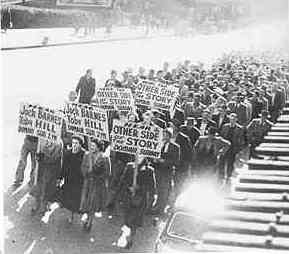
As the Dominion Post helpfully reminded me (otherwise I wouldn't have known) this week was the 55th anniversary of the waterfront lockout.

A very brief history (because I spent too long looking at the pretty pictures while writing my last post) in the 1950s the Waterside workers were one of the most militant unioins in New Zealand, and had disaffiliated from the Federation of Labour, which was at the time ruled by Finton Patrick Walsh (he was on my list of 10 worst New Zealanders, that I never got around to finishing). The company refused to give the watersiders the increase with the latest arbitration round (for nearly 100 years New Zealand had government wage arbitration), and so the watersiders put in an over-time ban. The company responded by locking the watersiders out.

The government swung in behind the strikers invoking laws (brought in by a labour government) which allowed it to declare emergency regulations that would make supporting the strikers in any way illegal (including writing a pamphlet supporting the workers, or giving food to workers families), and government and employers together tried to starve the workers out (and the Federation of Labour helped).


Over the next 151 days the waterfront workers, and their supporters, organised to gather support and to feed themselves. But after 151 days they returned to work, they had lost, not just the battle, but the union, which had been deregistered during the strike.

They didn't win, but they lasted 151 days despite the fact that any support of them was illegal. Unlike the anti-war movement, which failed because we weren't strong enough, they failed because their opposition was too strong.

This is the best website I could find about the strike, and it was where I got my photo from.

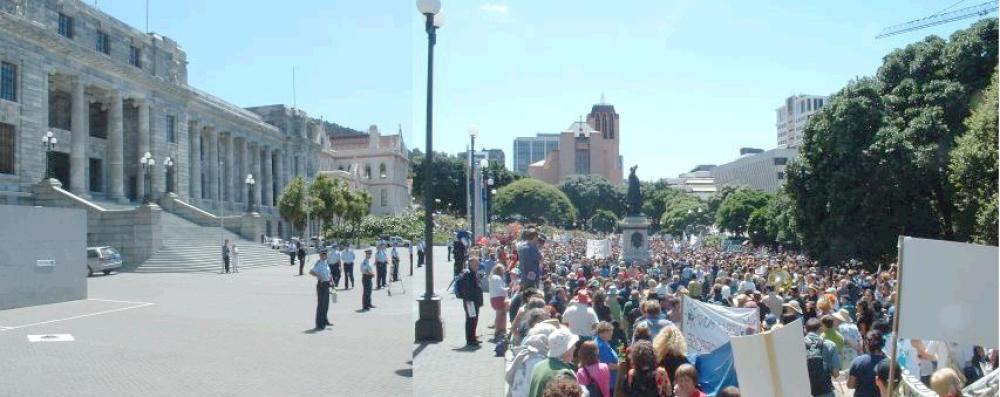
Sunday Protest Blogging: February 15 2003

This is where I was, my friends, my family, and a whole bunch of people I don't know.

I'd been really nervous the night before - I had a dream that no-one showed up. But then as I was walking to the protest I saw people I didn't recognise at every traffic light, obviously heading in the same direction, I let myself dream it would be really big. It was bigger than that. We spilled out of the park we'd planned to start in So many people had put together signs, or painted their face - we hadn't really done anything to make it happen (although there were some really dedicated stall holders) - people were just that angry.

It was the greatest protest I've ever helped organise; it was also a bit of a disaster. We'd planned to stop in Midland Park, but we were just too big. Once we got to Parliament we had no Sound System. The program of speakers wasn't the best we've ever organised, so we missed out on a great opportunity to educate people.

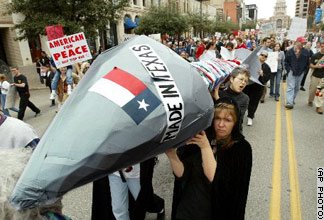
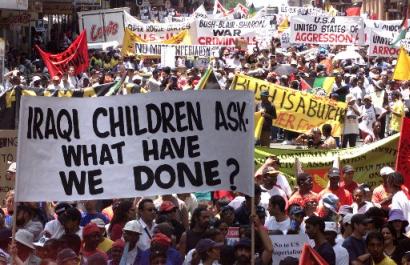
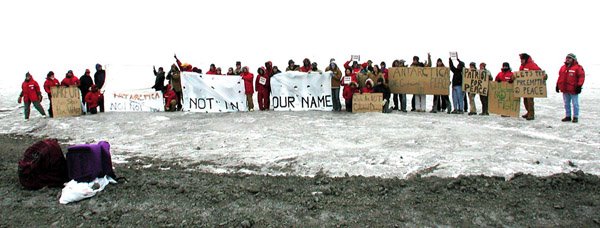
There were protests on all 7 continents that day:

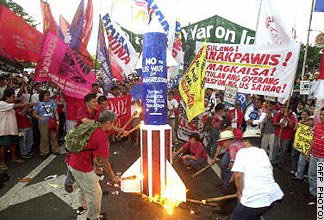
Austin, Texas


London


Johannesburg


Santiago


Manila


Antarctica (all photos come from this amazing photo archive - go there I left out many great photos. I also love this book).

That was 3 years ago, the protests are smaller now, and we didn't win. But there were still 30 million of us, and we have, hopefully, learnt something, so we can keep building.

'That's terrible' said Arthur, for he was a Guardian reader

We moved from London to New Zealand when I was 5. My parents were looking to escape the economic policies and Nuclear threat of Thatcher's Britain, and, I think, family situations (2 out of 3 ain't bad).

One of the things this meant is that we subscribed to the Guardian Weekly, where you could get Steve Bell cartoons on crinkly airmail paper. I used to read the Guardian Weekly long before I could understand what was going on. When my parents lived overseas and got the Guardian Weekly and the Listener I teased them that you could tell everything you needed to know about their class, politics and geographical history (although in their defence this was when Findlay McDonald was editing the Listener not the current Pamela Stirling beauty advice central Gordon Campbell firing piece of shit).

When I got old enough I'd always read the column on the right hand side of the second page (which unfortunately got cut in a revamp) it seemed to specialise in bad news from countries I couldn't necessarily find on a map: "1,000 people died in a long running civil war", "200 died in a mine disaster". You needed to have 100s of people dead to make those columns. At the same time I'd read Notes and Queries, where people asked for silly questions and waited for silly replies, usually with enjoyable results. If you look at the online version someone asked what's the least bad ciagertte company, as if the revolution was just an ethical hair-cut away.

Which brings me to the point of this post, which is why the Guardian Weekly is not enough, in times like these. It's not just that it's liberal and lets Polly Toynbee tell her readers to vote Labour with a peg on their nose. It's that it never has much space for actual hope.

I'm very wishy-washy about how we could build a new world, I'm happy to argue with most people about why I'm not sure they're right. I do know that if we're going to do it, we're going to do it by being organised, by using the strength and power that we have together.

I realised that I don't talk about that much on my blog, I just say 'that's terrible'. I don't talk enough about protests and resistance. So I'm going to institute a new feature (we'll see how long it'll last): Sunday Protest Blogging. I'll try and skew towards successful protests, although since there were two anniversaries of important, but ultimately unsuccessful protests this week, I'm going to start with them.

Just Because You're Dressed Like This:

Doesn't mean You're a Communist.

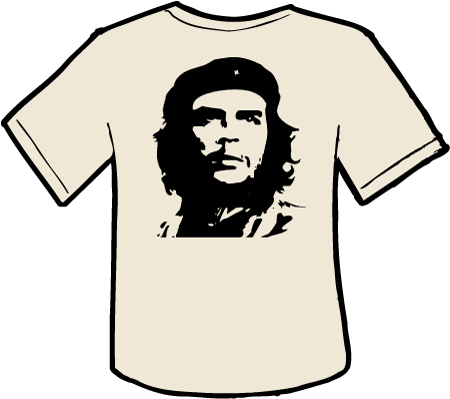
I do a lot of leafletting, and other forms of harassing passers by. I have random theories about leafletting (refusals always come in threes, your last leaflet is always the hardest to give away); I'm even quite good at it. But one of the things that sustain me while leafletting is hating people who are wearing Che Guevara T-Shirts but refusing my leaflets (which are always on things Che would support). They're a reasonably common occurance, and if you're a Che Guevara T-shirt wearer who ignores politics, you have no idea how much people curse you.

A Washington Post article about the commodification of Che as reprinted in the Dominion Post this Saturday. I really loathe the way that picture has been used, and see it as the ultimate example of style over substance. Even actual communists I know who have worn Che T-shirts haven't been able to tell me why it is Che, in particular, that they're wearing on their chest.

I think I have a solution. The picture should be licenced so that everyone who wears a Che Guevara T-Shirt has to participate in any protest an actual left-wing activist tells them to, or give a good Marxist reason why not.

Saturday, February 18, 2006

Panic

The obesity panic seems to be intensifying in New Zealand, and I feel I should be refuting this idea more. Which is ridiculous because I'm one blog with a tiny readership. But when you turn on National Radio in the afternoon (which I admit is never a good idea on week days) and they have someone saying that anyone who questions the links between BMI and health and longevity is stupid, opposition voices become important. I found Robyn Toomath's lack of grasp of history quite astounding (did you know that in the 1950s no-one lived in suburbs, and that we were all well fed in WW2 and the depression that followed because they grew their own vegetables?).

But what I wanted to talk about today, was the whole idea of childhood obesity, and the proposed solutions to it. My position is quite simple if you're worried about nutrition and exercise, worry about nutrition and exercise and leave weight out of it.

The only proposals that I've heard so far from government are to ban advertising certain foods during kids shows, to stop schools from selling junk food, and to instruct schools to include an hour physical exercise in the curriculum a day.

Only one of those proposals is a terrible idea. I actually don't think anyone should be selling food in schools, I don't think schools should be a business. I'm also all for restricting advertising during children's programmes. In fact if I had my way it'd be TV2 that would go advertisment free - I don't see why it should be the people rich enough to afford sky that get a government channel dedicated to them.

But an hour physical exercise in schools a day? Only if they completely changed the way they taught. Because I hated every second that I spent doing PE at school, except for swimming. I was hopeless at it, it made me feel hopeless, and it made me hate exercise. I think if I'd had to do it for an hour a day, I'd probably be refusing to exercise still (I'm aware this is true of many more subjects than PE, and changing of teaching methods is a wider issue). I don't think forcing kids to exercise in school will make them like exercise, and do it from choice when they leave.

But I have some much better ideas, ones that would actually work. So here's my list of proposals which would actually help kids get better nutrition:

  • Give their parents more money
  • Give their parents more time
  • Provide nutritous breakfasts and lunches in schools
  • Socialise food production and make it for nutritious value not profit
Here's my list of proposals that would help kids get more exercise:
  • Don't give them any homework, so they have time to play after school
  • Make entry to swimming pools free
  • Provide free public transport, so that kids have mobility and independence
  • Build more parks, and put wild areas for exploring in them
  • Stop trying to create panic around law and order to win elections, so people feel safe
  • Not create a whole in the ozone layer which means that it's often dangerous to be outdoors
  • Give their parents more time

Choices

Australian women should soon be able to use RU 486 to abort their pregnancies.

It feels like a funny time to be cheering for Australian women though. The changes to employment and social welfare legislation will seriously restrict women's ability to choose to have children. That they're able to terminate the pregnancy with a pill is important, but hardly a great step forward, if they're no longer able to not terminate the pregnancy.

Iran

There has been a thread on indymedia with over 40 comments, and a sensible intelligent debate. I know I almost fainted from the shock (but then I read this thread, which made me want to go out and strangle a kitten or two, and I realised that indymedia is still indymedia). The bit I wanted to respond to is this bit:

The point is not that I think that Iran is a nice place for trade unionists (see the article Dave linked to for more on the repression of the left by the mullahs), or that I think building nuclear weapons is the best use of a country's resources, but that I think that Iran has the right to pursue a nuclear programme, up to and including the building of weapons, without being subjected to sanctions, covert destabilisation, and invasion by the US and US allies like Israel.
I think Iran has a right not to be subject to sanctions, covert destabilisation, and invasion, but I actually don't think that has anything to do with the 'right' to build nuclear weapons (which I don't think anyone, or any country has).

What bothers me most about Scott's formulation, is that it implies that the only reasons Iran shouldn't be treated in the way he lists, is because they have a right to nuclear weapons. Even if Iranian politicians are doing something they have no right to do (like invading another country, or killing kittens) then that doesn't mean the US has the right to attack Iran.

My opposition to the US attack is completely independent of the pretext for that attack.

Evil?

A few weeks ago Idiot/Savant posted a pair of articles about Israel and South Africa. The first article compared the effect of policies in the two countries, and the second talked about the relationship between Israel and South Africa.

I'd meant to write about the first article when I read it; I found it fascinating how state apparatus that I usually think of being mostly benign (like town planning) can be used as a weapon:

One method of preventing further construction by Arabs in the east of the city has been to declare many open areas to be "green zones" protected from building. Bollens says about 40% of East Jerusalem is designated as a green zone, but that this is really a mechanism for land transfer. "The government calls it a green zone to stop Palestinians building homes there, and then when the government wants to develop an area [as Jewish] it lifts that green zoning miraculously and it becomes a development place."
Of course I realised that I knew town planning isn't benign even in New Zealand (no by-pass), but I just didn't think about it.

But now there's an interesting post about it on Alas, which seems to argue that people shouldn't make comparisons between South Africa and Israel, because it'll upset those who disagree with the comparison, and so they won't listen:
I'm also distressed by the Apartheid angle because Apartheid is one of our iconic images of "evil perpetuated by a state." Using such an iconic, stark image of evil to describe the Israel/Palestine conflict has the effect of covering up the extent to which some Palestinians - those that commit or support terrorism - are morally co-responsible for creating the current, appalling situation.
Even ignoring the morally co-responsible bit (which I totally reject, I don't think oppressed people who resist and morally co-responsible for their oppression), I actually think it's a problem if South African Apartheid, or any other regime is considered so awful that it must stand alone and no other regime can be compared to it. It was an actual regime, not an iconic evil. I don't think we should ring-fence anything people have done as too awful to examine, too awful to learn from.

Friday, February 17, 2006

Trevor Loundon for Vice-President

It is rare for this blog to pay any attention to the main political parties - except to criticise them. Internal politics of parties don't interest me that much. However, I'm going to make an exception today and endorse Trevor Loundon for Vice-President of Act.

Who is Tervor Loundon? He runs the most amusing New Zealand blog, possibly the most amusing political blog ever, called New Zeal. Basically he's a cross between McCarthy and a stalker.

Which doesn't sound that funny, but he doesn't have any power, it's just him desperately trying to point out the Red Menace of Jim Anderton to the world.

The highlight is the way he breathlessly lists all the red activities people have participated in without explaining why any of them were bad. Rona Bailey, the high priestess of New Zealand communism was involved in the following scandalous activities in her life-time:

  • "Back in NZ, Rona Bailey became active in the campaign for equal pay for women. Before this successful campaign, women were paid less than men in the public service. Rona bailey was president of the "Public Service Association's" womens committee and used her position to promote the cause. The communists found it easy to gain support for this campaign."
  • "In 1966 she was one of several Communist Party members who were listed as contributing 5 Pounds towards the 2000 needed for Committee On Vietnam leaflets. This literature "exposed" US atrocities in Vietnam, and was timed for release just before the 1966 general election."
  • She protested arpartheid: "Not content with a behind the scenes role, Rona Bailey marched in the huge demonstrations that brought central Wellington to a stand still. In the infamous, Street march, 67 year old Bailey was batoned by police and had to be hospitalised."
Oh My God! Someone who supported equal pay, was against the war in Vietnam and apartheid. How foolishly we have relaxed, not realising such dangerous people were in our midst.

In other profiles he'll go into great detail of solidarity work with the Phillipines and Chile. I'm glad someone is protecting us from those who oppose Marcos and Pinochet.

So I'm endorsing him as vice-president of ACT, because he's a nutcase, and I'd love it if they became a fringe party.

I'm also disgusted with the Greens Russell Norman for engaging with him. He red-baited Russell Norman, and Russell Norman said "yes I have been a communist, but I left them because Marxism is bad." This showed a remarkable lack of solidarity, and a strong degree of stupidity. Of course Trevor Loundon isn't satisfied, and is still going on about it.

There are two acceptable answer to the question 'Are you now or have you ever been?': 'Yes' or 'fuck off I'm not telling you'.

Thursday, February 16, 2006

This is also free speech

I was really unsatisfied about what I'd written about the Danish cartoons. I felt it didn't explain why I felt the way I did, and didn't tease out the important issues. So here's my attempt to explain where I stand . Like I already said I don't have a clue what's going on in the wider conflict, and lacking in knowledge I'm trying to refrain from commenting.

I should make something clear straight up: I don't think we have free speech when speech is something that can be bought and sold. But I still want to examine censorship, and the way it operates.

The first distinction I'd like to make is between a companies and people. I don't actually believe that companies should have the rights of people (which isn't surprising - I don't believe they should have any rights, because I think they shouldn't exist). Howard Zinn is the expert in all this, but the idea that companies should have all the rights of people was created about 150 years ago, because it suited the needs of capitalism.

The most important way corporations are different from people is that corporations need to return a profit, and every decision they make must be contribute towards this goal to create a dividend. This means that in the press all sorts of censorship takes place in order to ensure that this profit continues. I'm willing to bet that the reason the Dominion Post and the Press apologised for printing those cartoons and promised they weren't going to do it again didn't have anything to do with any actual people, but was because our exporters were getting pissed. Fonterra and the meat-board were not happy, and they have a more direct line to The Dominion Post than you or me. Any media that is beholden to their advertisers, grandstanding about free speech leaves a bad taste in their mouth.

I do believe that media should be free from government censorship. Mostly for lack of a better model, than because I think it's standing up for freedom of speech, because it's not.

Censorship by non-state forces is a different matter. Now non-state forces is a pretty wide category, but the first point I'd like to make is that for any kind of censorship to have effect those trying to censor you must have some kind of power over you.

I could get fired for writing this blog if I worked in a government department, or quite a lot of other jobs (not the one I've got though, luckily). That is censorship.

I'm not sure a whole lot of people being angry at you, or even burning your countries embassy on the other side of the world, is censorship. People in Pakistan have no power over the media in Denmark, and whatever power they have, the consequences won't be on the Danish media.

It's nice when they're honest

More from the RU 486 debate in Australia. This is from Danna Vale, a government backbencher:

"I have read … comments by a certain imam from the Lakemba Mosque [who] actually said that Australia is going to be a Muslim nation in 50 years' time," said Mrs Vale, MP for the southern Sydney seat of Hughes.

"I didn't believe him at the time. But … look at the birthrates and you look at the fact that we are aborting ourselves almost out of existence by 100,000 abortions every year … You multiply that by 50 years. That's 5 million potential Australians we won't have here."

Wednesday, February 15, 2006

Best Website Ever

This is lego-baby Jesus, from The Brick Testament - the bible in lego.

I hadn't realised quite how crazy the bible was, but all the best bits are there, including Lott's wife turning into a pillar of salt. I think I'd find this more amusing, if I was sure no one was following it.

In particular I recommend the law and the epistles. I was making sarcastic remarks about women being property, until I realised that was the point (I can be a little slow).

I know an awful lot more about the bible now than I did this morning. For instance, I'd always thought Jesus was cool and spent all his time talking about camels, needles and loving your neighbour (I once had an argument with someone who thought Jesus was a Marxist-Leninst with Maoist leanings, I said that even if this was true, this would make Marx, Lenin and Mao Christians rather than the other way round). But Jesus has his share of weird. Like why does he need oil? And what is the point of this parable?

Go look at the pretty lego pictures, go now.

Tuesday, February 14, 2006

2 4 6 8 Youth Rates Discriminate

I went to a great anti-youth rates demonstration in Wellington today. Currently the minimum wage for over 18 year-olds is $9.50, while the minimum wage for 16-17 year olds is $7.60 (80% of the adult rate). Employers can pay under 16 year olds anything they like, so you get 15 year olds making pizza for just $6.00 an hour.

There were quite a few school kids there, and they were leading the chanting, which was fantastic.

The most important point is that Sue Bradford's bill doesn't go far enough. While it would end youth rates for 16 and 17 year olds, it would not offer any minimum wage protection for those under 16. This is a ridiculous situation - the most vulnerable are the ones with the least protection.

We heard that Labour was going to support the bill to the select committee. This will only make a difference a if everyone who cares about the issue sees it as an organising opportunity, and use the next few months to build a campaign. Labour aren't going to end youth rates to be nice, or because they like young people. They'll only do it if we give them no choice.

Monday, February 13, 2006

Telling her truth

While I don't always identify with her spirituality, I've always really enjoyed Anne Lamott's writing. Not quite as much as I enjoyed reading The Rights of the Born though(I've linked to a feminist blog that reprinted the article, because the LA Times requires registration). I'm giving an extract, but only if you promise to go and read the rest:

Then, when I was asked to answer the next question, I paused, and returned to the topic of abortion. There was a loud buzzing in my head, the voice of reason that says, “You have the right to remain silent,” but the voice of my conscience was insistent. I wanted to express calmly, eloquently, that pro-choice people understand that there are two lives involved in an abortion — one born (the pregnant woman) and one not (the fetus) — but that the born person must be allowed to decide what is right.

Also, I wanted to wave a gun around, to show what a real murder looks like. This tipped me off that I should hold my tongue, until further notice. And I tried.

But then I announced that I needed to speak out on behalf of the many women present in the crowd, including myself, who had had abortions, and the women whose daughters might need one in the not-too-distant future — people who must know that teenage girls will have abortions, whether in clinics or dirty backrooms. Women whose lives had been righted and redeemed by Roe vs. Wade. My answer was met with some applause but mostly a shocked silence.

Pall is a good word. And it did not feel good to be the cause of that pall. I knew what I was supposed to have said, as a progressive Christian: that it’s all very complicated and painful, and that Jim was right in saying that the abortion rate in America is way too high for a caring and compassionate society.

But I did the only thing I could think to do: plunge on, and tell my truth. I said that this is the most intimate decision a woman makes, and she makes it all alone, in her deepest heart of hearts, sometimes with the man by whom she is pregnant, with her dearest friends or with her doctor — but without the personal opinion of say, Tom DeLay or Karl Rove.

Drug companies suck, but some of their products are kind of necessary

I find stories like this quite difficult, as I'm torn between two competeing analyses (if you're not a NZer we have a national health service and Pharmac decides which drugs are funded, and which aren't).

I've known people who have tried to get drugs that are subsidised, and fought tooth and nail, because they make a difference in their life (I've also got a friend whose health care has gotten into at least six digits - my general reaction for people who talk about privatised health care is to wish her illness on them). If you have cancer then of course you want every chance you can to try and get a longer life.

The reason I hestitate is that these campaigns are often funded by drug companies, who are on my list of more immoral industries (admittedly the list is quite long and at times all encompassing). The reason they fund the campaigns isn't to help people's lives, but to make money. Drug companies will lie about the effectiveness and safety, perform insufficient testing, and screw anyone over to make a buck. So I really don't want to put any money in their pockets if I can help it.

I suspect the only solution involves ending capitalism. In the meantime I do tend to believe the government should err towards wasting money and occasionally saving lives, than saving money and occasionally wasting lives.

Sunday, February 12, 2006

Comic Book Girls

I'm not geeky enough to have ever been into comics. However, I'm more than geeky enough to lay my hands on Serenity: Those Left Behind the comic that bridges the gap between the TV Series and the Movie.

Which made me realise that it wasn't the fact that I'm not geeky enough that made me not into comics, it's the fact that I find the way comic book girls are drawn terribly distracting and so I can never get into the story.

This is what Inara looks like when played by Morena Baccarin:She's both beautiful and conventionally attractive (although that dress is hideous, but that's another matter).

Here's what Inara looks like when a comic book artist draws her:Now she looks like she's had breast implants and had several ribs removed.

It wasn't just Inara, Zoe got her waist winched in as if she was wearing a corset under her combo gear, and River must have bra of steel, the way we can see her breasts under the loose clothes she wears. Kaylee was, if anything, drawn a little shapeless. So if the artists are told (and I'm sure they were) that Kaylee couldn't look like a comic book girl, they don't know how to make her look like a woman.

Television is not well known for portraying a wide variety of body types (Kaylee is described in the Pilot script as Zaftig, which is a whole nother issue I'll rant about sometime), but each of those characters is played by an actual woman, with an actual body shape. The fact that Will Conrad couldn't draw the limited range of women's bodies that are acceptable on TV is really depressing.