
Are you having a good day? Feeling pretty good about the world? If so don't read Amnesty's report on British attitudes towards rape (or my post about it), because it is, as you would expect, really, really depressing.
Amnesty asked 1,000 people about what level of responsibility they believed a woman had for being raped when the woman was in a number of different situations. Here are the results: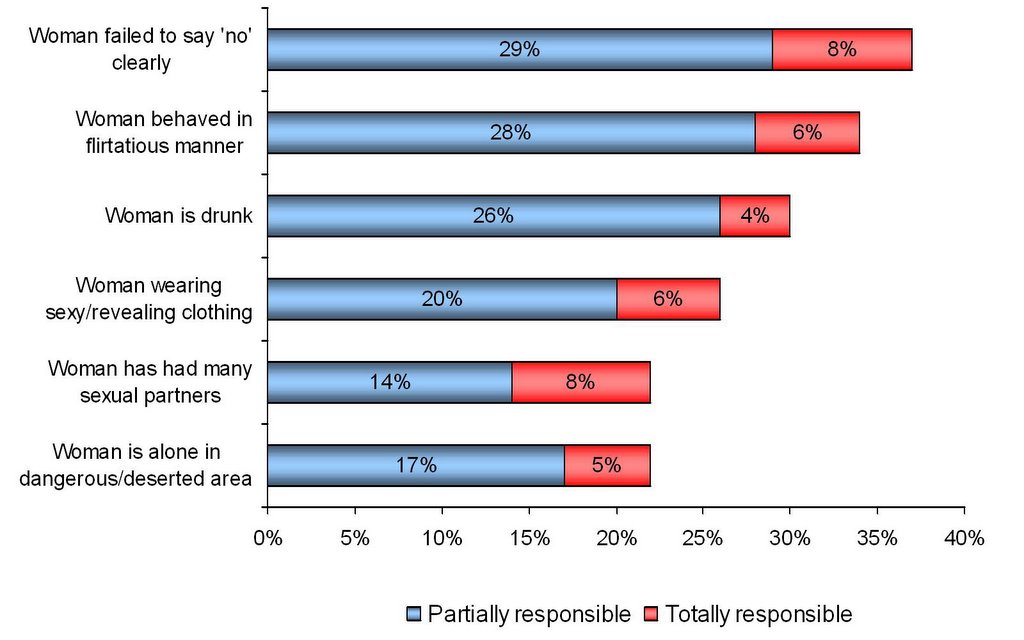 8% of people believed that women are wholly responsible for being raped if they are known to have many sexual partners. A full third believed women are at least partially responsible for being raped if they flirt. 17% of women and 22% of men believed women are partially responsible for being raped if they wear sexy or revealing clothing. More than a fifth of people believed that a woman is partially or wholly responsible for being raped if she walks in a dangerous area.
This all makes me feel sick, and unsafe. I find the idea of anyone, but particularly a man, thinks that women are ever even a tiny bit responsible for being raped absolutely terrifying.
But the bit that made me most sad was that if a woman doesn't say no clearly enough 37% of people believed that she was in some way responsible for being raped. Those are the options, you say no, or you don't say no.
Why don't women get to say yes? Why don't men wait until they hear yes? Why would you want to have sex with someone when they didn't actively want to have sex with you?
Tuesday, November 22, 2005

Monday, November 21, 2005
Secrets
Post Secret is a pretty amazing web site, that I only found out about a couple of weeks ago. People send in their secrets on one side of a hand designed post-cards, some of the secrets are silly, some hopeful, many are really sad. Each Sunday (Monday New Zealand time) it is updated with a new week's worth of secrets, but there are only ever two weeks at a time.
I think I find these fragments of people's lives so moving because they are fragments - because I start filling in the gaps imaging the lives of the women and men who wrote them.
So many women send postcards about being women, about their bodies, about pregnancy, about children, about their relationships with men. There are very few secrets that are specific to men. Women have all the secrets, all the fear and pain, men have, but then have to carry round an extra stash on top.
I'd hate to see the edge
Ariel Sharon has left the Israeli government to form a new centrist party.
I'm fucking terrified of any political spectrum in which Ariel Sharon is at the centre.
Sunday, November 20, 2005
The Place to Aruge about the Morality of Abortion
I'm going to post a lot about abortion - I'm very passionate about the issue, I think it's very important.
But what I'm not interested in, is the debate about whether or not abortion is moral. Whenever anyone tries to talk about the reality of abortion someone comes in and says "what about the babies". I used to be interested in those sorts of arguments, I used to be pretty fucking good at them, but I'm no longer have the energy to argue with people who don't believe women can make their own decisions, and have no interest in acutal lived experienced.
I don't want every post I write about abortion to be a place where these debates happen, because they bore me, but I understand that other people want to have this discussion. So my solution is to create a thread where these discussion can happen. If anyone ever posts about the morality of abortion anywhere else I'll cut and paste it here.
My opinion is that the only person who can judge the morality of any abortion is the individual woman involved. I believe it's simple, I believe it is cut and dry, and I don't believe in any time limit. Here and here are some posts by Bitch Ph.D. that I love, and say everything I need to say about the relationship between morality and abortion:
The bottom line about abortion is this. Do you trust women to make their own moral judgments? If you are anti-abortion, then no. You do not. You have an absolute moral position that you don't trust anyone to question, and therefore you think that abortion should be illegal. But the second you start making exceptions for rape or incest, you are indicating that your moral position is not absolute. That moral judgment is involved. And that right there is where I start to get angry and frustrated, because unless you have an absolute position that all human life (arguably, all life period, but that isn't the argument I'm engaging with right now) are equally valuable (in which case, no exceptions for the death penalty, and I expect you to agonize over women who die trying to abort, and I also expect you to work your ass off making this a more just world in which women don't have to choose abortions, but this is also not the argument I'm engaging right now), then there is no ground whatsoever for saying that there should be laws or limitations on abortion other than that you do not trust women. I am completely serious about this.
Let me unpack a bit, because I know this sounds polemical, since I am clearly stating a bottom line. When pro-choice feminists like Wolf, or liberal men, or a lot of women, even, say things like, "I'm pro-choice, but I am uncomfortable with... [third-trimester abortion / sex-selection / women who have multiple abortions / women who have abortions for "convenience" / etc.]" then what you are saying is that your discomfort matters more than an individual woman's ability to assess her own circumstances. That you don't think that women who have abortions think through the very questions that you, sitting there in your easy chair, can come up with. That a woman who is contemplating an invasive, expensive, and uncomfortable medical procedure doesn't think it through first. In short, that your judgment is better than hers.
16 Reasons Green Party Food Policy Sucks
The Green's food policy is here:
1. They're somewhat obsessive about the word healthy when referring to food. I have issues with that.
2. They buy into the moral panic over obesity, mentioning it as something to be avoided three times, without once arguing why.
3. "Prohibit the funding of health services by food companies that sell or promote unhealthy high fat, high sugar food." So they don't object to the privitisation of health services, they just want to moderate it a little bit.
4. Just like they have no problems with businesses on school grounds unless they're selling sugar.
5. To belabour a point they say that they only want food sold at sports functions to meet national guidelines to promote the health of children. But you need different food when you've run a marathon than when you've swum 100m freestyle or done a floor routine gymnastics - well I believe no food is often a pre-requisite for gymnastics, but that's a different matter. The idea that there is one set of healthy food for all people and circumstances is ridiculous.
6. They keep on talking about getting agreed nutritional guidelines - if you follow these sorts of things you know that most of the science is funded by someone, and that most people have an agenda. To think that you can get meaningful, helpful nutritional guidelines - even if people did all need to eat the same things at all times - is naieve at best.
7. They're funding it all by a consumer tax on soft drinks. Consumer taxes suck, consumer taxes are regressive and impact on poor people more than rich people.
8. They want to provide free fruit in schools, and create some kind of cross whatever working party to investigate the feasibility of the possibility of creating a report about implementing a pilot programme to research the advantages of providing free breakfast in schools. The single best things you could do to improve the diet of New Zealand children is provide breakfast and lunch free in schools - and get the government to do it directly, no sub-contracting to spotless - but no they care more about nuritional guidelines.
9. They want a red, orange, and green system to label food - doesn't that sound like a good way of communicating complete nutritional information and making sure people make choices based on knowledge.
10. My old school has instituted a policy banning regular soft drinks, but allowing diet coke and sprite zero.. This isn't, strictly speaking, the Greens fault, but what's the point of having a blog if you can't rant about everything that is making you grumpy.
11. Hospitals wouldn't be allowed to sell or provide high fat or high sugar foods. You know what, sometimes people need high fat or high sugar foods to recover and rebuild their bodies.
12. I still can't get over the fact that they thought soft-drinks in foods were one of the half a dozen most important issues facing New Zealand today. I don't think there should be vending machines in schools, because I don't actually think there should be any profit making businesses in schools, but it probably wouldn't make it into my top 50.
13. Their entire policy is based on the idea that problems with food and diet are individual problems, and if people had more information then it'd all be great. This is bullshit, the problems with our food and diet are created because food is made for profit, not for nutritional value - individual choices aren't going to change that.
14. LABELLNG ARGH
15. Of all the bullshit solutions based on privilege, that is by far the most annoying, stupid morons, why did I vote for them.
16. Sorry now I'm coherent again, the green party is obsessed with labelling food, as if it's knowledge that we lack, not choices. It only makes any difference if GE food is labelled if you can afford to choose the GE free.
So to summarise the green party food policy entrenches the reality that nutritious food is a privilege based on your financial situation, it has very little grasp of the scientific research in the area, is full of abstract good and bad things with no meaningful way of creating change, and ignores the concrete ways of that you could improve people's food and diets. I could curl up and die from not surprisedness.
There are a few points there I agree with - particularly in part 1 of their policy, about cleaning up food production, but that's because they take a much more structural approach. They say 'ban battery farming' not 'ensure all battery eggs are suitably labeled'.
I haven't developed my 2011 exit plan - yet
Stofile said that he was sure South Africa's two votes would have gone to New Zealand in the second round.There's a weird kind of logic going on there. It certainly wasn't the NZRFU which was supporting him in his struggle against apartheid.
"New Zealand supported activists like myself in the struggle against apartheid and if it was up to me my vote would go to them," Stofile said.
I wonder what would have happened if you'd told a HART that one of the effects of their actions would be to help secure the 2011 rugby world cup (I know not everyone who was anti-tour was anti-rugby, but there was a significant anti-rugby element to the anti-tour protests)
Sunday Advice Blogging: AJ Chesswass edition
For the last little bit I have been posting extracts from an American text book called Teen Guide to Homemaking. Now it's NZ's turn, because I also own "Towards Tomorrow: A Guide fo the New Zealand Homemaker", published in 1969. This is a litle more down to earth than the American book, and has less information on how to accessorise to emphasise your figure. But it's just as fantastic. Today I'm sharing the discussion questions from the end of the Responsible Relationships chapter.
3. You have not been able to find employment in your own town and have had to go to another larger centre. Having found yourself in a flat with others wose standards are very different to your own, what should you do?
Get a cleaning roster, but they might be talking about sex, in which case a cleaning roster won't really help (well possibly it'd help if people were having sex in the kitchen).
5. A girl who married at seventeen has had two children by the time she is twenty. She complains that she is tried of being tied to the house, to debts, to children's washing and to dishes. Discuss why she may be feeling this way when she could be loving and enjoying her young family. Suggest what she might do to overcome her loneliness and boredom.
Patriarchy, alienation, capitalism.
Get a copy of Sisterhood is Powerful and find a consciousness raising group.
7. You are a nurse with one year to finish your training. You are friendly with a fine young man who asks you to marry him. Discuss whether you should finish your training fist. Give reasons for your decision.
Ok this one I can't even make fun of, I can just say huh? This was an actual question written in actual text book less than ten years before I was born. The world is a very scary place.
9. Early marriages can be extremely happy and lasting. But it is a quite wrong basis for marriage to consider you are a failure if you haven't a ring on your finger by the time you are twenty? Why? Is it wrong that some girls prefer to continue a career?
Do you hear that, quite wrong to consider yourself a failure if you're not married by twenty. Don't you feel betrayed that none of your school text books informed you of this fact.
Saturday, November 19, 2005
Don't Mention the War
David Irving was arrested in Austria for the crime of denying the Holocaust.
I'm trying to figure out the process where you pass a law saying that it's a crime to deny the holocaust.
He was going to travel to New Zealand, but he was not allowed entry, because anyone who has ever been deported from another country needs a special waiver to get into New Zealand and he wasn't granted one. I had no problem with that at all. Or rather I have a problem with our immigration laws, but given that we have these immigration laws then I have no problem with them applying to David Irving just like he was anyone else. But arresting him?
At first I was surprised because I thought Austria was particularly bad at facing up to its anti-semitic past (I may be wrong about that - I've no idea why I think it's true), but actually it makes sense. If you're trying to pretend that something never happened you don't want someone tramping up and down saying in a very loud voice "THIS NEVER HAPPENED". You just ignore it and hope it goes away.
I'm against the state engaging with Holocaust deniers for much the same reasons I'm against the left engaging with neo-nazis. But I think in a country like Austria, putting laws up to deal with a Holocaust denier, paradoxically shows an unwillingness to deal with the reality of the holocaust.
Ha Ha!
I want my writing to reflect my beliefs, and this means I try not to focus on the easy targets (which is why I stopped writing about Wayne Mapp) and I make it my goal to criticise the Labour Government every day.
But sometimes a story is just so beautiful, just so perfect, that I feel compelled to write about it even though I don't have anything to say, and everyone knows about it anyway.
So when ACT's bus got left on a lifestyle block with the keys in the ignition, and two 13 year old girls left the keys in the ignition, I knew that I was going to write about it.
If those girls' families need help for a lawyer, or anything, I'm sure we could start up a fund. But since they're below the age of criminal responsibility it probably isn't necessary.
Wednesday, November 16, 2005
I know I'd riot to get an individual agreement
The Workplace Relations Minister, Kevin Andrews, said claims that the new laws would spark Paris-style riots were hysterical. He even suggested that riots would occur if Australia did not embrace the laws.From Stuff
"It's well known that France still has a very rigid labour market, and it's a consequence of those rigidities and the failure to bring about some flexibility in their labour market that is a major cause of what's occurring in Paris at the present time," Mr Andrews said.
Bits and pieces on abortion
The Abortion Supervisory Committee released its report last week. I was going to comment on it after usual round of press releases condemning women who aren't sufficiently committed to their wombs, but they didn't come.
The abortion rate went down, and I'm always very wary of celebrating that fact. At one of the meet the candidates meeting Sue Kedgley said that she believed that every abortion was a tragedy. I refuse to frame abortion as a necessary evil.
Women do feel a wide variety of different things about their individual abortions and of course whatever an individual woman fees feel is the reality for that abortion. If a woman feels relieved, then that abortion is a relief, if a woman feels distraught, then that abortion is distressing.
But in a wider context I don't care what the abortion rate is, I don't care if it's high or low. While I believe in some policies that are shown to reduce the abortion rate (eliminating poverty, education about contraceptives, and the development of better contraceptives, for example), I believe in them for their own sakes, and I'd keep on believing in them if they were shown to increase the abortion rate. To me the fact that the abortion rate went down is just that, a fact.
This is an interesting article about the way abortion is shown on American network telvision (via Feministe), or rather the fact that it's not shown:
Real women have had decades of hard-won reproductive freedom in this country, but their televised doppelg do not have the same options. Why aren't our real-world choices reflected in our pop culture landscape? If the networks can show violence against women and teen sex and rape (shows like Law and Order: SVU are propagated entirely on those topics), why can't we see the outcomes of those actions? Abortion is not a dirty word, nor is it simply a political topic. It deserves a place on TV, and not just on C-SPAN.Now my not-so-secret-TV-boyfriend Joss Whedon has talked about trying to write a script on Roseanne where Jackie got pregnant and had an abortion, and once it got mangled through the various notes she wasn't even allowed to get pregnant. I wonder if Firefly hadn't been cancelled if he'd have gone back there - I would have loved it if he'd portrayed it in a truly matter of fact kind of a way. Although if that happened I'd probably spend even more money on stuff he's created than I already do, so maybe it's all for the best.
What I was curious about is whether it was any different in New Zealand. In particular the portrayal of abortion on Shortland St. Have their been any abortions on Shortland St, how were they portrayed? How about unplanned pregnancies. I wouldn't be surprised if things were no better here than they were in America, but don't watch enough local TV to know for sure.
Finally if you're interested in abortion I recommend reading Abortion Clinic Days, by two women who work in an abortion clinic. What I find so frustrating about the abortion debate is that abortion is part of women's experience, whatever the legal status is, and whatever moral frameworks anyone wants to throw at it. This blog shows that reality is far more important than all the philosophy class pontificating, or church moralising, you've got.
Tuesday, November 15, 2005
My Body is not a Computer Game
My follow-up to 16 reasons why Gareth Morgan sucks (and it was supposed to be a start, not a complete list) was going to be an equal number of reasons why the Greens 'healthy food' policy sucked.
But I hate the word 'healthy' being applied to food with something approaching a burning passion. I occured to me that if I didn't get my rage at that out of the way first then my post might be quite incoherent. So first I am going to explain why I tend to say "foods aren't unhealthy or healthy, they're nutritious, or lacking in nutrients" on a semi-regular basis.
The language around food and health is pretty common. People don't just call their own food healthy they feel perfectly entitled to comment on the health qualities of what someone else is eating. Sometimes it's intended in a sarcastic manner 'healthy breakfast', if you're eating a chocolate bar, sometimes it's supposed to be a compliment. All this usage suggests that some foods have 'health' and some lack it, and this quality is the same no matter who is eating the food, which is ridiculous. Brazil nuts are very nutritious, but they're not going to be healthy if you're allergic to them, or if you've a high selenium in-take.
The idea of food being 'healthy' reminds me of computer games, where you lose health if you get shot at or land on the spikes, and gain health when you find first aid. But instead I'm supposed to be gaining health by the broccolli I'm eating right now, but I would have lost health for the chocolate I had this morning.
Our bodies don't work like that; they're not simple input/output machines. Any food that has any nutritional value (and apart from diet soda and the like, almost all food has some nutritional value) can improve the health of a particular individual at a particular time.
Just to be 100% clear, I'm not saying that there is no relationship between what we eat and our health. I'm intolerant to milk, I know that certain foods can make me unhealthy, but that doesn't mean that those foods have some mysterious amount of unhealthy that they subtract from my body.
The effect food has on our health is a relationship between the food and the state of our body atthe time that we eat it. Health is not an intrinsic quality in any food.
So I've proved my semantic point, why do I care? Mostly because I think it's a wider reflection of our eating disordered culture. Generally people who talk about food being 'healthy' and 'unhealthy' are people who are self-conscious about calling food 'good' or 'bad', but it sustains exactly the same fucked up attitude towards food.
But more fundamentally because I think that it is part of a wider project to create a commodity called 'health'. This commodity is becoming divorced from the needs of us as people, both in terms of the actual physical bodies we live our lives in and our wider social needs.
Terrorism?
The threatened insurgent attacks on the Australian High Commission were non-violent, but impressive. In Wellington we had maybe 200, maybe more. It was the largest cross-union protest since 1998.
The protests in Australia were phenomenal indymedia has a good summary if you want to know more.
I was disappointed that our demonstration wasn't a march. Rallies are ususally deathly boring, you supposed to listen to the mediocre speakers, but I never do, I always go round finding people I want to catch up with (or if I think of a good line using it on about half a dozen different people). In this case particularly mediocre speakers, because not one of them would like the struggle of Australian workers with the struggle New Zealand workers have. None of the scheduled speakers pointed out that the current Employment Relations Act has far more in common with the Employment Contracts Act than it does with Australia's current employment legislation.
The highlight, by far, was Don Franks (a member of the brass razoo solidarity band, who were a welcome break from the speeches). He jumped up and took the opportunity to point out that it's no good just standing in solidarity with Australia, we have to also fight for better conditions here.
The head of the Maritime Union of Australia was in New Zealand, and they're usually quite good, so I was particularly disappointed in his speech. He repeatedly mentioned Australian workers participation in wars as a reason this legislation was unjust.
If someone needed a historical basis for their claim that the proposed Labour laws are unjust (and I don't believe you do) I'd suggest this:
It is we who've done your cooking, done your cleaning, kept your rulesand this
We gave birth to all your children and we taught them in your schools
It is we who ploughed the prairies, built the cities where they trade, Dug the mines and built the workshops, endless miles of railroad laid;
Authority
If you take the political compass test one of the statements is "All authority should be questioned" and you strongly agree, strongly disagree or somewhere in between. I've taken it a couple of times, and each time I strongly agree. If anyone ever asked me why I'd talk about how important it was people use their own critical judgement and have an awareness that their interests, and the interests of those
Now I'll just point them to this case of a McDonald's Manager who imprisoned and strip searched a McDonald's worker because someone at the end of a phone line, who claimed to be a cop, told her to. The Manager then left her fiancee in charge of the worker. The worker proceeded to assault and rape the worker. Ampersand has a reasonably good summary for people who can't handle reading the whole thing.
The segment was about an incident that occurred at a McDonalds in KY. A caller phoned the shift manager, telling her that he was a police officer who needed her help in conducting an investigation of a teen employee, then on-duty, believed to have stolen a purse from a customer. The caller then made a series of instructions over about a three hour period, that led to the girl being strip searched, spanked, and humiliated. Finally, the supervisor is asked to bring her fiancé in to watch the girl, while the supervisor returns to work at the counter. The "police officer" then instructs the fiancé to have a girl perform a sex act on him, which he complies with. The girl is crying throughout this ordeal. At no point does anyone question the authenticity of the call, except for one teen worker who leaves in disgust, saying it's all BS. The security camera in the office, captured the entire assault.While I believe that fiancee would have raped in any other situation where he was given the opportunity it's entirely possible that the manager was just following orders. If we're taught 'because I said so', then we stop asking 'why', and we must always ask why.
Monday, November 14, 2005
I have theological objections to capitalism
So today's biggest nutcase is Carl van Zijll de Jong. He owns a clothing factory in Christchurch and his employment relationships were on the exploitative and illegal side. The Employment Relations Authority found against him, and he's refusing to pay because God told him not to. But that's not even the nuttiest thing:
Thompson will continue to pursue the money his client is owed. Van Zijll de Jong said he would accept the consequences of his stance, whatever they were.If they can have his material things why doesn't he give the woman her fucking money - all money is is material things.
"What can they ultimately do? They can only take your possessions. They can have my material things. I'm not worried about it," he said. "It's a test to build up my character. You can never be able to build up your character if you don't go through problems."
This sounds ridiculous but under other circumstances employers can claim "God told me not to" and get away with it. Under New Zealand law authorised agents of a registered trade union can enter a workplace to conduct union meeting, unless that workplae is a small workplace and the employer has an religious objection to unions.
The bretherens claim that they have a religious objection to unions because it interferes with the master servant relationship, which they believe is a Godly institution (and, of course, God made the leaders of the church the masters in this situation). This is ridiculous; the employer's beliefs should have no affect on a worker's rights.
Go listen to Checkpoint on this issue, particularly the second interview which is with Laila Harre (there's a story about how come she's now the secretary of the National Distribution Union - as one union official put it "Democracy has broken out in the union movement").
Sunday, November 13, 2005
The Ideology Behind Our Maternity Policy
Over the last week or so there has been a lot of media attention directed at New Zealand's provision of Maternity care. There has been some criticism of midwives, and comments pointing out how few doctors are now available to do maternity care.
David Farrar wrote a post about the current midwife situation and he filed it under political correctness. The problem is the dominant ideology in the provision of maternity care isn't 'political correctness' (whatever the fuck that means), but neo-liberal economics.
In the mid-1990s the National Government introduced a new payment scheme for childbirth. Under this scheme each woman had to nominate a Lead Maternity Carer and there was a fixed sum available for each birth (there was more money for more complicated pregnancies). If the Lead Maternity Carer wanted to work with another professional, than this professionl's fees had to be paid out of the fixed sum available for the birth.
My sister was born at home in the late 1980s, before this system came in. My Mum had a midwife present all the time, and her doctor was there for a much shorter period of time (I don't know how they divied up the pre and post natal care). The doctor also ran a weekday practice, and my sister was born at 2.30 in the morning - so I'm not quite sure how GPs who did maternity care balanced all that out then.
This explains why most GPs no longer do maternity care. If a similar situation was going to happen now the doctor would have to pay for the midwife out of the fixed sum of money available for the birth. The new system meant that it was no longer worth it for GPs to do maternity care. They weren't driven out by anything but cost saving economics.
Government subsidies at a fixed price is part of the neo-liberal plan for our health system (and other areas of public services as well). On one level it is simply a cost-saving plan, as it fixes the costs the government will be liable per birth. But it also part of a larger trend towards commodification and privatisation of the health service. Firstly this plan created a gap, care by a doctor during maternity that could be filled by private health providers. Secondly a fixed price, rather than meeting the costs, the state began the process of turning maternity care into a commodity, as opposed to a service.
It is true that the change in the funding structure happend at the same time as the status of midwives changed, but that wasn't a necessary connection.
16 reasons Gareth Morgan sucks...
...and why all neo-liberal economists should be kept well away from our health system (I know it's too late).
In yesterday's Dominion Post Gareth Morgan explained how the government could use rational incentives to lower the cost of a public health service. For example, he suggested that anyone whose Body Mass Index was below a certain level should get a tax break. Here are some of the, many reasons that's a bad idea:
1. It's racist, Maori and Pacific Islanders tend to have a higher BMI.
2. Poor people also tend to have a higher BMI.
3. It's basically offering a tax cut to the rich and white.
4. Although it's 'common knowledge' that overweight people have more health problems, the scientific evidence for this knowledge is pretty thin on the ground, and even where there may be correlation that doesn't prove causation. If he doesn't pay the slightest bit of interest to the scientific evidence for his claims then we really shouldn't pay any attention to his proposals
5. He's basically arguing that there isn't enough incentive for people to live a lifestyle that lessens the risk of ill-health, because when they get sick they don't face huge medical costs - I would think not being in pain would be a good beginning incentive.
6. He implies that what we really need is a more privatised health system, but that governments are too cowardly to do it - because a privatised health system works so well in the United States.
7. He calls his approach the carrot rather than the stick, but it is still based on paying more tax if you're over a certain weight, which sounds pretty stick like to me.
8. There is no evidence that bodyfat is an independant risk factor for ill-health (independent of activity, diet, poverty etc.). If you were actually going to address so-called 'lifestyle' issues you could start by asking what would increase activity and nutritious food.
9. I don't think it's tax, although if they wanted to take the GST off food that'd be a start.
10. If the government wanted to ensure that people were more active more there are a number of things they could do: provide free exercise facilities, offer free public transport, and most importantly legislate for a shorter working week (I actually like the tone of the Push Play campaign, but it doesn't address any of the structural reasons people don't exercise, starting with the fact that exercise has become a commodity).
11. If the government wanted to ensure that people ate nutritious food then they could start by eliminating poverty - actually that'd probably be enough.
12. Having a low BMI is as strongly linked to health problems as having a high one (ie not very), should we tax those with a lower BMI as well?
13. In the last paragraph he makes his aim clear - the introduction of user pays throughout the health system. Which is fine for him, because he's a user who could pay.
14. "All adults at least are either taxpayers or benefit recipients" - you pay tax on your benefit - all beneficiaries are tax-payers.
15. He wants people to take 'responsibility' for their health, as if these are individual choices made completely separately from the social context we live in.
16. For example poverty is quite a big indicator of an increase in health problems (although whether that means higher health costs depends on whether poor people have equal access to our health system), does he really believe it is poor people's responsibility that they are poor?
Like Howard Morrison's comments about Rosita Vai, Gareth Morgan's fat tax shows that the current anti-fat hysteria is actually just another way of attacking the poor and brown.
In 1649 to St George's Hill...
Amanda has an excellent post on why glorifying the middle ages is more than a bit creepy:
I will say that teaching kids the "virtues" of knighthood is a wicked past time, no matter how you slice it. That's basically like teaching kids the virtues of vampirism. Teaching kids the virtues of being in the mob would be more morally sound, because while the mob runs a protection racket just like the lords of feudal times, they don't lower themselves to telling everyone they were appointed by god and that their criminality is actually holy. That's got to count for something.I think challenging idealised views of the past is really important, both because I value history, but also because I think the past is usually idealised in an attempt to say something about the present. The only past that can be useful to the present is the past that actually happened.
But my favourite bit was one of the comments who said:
I've always harbored a fantasy of getting a bunch of friends together to go to the Renaissance Faire in the character of Gerrard Winstanley and the Diggers. We'd take our rude farming tools and start cultivating a reclaimed "commons" in front of the leather mug booth.Now I want someone to do Rennaisance Faire in New Zealand, or some similar event, I would be so into being a digger.
He Obviously Watches Fox News
Bill McCormick is the new US ambassador to New Zealand. He owns a bunch of restaurants, and he also donated to the campaigns of both Bush Senior and Bush Junior. Which explains more about his appointment to ambassador than his grasp on current affairs:
The restaurant tycoon appointed by George W. Bush brushed aside the fact that no weapons of mass destruction had been found in Iraq since the invasion began and yesterday declared of Saddam Hussein: "Every intelligence network knew this fellow had weapons of mass destruction."No, no they didn't. You also don't just magic away weapons of mass destruction.
Although I always thought there was a sort of catch 22 situation with those unfound weapons:
1. If America thought Iraq actually had weapons of mass destruction then they wouldn't have invaded, because then Iraq would have used those weapons (see Korea, North).
2. If America didn't think Iraq had any weapons of mass destruction then they would have planted some to justify invading the country.
So when they didn't find any weapons of mass destruction I thought America must have really thought those WMD existed, but if they thought they existed then why did they invade?
Belated Saturday Advice Blogging: Accessories Edition
It's time to revive my advice blogging, because the glory of 1950s and 1960s advice is not something I should keep to myself. Now next week I will find something amusing from Towards Tomorrow: A Guide for the New Zealand Homemaker which was published in 1969 and is fantastic. But first New Zealand school text books no longer teach girls how to accessorise to best emphasise their figures. The American 'Teen Guide to Homemaking' rectifies this, and I thought it was important information to share.
Selecting Accessories If You Are Average Size
- Choose accessories you like and with which you feel comfortable
- Avoid wearing too many accessories at the same time. If you are wearing a hat, glasses, earrings, necklace, a dress with special trimmings, fancy bag, gloves, bracelet and dressy shoes, you are probably overdressed, especially if the acccessories contrast in color.
- Choose accessories that are in good taste, suited to the occasion and suited to you.
Selecting Accessories If You Are Tall and Thin
- Choose contrasting accessories, rather than those that match your basic dress or suit.
- Choose bold, striking jewelry
- Choose wide belts in contrast to your outfit.
- Choose big hats or "different," unusual ones.
- Choose full skirts and bulky sweaters.
- If you wish, wear low heels, but remember that high heels will add to your charm and poise
Selecting Accessories If You Are Tall and Plump
- Choose accessories that are large in scale - large bags, hats, and belts that do not contrast with the basic jewlry
- Choose plain but unusual jewlrey
- Wear sweaters that fit well but are not tight.
- Wear skirts that flare moderately, and never wear tight-fitting ones
Free Trade and Tonga
The recent strike in Tonga was a testament to exactly how much power collective action can have. But unfortunately it's not all hugs and puppies after that. SNAP has a very important article about New Zealand sponsoring Tonga's entry to the WTO. Current WTO negotiations aren't just about cars and milk powder, but are focusing on services, including government services (which can only become free trade if they're commodified and privatised). All the gains the Tongan workers have won could disappear if their jobs were privatised.
Friday, November 11, 2005
Armistice Day
World War One ended 87 years ago today. The only way to honour the dead would have been to make sure it never happened again. Instead those who send more soldiers to more wars wear poppies, and erect tombs to unknown soldiers.
Last year Vincent O'Sullivan was comissioned to write a poem about World War One here's the first verse:
The figure at the paddock’s edge,Which is a compelling argument against state funding of the arts if ever I saw one.
The shadow in the football team,
The memory beside the hedge,
The notes behind a song that seem
Another song, a different dream –
The past we harvest that was yours,
The present that you gave for ours.
It perpetuates the greatest, and most dangerous, myth of World War One: that there was any purpose to that four year long blood-bath.
The boys who were sent to war didn't make a sacrifice, which implies they died for something. They were sacrificed.
As Crazy as the Sun
Until I went to Britain I thought that Steve Bell was exaggerating in his drawings of Tony Blair. Then I saw him on television a bit and realised that Tony Blair actually took the word maniacal to a whole new level.
Well the thought that someone might possibly disagree with the word of God obviously brings out the worst in him:
Not In His Name

This was the front page of the Sun after the British Anti-Terrorism legislation was defeated. The man pictured is John Tulloch, and he was seriously injured in the July Tube bombings. His views are slightly different from the Sun's:
This is using my image to push through draconian and utterly unnecessary terrorism legislation. Its incredibly ironic that the Sun's rhetoric is as the voice of the people yet they don't actually ask the people involved, the victims, what they think. If you want to use my image, the words coming out of my mouth would be, 'Not in my name, Tony'. I haven't read anything or seen anything in the past few months to convince me these laws are necessary.But what do his opinions matter, it's only his photo.
From Lenin's Tomb (that's a blog called Lenin's Tomb - not his actual tomb).
Bits and Pieces
No Feminist of the day today as I've already written about Abigail Adams in my special First Lady bonanza a few weeks back.
The South Auckland man I wrote about a week ago was awarded $10,000. Now the police officers will know that kicking people in the balls is not considered reasonable force. I can see how these things might need to be cleared up - if you're a group of thugs.
As well as seeing Serenity I saw the trailers for Narnia and King Kong last night. I'm vaguely hoping that King Kong fails because the way Peter Jackson acts like employment laws are for other people makes me angry. But I'm terribly excited about The Lion the Witch and the Wardrobe (Andrew Adamson probably has exactly the same attitude, but I haven't heard about it yet). It looks fantastic, and I didn't find a significant change from the book in the trailer (this is actually quite significant, I was more than a little obsessed with these books as a small girl, and it wouldn't take much for me to say "what's wrong with this movie, they're not supposed to be eating bacon in this scene, they're supposed to be eating Fish").
If I had children I'd feel quite uncomfortable about them reading the Narnia books by themselves. They're sexist, racist, and the religious subtext rapidly becomes text. But I loved them as a child, and can't wait to go see the movie (I'm not even going to try and find a random young person to use an excuse to go).
You can't take the sky from me
If you didn't know what the subject of this post was going to be from the title then you are probably too cool to read my blog.
Serenity opened today and so I went to see it; I'm a Joss Whedon fangirl (I know it's shocking that a feminist blogger could possibly be into something like that - but there you go).
I was a little bit anxious before I went into it. I wanted it to be good, but I wasn't sure it was going to be. I was never a huge fan of Firefly - I liked the concept, but the execution was often a bit rocky. I loved some of the characters & relationships (Kaylee, Wash & Zoe, Simon & River, Jayne), and hated some others (Book, Mal & Inara, Simon & Kaylee).
Well I should never have doubted Joss - it fucking rocked. You should go see it now. I don't care if you haven't seen Firefly, go see it anyway. It looks fantastic, the dialogue is great in a very Jossian way, the plot is compelling, the characters are all as interesting, or more so than they were in the series, and the acting is amazing.
There is something about being a Joss Whedon fan that makes you kind of evangelical. I'm not sure why, but I'm sorry if it's scaring you.
That's the general review, I do have some specific comments. I was quite heavily spoiled for the movie (I'm really bad at not being spoiled - I considered myself unspoiled for the final episode of Buffy when I knew who died, and all about the magic scythe power-sharing thing), but if you like being surprised (a feeling I don't really understand), then read no further.
I think the real strength of the movie was the richness that comes from having 9 core characters. It meant there was always so much going on, because they had the ability to show different reactions and different views.
I think it was Kaylee that made this most clear. About twenty minutes in I started to get worried that they were under using Kaylee, particularly as I knew she didn't play a huge role in the plot. But she does get used, because her viewpoint is always there, for every event (Jewel Saitie was excellent).
I thought both the new characters were awful. The movie needed some plot devices, but the way you hide the fact that people are plot devices is you make them into normal people - you should try to avoid using them to make philosophical points.
They made me like Kaylee and Simon! I always found that relationship annoying, because the only reason I could see that Kaylee was so into Simon was because he was male. Which is fine - her options were rather limited and she's well into sex, but then why did it take so long, and why should I care? But because he gave a reason why he hadn't seemed that into Kaylee, and because there was the great Joss undercut it worked for me.
I think I've come a little bit used to Joss's writing though. During the fight with The Operative at Inara's, I kept on thinking to myself "why isn't Inara doing anything?" "Come on Joss you have to get Inara to save the day in this scene" "see she could have clobbered him right then". I knew what Joss would do with the scene, and he kept on holding out and not doing it. I wonder if he was playing with us.
What is it with sci-fi geeks and fan shafts? Really having the climactic scene in a fan shaft was completely unnecessary, in fact it was stupid.
I came home and I wanted to rewatch the pilot and found I've lost my first Firefly DVD (I know I said I wasn't that big a fan, but I'm really into Joss's commentaries, and would buy most things if they came with a Joss commentary. Joss's commentary on Innocence is the all time greatest commentary in the (somewhat short) history of DVDs). I'm really worried by this because my flat is tidy, which means it may be actually lost, rather than just under something. I'm going to turn the place upside down tomorrow to find it. I have to lend it to people to persuade them to go to the movie.
Thursday, November 10, 2005
Amedlia Bloomer: Feminist of the Day?
 | "It will not do to say that it is out of woman's sphere to assist in making laws, for if that were so, then it should be also out of her sphere to submit to them." |
We have another Quaker and another 19th Century American Feminist. This one is most famous for having an item of clothing named after her, which is pretty cool even if it was a particularly ugly one. She continued to wear the alternative even thoughother feminists had given it up, because it got them laughed at too much.
Dress reform was obviously a very worthwhile cause - particularly if you like breathing and therefore prefer not to wear corsets. I sit here in jeans, a t-shirt and a cardigan and it's fantastic. The amount of clothing I'm wearing cannot be measured in pounds and my body is not bound in place by any of my clothes (well possibly my bra - but it doesn't restrict my ability to move in any way - in fact the opposite). But I also wonder about working class women's clothing - I know they wouldn't have worn corsets (because they required you to be dressed by someone else), but those clothes were heavy. How did women sew, work on farms, and care for children under that much fabric?
It's a combination of economic, technological, and social changes that mean we don't wear those clothes now. The T-shirt I'm wearing has some post-war stretchy stuff in it (which is why it is probably tight enough to send AJ Chesswass into a frenzy - but I think the slogan on it would upset in more, as it asserts women's independance) and it was made in China. But the social changes came about partly because women (and men) chose to fight the restrictions on women's clothing.
Conclusion: If she's just 1000th of the reason that I can now wear jeans then she has my eternal gratitude.
Couple of links
One is a Guardian article from my friend Suse. A western journalist managed to find some people who were rioting, and then let them speak for themselves - I know it's shocking.
Sylla summed it up. "We burn because it's the only way to make ourselves heard, because it's solidarity with the rest of the non-citizens in this country, with this whole underclass. Because it feels good to do something with your rage," he said.The other is from Ampersand, written by an American who had lived France for 10 years. He gives the economic background over the last fifty years or so:
"The guys whose cars get torched, they understand. OK, sometimes they do. We have to do this. Our parents, they should understand. They did nothing, they suffered in silence. We don't have a choice. We're sinking in shit, and France is standing on our heads. One way or another we're heading for prison. It might as well be for actually doing something."
If France's population of immigrant origin -- mostly Arab, some black -- is today quite large (more than 10% of the total population), it is because there was a government and industrial policy during the post-World War II boom years of reconstruction and economic expansion which the French call "les trentes glorieuses" -- the 30 glorious years -- to recruit from France's foreign colonies laborers and factory and menial workers for jobs which there were no Frenchmen to fill. These immigrant workers, primarily from North Africa, were desperately needed to allow the French economy to expand due to the shortage of male manpower caused by two World Wars, which killed many Frenchmen, and slashed the native French birth-rates too.Unfortunately I don't speak French but this looks good, if you do.
Moreover, these immigrant workers (especially Moroccans, particularly favored in the auto industry) were favored by industrial employers as passive and unlikely to strike (in sharp contrast to the highly political Continental French working class and its militant, largely Communist-led unions) and cheaper to hire. In some industries, for this reason, literacy was a disqualification -- because an Arab worker who could read could educate himself about politics and become more susceptible to organization into a union.
Wednesday, November 09, 2005
Anne Frank: Feminist of the Day:
 | "In spite of everything, I still believe that people are really good at heart." |
It has been years since I read Anne Frank's diary. I cried, of course, but I think some of its power came not just its exoticness, but from its familiarity. She writes about growing up, and the relationships with her family, just in very unusual circumstances.
Unfortunately I only ever had the first version, the one that had been published by her father (I think her sexuality was the area that was most heavily edited). She'd recognised her diary as a worthwhile piece of writing while she was still in hiding and started re-writing it. You can get copies that compare what she'd originally wrote, with the bits that were rewritten.
Now it may look like I'm contradicting what I said yesterday, but I'd classify Anne Frank as a feminist. Now she didn't identify as a feminist, and unfortuantely her life didn't leave her many opportunities to join together with other women to improve their lives.
But I believe that women telling the truth about themselves is a vital part of feminism. Which is why I think women who write honestly about their lives are always performing a feminist act even if they don't see it that way.
Conclusion: I've no idea who she would have been, but her diary tells her life as it was, and to me that's feminist.
Reading Comprehension
To see a hilarious tale of much stupidity start with Random Contributionz and this post:
Apparently Australians face a major terror threat and intelligence suggests the 15th of November may be a significant date. Authorities have taken certain steps and apparently will encounter fierce resistance from what are reported to be insurgent nationals. More...If you didn't know that August 15 was the Australian National Day of Action against the new Industrial Relation Laws and that New Zealand had organised solidarity demos outside the High Commission and Consolute General then Mellie helpfully provided links so you'd have the necessary context to understand the post.
In New Zealand, it is understood that the Australian Consulate-General in Auckland and the High Commission in Wellington will be under threat as well on this day. NZ Police have been warned and are taking this threat seriously, with police presence expected to be high around these places in the period around the 15th.
David Farrar linked to the story with the following comment:
Random Contributionz blogs that 15 November is the date when Australia may face a significant terrorist attack. The Australian High Commission in Wellington is listed as one place under threat.I'm not sure whether David Farrar was trying to be funny, or whether he is such a moron that he'd believe anything written about a terrorist attack on any blog. Some of his commenters, on the other hand, clearly don't have the sense God gave a turnip.
As the next door neighbour of the High Commission, I will be rather pleased if there is no attack. However on a totally selfish front it does partially block my view :-)
The New Zealand Herald showed all the scepticism and intelligent that you'd expect from mainstream media:
NZ's terrorist alert remained low yesterday - below Australia's medium risk warning - despite the arrests across the Tasman.You should always be suspicious of people who write in the passive tense. I can judge the authenticity of the threat on Random Contributionz blog. I would suggest that this isn't a particularly rare skill, but facts seem to be suggesting otherwise.
However, an anonymous internet claim that there is a threat to the Australian High Commission in Wellington next Tuesday is not being dismissed, although its authenticity can not be judged.
Now if that wasn't enough a mainstream Melbourne newspaper joined in on the fun:
A claim of an anonymous "threat" against Australian diplomatic posts in Wellington and Auckland this month appears to be linked to protests against Australia's new industrial relations reforms.I hope when I use my sarcastic voice I get international news coverage.
Edited to add the Herald stuff
Tuesday, November 08, 2005
Marie Curie: Feminist of Yesterday?
I was having too many computer problems to post last night, but since I've already written about Denise Levertov I thought I'd write about Marie Curie today.
 | "Life is not easy for any of us. But what of that? We must have perseverance and above all confidence in ourselves. We must believe that we are gifted for something and that this thing must be attained." |
Marie Curie didn't identify as a feminist, she never organised as a feminist. She focused her life on chemistry, and poisoning herself. She was a brilliant chemist, won the Nobel Prize twice, I'm not disputing any of that. I just don't think that makes her a feminist.
Feminism is a necessary prerequisite for individual women to 'achieve', but that achievement is an effect, not the goal, of the feminist struggle. To quote Barbara Ehrenreich in a slightly:
Feminism is not a particular lifestyle, defined by having your own job and checking account, for example. It is a moral stance and one that has always valued the stay-at-home mothers just as much as the corporate strivers.There's nothing wrong with being a Nobel-prize winning chemist, but its no more feminist than looking after your children.
Conclusion: Nothing against her, but not a feminist.
Two more thoughts about riots
Modern rioting appears to be a gendered phenomena (if I recall my early modern history right, women participated in the bread and grain riots). It does make me wonder, where are the sisters of the rioters? They're living the same lives, suffering from the same racism, and poverty, while being paid less, and doing more unpaid work (although I think also more likely to have paid employment). Is it the exhaustion of the double shift? Is it the responsibilities women have? Or is not safe for women to go out, even to burn cars?
David Farrar imagined the reaction would have been different if the riots happened in America, I thought I'd oblige by comparing my reaction to the riots in Paris to some hypothetical riots in America.
I imagine there would be several dozen commentators all saying that this shows how deeply flawed, repressive and racist the US is.The riots show how deeply flawed, repressive and racist France is.
Have I missed anything? Oh yes, don't forget how it would all be Bush's fault again.I wouldn't think the riots were Bush's fault (anymore than I think they're Chirac's fault). Capitalism isn't individual leaders 'fault'. But I am convinced that Bush would act like a complete fuckwit, and make things worse for all involved, probably in some kind of incompetent way.
Paris Burning
I've been meaning to write about the riots in France for nearly a week, but I keep putting it off. Writing comes more easily when I'm able to mock with righteous indignation than when anger is combined with uncertainty.
My anger is for those with power in France. From the cops who chased those two young boys, to Chirac. Racism and poverty created these riots, but state violence is the only solution they've got.
I'm impressed with the ability of angry young men to organise themselves (and not at all surprised that they're using cellphones, the revolution may not be televised, but it'll probably be texted).
There's a lot of rage. Through this burning, they're saying, 'I exist; I'm here'.That's the reason for my uncertainty. Whether it's burning cars in poor areas, or setting fire to a bus, the targets are all wrong. I understand their anger, but unless that anger is directed towards those with power, then it can only ever proclaim the existance of someone with a molotov cocktail.
Monday, November 07, 2005
From the courts
I spent a lot of time listening to National Radio today (my car only has an AM radio and I was driving most of the day), so I'm all up on the latest court reports and two of the cases are worth following.
The first was a Hamilton woman who is charged with poisoning her husband with 50 sleeping pills 17 years ago. She appears to admit to the act: "the accused told police Mr Roycroft used to beat her and her children, and she just snapped."
I don't know what defence she will be using, but this case could, again, demonstrate the sexist nature of the New Zealand legal system. The difference between murder and manslaughter is premeditation. This means that if you're stronger than the person you're killed you're much more likely to get convicted for manslaughter rather than murder (because you can kill them without using a weapon). There was a case about 15 years ago (unfortunately I can't remember the woman's name, but I'm sure somebody else will) where a woman was convicted for murdering her husband, when her defence was that she was generally afraid for her life. At about the same time a man got convicted of the lesser charge of manslaughter, because he was angry that his female partner had hidden his drugs.
The other case was a man who is suing four South Auckland cops. When they arrested him they assaulted him so severely that he lost his testicle. He was later charged with some bullshit disorderly/obstruction charge, and also resisting arrested. He was convicted for the first charge but not the second.
Unfortuantely even if he succeeds (and he better win), this will be treated as 'a few bad apples', not as a systematic culture of abuse and power, let alone as the violence necessary to maintain our current political and economic system.
New ambition
I've decided to become a Coroner. The constant death would be a bit depressing, but apart from that it'd be the funnest job ever. Or at least Garry Evans's job would be. Whether it's highways, glue or Maternity Services he gets to yap on about what the root cause of the problem is, and then the media listens to him.
I could do that, it's all Capitalism's fault. I'd even call it poverty rather than capitalism for the press releases. I think I need to become a lawyer or a doctor first though - lawyer requires less training.
Sunday, November 06, 2005
Kelly Osbourne vs. Dr. Phil
I have long hated Dr. Phil. An achievement made much greater, because I've never actually watched anything with him in it till last Friday. I've hated him ever since I read about this episode of Oprah, which was basically telling girls off for giving oral sex to boys. Sars covers most of the basics on why this all sucked (although she liked Dr. Phil for some reason - I think she's changed her mind) I have long wanted some snotty teenage girl to kick Dr. Phil's head in. So it was with much satisfaction that I watched Kelly Osborne arguing back against his sanctimonious bullshit, on the last episode of the Osbornes.
Which is all just an introduction to post immortal words of Kelly Osborne's:
My keys, my car, my vagina: my business
Parihaka
Norightturn wrote an interesting post about Parihaka, and ended with this:
Why should we remember Parihaka? For the same reason we remember any event in history: to avoid repeating it. Parihaka was a gross injustice, but it is also a warning of what happens when government acts on fear and without respect for human rights. Only by acknowledging and remembering it can we hope to avoid making the same mistake in the future.I don't remember Parihaka to try and avoid it happen again; I remember Parihaka to make it happen again.
I never looked at history and think of the implications for those in power. I'm on the opposite side from them. For me, the point of studying history is to learn about resistance, to remember that we can fight and win, and that it's worth fighting, even if you lose.
Margaret Thatcher: Still Not a Feminist
Today Margaret Thatcher is, again, Spacefem's Feminist of the Day. I'm not linking to her this time, because it's my blog and I make the rules. When I was growing up there was only one picture of Margaret Thatcher in our house, and it was this one:
So instead I will link to my previous post on the subject, and suggest that you go find out some more about Jessica Mitford, who was a much better feminist than any British Prime Minister
Feminist of the Day: Fatima Mernissi?
 | "If women's rights are a problem for some modern Muslim men, it is neither because of the Koran nor the Prophet, nor the Islamic tradition, but simply because those rights conflict with the interests of a male elite." |
There's some awkwardness here. I'm a white feminist blogger who has never even visited a country where the majority of the population is muslim. A lot of what I know about Islam comes from someone I never met. After September 11, Women's rights in Afghanistan became a propaganda tool in the most disgusting and hypocritical way. New Zealad sent troops to that war. I don't write this in a vacuum.
But that's no excuse not to write at all. Men have long used religions as a tool to exert their control over women, and women fighting back isn't that new either. As feminists it is important that we actively support women like Fatima Mernissi, and her observation is so important I'm going to quote her twice: "If women's rights are a problem for some modern Muslim men, it is neither because of the Koran nor the Prophet, nor the Islamic tradition, but simply because those rights conflict with the interests of a male elite."
Now my position is a little bit stronger than that. I'm enough of a materialist girl to believe that a religion will only become institutionalised, if it serves the needs of power structures, and men's power over women is a pretty important power structure. Despite this I also believe that religion can become a site of resistance, and those who hold power in a religion will serve those power structures over whatever their religion professes to believe (see any of the Christian right and most of the New Testament). But ultimately she's right, the problem for women in Saudi Arabia, isn't actually the Koran, it's men's power over women.
Saturday, November 05, 2005
I hate Fairfax
The Dominion Post and its free weekly counterpart The Wellingtonian have decided that what Wellington really needs is a good fear campaign.
The Wellingtonian kicked it off with tales of how Wellington wasn't nearly as safe as we thought it was, and how we should all be terrified on the streets. It gave us the statistics on assault, and sexual assault, in the city. Implying that the only places anyone ever gets attacked is when they're outside.
The Dominion Post has got in on the act, claiming not enough is being done to harrass Homeless people. Apparently: "Mr Blumsky wants its weekend liquor ban toughened to curb drunks' offensive and intimidating behaviour". Although apparently he only objects to homeless people, not ex-mayors.
Shopekeeps and pedestrians may not like them, but if they're not breaking the law, there's little the police can do about the homeless.Well yeah, last I checked people disliking you wasn't, in and of itself, a police matter (although if it is, as I say there are quite a number of MPs I'd like to be dealt to).
But No Thanks
So, after doing a little bit more research I discovered that Maxim's database is wrong. I thought it was unlikely that Matt Robson voted for parental consent/notification of abortions (I know that he has abandoned most of the principles he supported as a 1970s Socialist Action League member, but that would be a bit much).
For anyone who is as geeky about abortion law as me check Hansard out to see how people actually voted.
Thanks Maxim Institute
Interestingly enough that's not my sarcastic voice - they've set up a nifty page where you can compare how MPs have voted in conscience issues with how you would have voted (thanks No Right Turn). It's worth spending a few minutes there figuring out who to abuse (most of NZ First, United Future, and National's caucus for a start).
Tariana Turia appears to have voted for an amendment that would have requried parental permission before having an abortion, and against an amendment that would have required parental notification before having an abortion. Anyone who can come up with any sort of justification for that gets a prize.
Anyway my actual point of this post wasn't to obsess over which MPs to hate, although that's always a worthwhile project, but to point out the stupidity of conscience votes.
An MP gets to use their conscience in deciding whether or not I can have a safe legal abortion an action that won't affect anyone but me. But being involved in a war or cutting benefits has nothing to do with anyone's conscience, apparently.
Bah Humbug
I really, really hate commodified holidays when you still have to go to work. If you give me a day-off I'll happily go along with almost any kind of nonsense as part of the payment for the day off ('so you're telling me that because of this guy duying we eat spherical chocolate and hot-cross buns, as part of spring festival that happens in Autumn? Sounds good to me'). But if shops are going to set up perfectly ridiculous displays in order to sell me perfectly ridiculous stuff, and there's no day off involved, I get cranky.
So this is a bad time of year, what with Halloween and Guy Fawkes one after the other. Both are pretty stupid and irrelevant as far as rituals go (although SNAP has a good article about November 5 also being a significant event in New Zealand History), as well as being in the wrong season.
What New Zealand actually needs is more Public Holidays, by world standards 11 is a very puny number, particularly as two of them don't get Monday-ised. I think the easiest way to bring one in would be to celebrate something right-wingers and conservatives think is really cool and I find repugnant, and then that might blunt the whining about time and a half. If I was in America I think I'd propose Ronald Regan day. The best I can think of here is "All Black day". The important thing is for the public holiday to fall sometime between Queen's Birthday and Labour Day. So I guess ideally I want someone truly evil who was born, or died, in July, August or September.
Any ideas?
Sojourner Truth: Feminist of Any and Every Day
 | "If women want any rights more than they's got, why don't they just take them, and not be talking about it." |
There are times when you just don't think the words you have could possible do justice to someone's life and history. Luckily at times like these you can turn to their words, which are likely to be better. This is Sojourner Truth's famous speech from an 1851 women's convention:
Well, children, where there is so much racket there must be something out of kilter. I think that 'twixt the negroes of the South and the women at the North, all talking about rights, the white men will be in a fix pretty soon. But what's all this here talking about?
That man over there says that women need to be helped into carriages, and lifted over ditches, and to have the best place everywhere. Nobody ever helps me into carriages, or over mud-puddles, or gives me any best place! And ain't I a woman? Look at me! Look at my arm! I have ploughed and planted, and gathered into barns, and no man could head me! And ain't I a woman? I could work as much and eat as much as a man - when I could get it - and bear the lash as well! And ain't I a woman? I have borne thirteen children, and seen most all sold off to slavery, and when I cried out with my mother's grief, none but Jesus heard me! And ain't I a woman?
Then they talk about this thing in the head; what's this they call it? [member of audience whispers, "intellect"] That's it, honey. What's that got to do with women's rights or negroes' rights? If my cup won't hold but a pint, and yours holds a quart, wouldn't you be mean not to let me have my little half measure full?
Then that little man in black there, he says women can't have as much rights as men, 'cause Christ wasn't a woman! Where did your Christ come from? Where did your Christ come from? From God and a woman! Man had nothing to do with Him.
If the first woman God ever made was strong enough to turn the world upside down all alone, these women together ought to be able to turn it back , and get it right side up again! And now they is asking to do it, the men better let them.
Obliged to you for hearing me, and now old Sojourner ain't got nothing more to say.
Conclusion: I let her speak for herself because she was so strong, and her words so powerful, that they mean as much now as they did 150 years ago.
Friday, November 04, 2005
Walmart, Alito, Michael Cullen & other bad things
A couple of weeks ago there was a New York Times article about Walmart's plans to cut the amount they spend on employee health insurance. To the surprise of no-one they're evil. Part of their plan appears is make sure all jobs involve some physical labour, in the hope that this will mean that they will mainly hire people who won't use their health insurance, and then Walmart can save millions. Walmart particularly plans to target obese employees. There's an interesting discussion about this on Alas from a fat-acceptance activist. He focused on the fact that the proof of causation between and fat and ill health is most notable for its non-existance.
But someone else pointed out that there is a flaw to this logic, if you say "if you want to save money on health care you shouldn't discriminate against fat people because they're not unhealthy", then you're kind of conceeding that discriminating against people who will actually require more health treatment is a-ok. It's an important lesson in not getting so active around one issue that you ignore the implications for other people. If you're interested I recommend the whole discussion.
Of course the only solution to this problem is universal health care (and/or getting rid of capitalism).
Scott Lemieux has a very good article on Alito and abortion law. He explains why appointing Alito now would have such a disastorous effect on abortion rights in America. It's similar to the point I was making about the difference between abortion law and abortion practice - and he knows more about it than I do.
And to prove that I haven't moved to America since yesterday: Michael Cullen is a moron. He gave a speech as minister of Tertiary Education criticising Universities for spending advertising.
Now I also criticise universities for advertising, but I haven't been in government for 6 years. The reason universities advertise is because of changes to the funding of tertiary education made in 1998, which created a market-like situation for education. Every crappy thing that has happened at universities since then is an inevitable result of the commodification of tertiary education.
I can whine about that, Labour (or National or NZ First) MPs cannot.
Thursday, November 03, 2005
Feminist of the Day: First Ladies Edition
I'm too tired to blog tonight, but here's a feminist of the day that I wrote when I was deciding whether or not to do the future. It's a special 'feminist of some other day' edition.
 | "No one can make you feel inferior without your consent." |
I was dithering about Eleanor Roosevelt. She’s one of those people you find impressive at school and it’s hard to shake that feeling. For a first lady she’s got a lot going for her. She was on the left of her husband, and had no problem disagreeing with him (for example, when he decided that locking up anyone who was a bit slanty-eyed was a good idea). She was a long-range catalyst for he formation of the National Organisation of Women. Plus whatever I think of the Universal Declaration of Human Rights, she wasn’t the ones arguing for men’s human right to be paid more than women (that was the beloved first Labour government of New Zealand).
But then I read her feminist of the day quote and I got angry. According to Eleanor Roosevelt “no-one can make you feel inferior without your consent.” Wow – isn’t that deep meaningful, and about as empowering as a Lemon Bundt. Maybe, just maybe, if you’re the beloved niece of the president, become first lady, and can do pretty much whatever you want (except coming out), then no-one can make you feel inferior without your consent. But for the rest of us, it’s not that simple, and this sort of victim blaming doesn’t make it easier for anyone. If you’re being harassed at work, or in an abusive relationship then withdrawing consent doesn’t do much good, because people have power over you.
While I’ll accept that she was a feminist – she’s not really my sort of feminist (she beats Abigail Adams hands down though).
Conclusion: Well she’s certainly on the 99th percentile of feminist white house inhabitants, which isn’t saying that much. Her life makes a pretty cool feminist story: get treated like shit by your husband and respond by claiming your freedom and fighting for others. It’s just not enough for me. It’s not that she was privileged (I don’t come from a deprived background), it’s that she doesn’t seem to have recognised her privilege (plus I’m not that into social democracy).
Wednesday, November 02, 2005
Christine Rankin needs a...
If you were an activist in 1998/1999 you can probably finish that chant, if you weren't then consider yourself lucky (the answer is 'spanking' for those who can't figure out the rhyme).
I hated that chant. This was partly because I thought it was a bad idea politically - we were helping the Labour government (and their predecessors), excape the blame for the effects of their policies.
But it was also because I believe that threats of sexual violence against women are unacceptable - no matter how much I dislike the women. I found that chant creepy and I remain convinced that it would have never have been used against a man.
I had several very frustrating conversations about that chant (one guy's response was "I use it because I think she does need a spanking" - gee thanks for clarifying that the misogynist undertones weren't just undertones for you). I never felt that I had done enough at the time to fight against that chant, and those who used it.
That's why I ask everyone to go and read this whole thread at Pandagon. The one male blogger there wrote that he wanted to ask Ann Coulter: "would it turn you on to get violently fucked in the ass by a screaming Al Gore, hissing 'this is for Max Cleland, bitch!'"
Unfortunately that sort of stuff isn't as rare as you'd hope. But what was cool was the reaction. There's a lot there, but my favourite summary was this: "The problem is that sexist language doesn't discriminate between attacking someone because you dislike them and attacking them because they're female." But go read the thread, particularly if you think that misgynist attacks on women are OK, as long as the women are evil.
Abigail Adams: Feminist of the Day?
 | "If particular care and attention is not paid to the ladies, we are determined to foment a rebellion, and will not hold ourselves bound by any laws in which we have no voice or representation." |
I'm really not sure about First Ladies in general, and American First Ladies in particular. I own New Internationalist's Little Book of Great Women and it has some really lovely quotes, but three of them are from First Ladies, which is at least two too many. More than most women the role of a First Lady, both in her life and in historical memory, is tied to that of a husband. Which doesn't preclude her being a feminist, but it certainly isn't a starting point for one.
Abigail Adams's, oft quoted, letter to her husband, appears to have been the high point of her feminism. To me feminism is meaningless if all you do is write about it.
Conclusion: Cool quote, but she's on the long list of First Ladies who are not my sort of feminists.
Tuesday, November 01, 2005
Who owns women's bodies?
I've been having an interesting - I was going to call it discussion - but I think sniping match sums it up better - with A J Chasswess on a post about women being responsible for men's sexual response.
A J Chasswess said many things, including implying that I was a prostitute for wearing a singlet. But this was what I wanted to respond to:
This is the same attitude you display in refusing to help men in their battle against their animality [by not wearing a singlet], purely for the sake of ego.Now like many feminists I roll my eyes when all too many discussions about the oppression of women get quickly turned into discussion about how Patriarchy Hurts Men To. But I do think the view that women as objects for men, always ends up limiting and insulting men. A J's comment makes that startlingly clear. The idea that the sight of women's bodies will turn a man into an animal would restrict women's lives hideously, but it's also extremely degrading to men.
I believe that men can choose to treat women as people. I don't believe that there is anything inside themselves that men have to battle, but the world that they are born into and the power that world gives them.
Dr Miranda Barry: Feminist of the Day
 | "If I had had my sword on when Mr. Fiscal proposed sending me to the tronk (gaol), I would certainly have cut off both his ears to make him look smart." |
From the Manchester Guardian, August 21, 1865:
"A Strange Story - an incident is just now being discussed in British military circles, so extraordinary that were not the truth capable of being vouched for by official authority, the narration would certainly be deemed absolutely incredible. Our officers quartered at the Cape may remember a certain Dr. James Barry. He enjoyed a reputation for considerable skill in his profession, especially for firmness and rapid directions.
The gentleman in question pursued a legitimate medical education at one of our most prestigious universities and received its diploma. Passed through the grades of assistant surgeon and surgeon in various regiments quartered all over the globe and had acquired celebrity for skill as a surgical operator, ultimately achieving the rank of Inspector General of Hospitals, in his last post, the Dominion of Canada.
After retirement he settled in London, where in the month past he perished in the dysentery epidemic and upon his death was discovered to be a woman. The motive that occasioned and the time when commenced this singular deception, are both shrouded in mystery.
But thus it stands as an indubitable fact, that a woman was for forty years an officer in the British service."
What I find so powerful about this story, is that we have no idea who this woman was. Although there is considerable documentation about her life, none of it is from her perspective. We can never know where she came from, what made her make those choices, or what experiences that she had.
I've said before that I don't think that individual women bucking patriarchal expectations are intrinsically feminist. But I do think they are women worth knowing about. Particularly when, like James Barry, they fight for other people as well: "Barry denounced the cruelty and negligence of the officials in whose care were prisoners, lepers and lunatics. This led to accusations of defamation, but Barry tore up the summons and refused to answer questions."
There's something fitting about the way her sex came to light: "A doctor signed the death certificate without realising that Dr. Barry was a woman. A charwoman who laid out the body was more observant."
Conclusion: I've heard her story several times and I like Manchester Guardian's contemporary summary the best, because it conveys the most compelling aspect of her story: everything we don't know.
Not The Church...
Linda Clark did a three-way interview with two Catholic doctors who refuse to provide contraception and a representative from a women's health group. You can listen to it here.
It was quite terrifying to hear doctors justifying priortising their conscience over their patients care. It shows you should check your doctor's position before you go for your first consultation. Women and men who have the freedom to move PHOs should consider sticking with ones that will actually treat people.
Incidentally National Radio's web page is my new favourite thing, go and explore.
...Not The State
Since ridiculous cronyism has failed him, today George Bush announced a new nomination to the supreme court of the US - Samuel Alito. This fine, fine man believes that states have a right to force a woman to notify her husband before she has an abortion
He also believes that discriminating on race is a-ok. But it's all right, we know he's not a racist; Rosa Parks is lying in state in Washington and Samuel Alito went and visited her. I think it would have been really cool if she'd been so disgusted that she'd risen from the dead and started yelling at him, or possibly killed him zombie style.
He has many other repellant beliefs Pandagon covers most of the basics.
Anyway you can find rants about this on any and every left-wing feminist blog in America. I wanted to use it to talk about the similarities and differences between New Zealand and American abortion law and practice.
If Samuel Alito gets appointed to the supreme court it won't over-turn Roe vs. Wade (or actually Casey vs. Planned Parenthood - which is I think is the current precedent), which is currently upheld by a 6-3 vote. What it will do is nibble at the edges of abortion rights even more.
The most important restriction on abortion access in America happened in 1977 when the Hyde Amendment made it illegal for any federal funds to be used to provide abortion. It immediately became the right for any woman with cash to have abortion. Since then there have been many other restrictions on access to abortion: waiting periods, parental notification for minors, and legal requirements for doctors to use scare tactics.
Other restrictions have been overturned at the supreme court level (sometimes 5-4, which would presumably be reversed if Samuel Alito was successfully appointed) such as a ban on using certain procedures for late terminations and a requirement that women notify their husband.
Guess what? These restrictions are all easier to get around the more money and power a woman has. That's why it's incredibly dangerous to have a finally balanced court which will approve of almost any restriction on abortion up to an upright ban.
I'm both extremely hard-line, and extremely pragmatic when it comes to abortion law. You won't ever get me to agree with any government's right to restrict abortion in any way. I believe there may be all sorts of issues involved in individual pregnancies, but the only person who can make a decision about whether or not a termination is the right choice is the woman carrying the pregnancy.
Despite this, I care less about what the law says than what effect it has. New Zealand's abortion law is absolutely apalling and I would happily dance and spit on the grave of every single person who voted for it - particularly those that aren't dead yet. Despite this it's relatively easy to get an abortion in New Zealand as long as you jump through the administrative hoops, and abortion is paid for by the public health system. We don't, technically, have any time limit, and there are no notification requirements. Although there are differences in access throughout the country -it's ridiculous that some DHBs don't perform the safest medical procedure mainly performed in hospital - and the administrative requirements add unacceptable delays.
In America women's right to an abortion is protected by the constitution and in New Zealand the criteria for an abortion is extremely restricted. But if I didn't want to continue a pregnancy I'd far, far rather be in New Zealand than America. There is a long history of Abortion Law and Abortion Practice having absolutely no relationship, except for every so often holding a specially arranged prize fight.
This is why, in some ways, it's as dangerous to have a supreme court that is narrowly divided and prepared to agree to almost any restriction on abortion up to as long as it remain nominally legal, as to ban abortion outright. It's so easy to divide women through by restricting abortions, but only for some women and weaken our ability to fight back.
Wayne Mapp is a Moron
I told myself that I would resign as Shadow Minister for Ridiculing Wayne Mapp. It's too easy, and he's not the biggest problem New Zealand has right now. But I'm going to comment one more time, because his statements are stunningly ignorant, and the Mainstream Media are taking him far too seriously.
Last year Don Brash complained about a level 1 history exam where the students were asked to write from the perspective of a National MP who was not sympathetic to Maori concerns. Don Brash had two problems with this, first he thought that the cartoon looked like him, and secondly that it implied that National MPs were racist (this actually shows a basic lack of reading comprehension. The fact that this individual was a National MP and the fact that this indvidual wasn't sympathetic to Maori concerns were presented as two separate pieces of information in the sentance. Thich implies that there were National MPs who were sympathetic to Maori concerns).
If National MPs of the 1970s didn't want to be portrayed as racist they probably should have been less racist.
Anyway NZQA (cowards) responded by having someone go through all the papers to check that they wouldn't offend anyone. So Wayne Mapp goes on Morning Report calling this action 'politically correct'. I agree that this move by NZQA was caving to political pressure, but that political pressure came from Don Brash.
Then Wayne Mapp attacks the PPTA for disagreeing with decision to drop the Gender Identity Bill.
"Is this what our taxpayer dollars are funding in schools? They really are out of control and should stick to teaching," Dr Mapp said.So if a membership based organisation, that has no power except to represent its members views and interests, disagrees with the action taken by an MP then that's political correctness. But if an MP criticises the same membership organisation because they disagreed with him, that's a stunning example of upholding the value of free sppech?
