Tuesday, February 28, 2006

Prisoners pick apples for 20c an hour

No Right Turn does an excellent job of outlining the problems of using prison labour to pick apples because there's a labour 'shortage' (the quote marks are there because if employment conditions weren't so fucking awful then they'd have no problem getting their apples picked).

I want to just point out the media issue. This was the Dom's headline:

Jail lets sex crims out to pick fruit
Because, of course, the main problem with slavery is that we might get sex offender germs on our apples.

Monday, February 27, 2006

A couple of bits and pieces

I don't really drink beer, mostly because I don't really like it, but because almost every beer ad is actually just clubhouse whose main purpose is the 'no girls allowed' sign on the door. Now it seems I will have to avoid drinking vodka as well. 42 below is using a Russian Bride as a prize for its competition (in the accompanying picture she is scrubbing the floor). It's a good think I'm almost a teetotaller.

There will be no protest blogging this week, because the last few days have been extremely exhausting. I will resume the series next week (when it will become a series and not just a once off).

I haven't written about the Air NZ situation, because I was just too exhausted, and I wanted to be able to do it justice. This is a good article. But what made me furious is that every single news article referred to the plan as saving 300 jobs. They ignored the jobs that would still be lost, and the conditions that would be lost. Now obviously the workers who are facing those choices are the best people to make those decisions. But the least the news media could do is tell the truth.

A Question

I was reading an article today about Sunday Star Times about ADHD and someone was quoting as saying "I come over as a bit weird. I don't htink I'm sleazy though, which is an issue with some of us, we're too full-on. We stand too close, we don't know the social cues."

Now I often feel uncomfortable around men who are really socially awkward (and I'm talking about people who have something seriously physiologically or psychologically wrong with them, not your common or garden, 'oh my god why is my life so much worse than everyone else' - that we're all pretty much trying to grow out of). It made me wonder about the politics of that uncomfortableness. To what extent is it just prejudice against people who don't fit the social norms, and to what extent is it an actual awareness of danger?

I don't really have any answers to this. I certainly don't want to make women feel guilty about their spidey sense for danger (because I don't think we trust it enough - and I've been right about a socially awkward person).

But I think it may be an example of us making the wrong things seem unsafe. Just like we're in much more danger in our own homes than we are in the dark alley at night. We're probably in much more danger from someone who doesn't intimidate us, who doesn't make us feel creepy when he looks at our bodies, who knows what to say.

Sunday, February 26, 2006

An expansion of my comment policy

I've already made it clear that I will delete abusive comments. I've also had an informal policy of trying to promote on topic discussion on abortion threads, for example by providing one single thread where abortion may be discussed.

I'm going to expand this policy so that on some threads I will limit the sort of comments so that they don't get derailed. These will be put at the bottom of the post, and I will delete or move off-topic comments.

I should make it very clear that my intention here is not to provide a forum for political debate between the left and the right. There are plenty of places where that can happen. I think there's a lot of discussion that needs to happen between people who have a common starting point, and that discussion is what I am more interested in.

Today's blog post is brought to you by the letter E

There's a language among activists, where certain words become short-cuts and over used (I'll freely admit that inappropriate is my own personal short-cut for things that I don't like but I'm too lazy to articulate why). Recently I've begun campaigns against some of these words, because I found them annoying an imprecise. The first time was using 'community' when it makes a group of people sound a hell of a lot more homogenous than they actually are, another time it was 'healthy' when used to refer to food (I'm sure that'll surprise exactly no regular readers).

I can't remember if I ever went on a month long campaign against 'empower', but I should have. And Graham Watson's comment on my previous post gives me a perfect example of why:

There seems to be a focus on power in the post.

Surely empowerment, the freedom for individuals to express themselves as they see fit is more virtuous?
So here are the reasons I hate the word 'empowerment'.

1. It sounds, really, really smurfy, even if I was OK with the concept I'd want a word that sounded less like a bunch of hippies sitting round a meadows humming to express it.

2. I think the very word form undercuts the supposed meaning. I empower you; subject verb object. Surely the gaining of power can't be something that is done to you.

3. 'Empower' is a really imprecise word - when you say something empowered you, you're not describing the effect it had on you specifically. It can mean it articulated something you were feeling, it can mean you felt stronger, it can mean it made you feel less alone. I think it's generally a good idea to try and describe things more specifically.

4. People often talk about a particular situation feeling 'empowering', as if that's the only way to evaluate the situation. While I think the way people feel is important, it's no the only thing, we also have to example whether things make us strong or powerful, or just make us feel that way.

5. I think the whole use of 'empowerment' is individualistic. An individual is 'empowered' or 'disempowered' and that's what matters. It's very easy to ignore the fact that what gives us power and strength is each other.

I don't actually have the same criticism of 'disempowering'. I think a lot of people use 'disempowering' the same way I use 'inappropriate' - 'this bothers me, but I don't know why'. I think that's fine, as long as 'disempowering' is not the end of the analysis. I think 'empowering' is more dangerous, because it's much worse to have inaccuate language about what you're aiming towards, than inaccurate languageof what's bugging you.

Thursday, February 23, 2006

Pro-Women

The latest Carnival of Feminists from Mind the Gap is amazing, and has heaps of stuff that I want to respond to. I thought I'd start with a question about women and patriarchy from Den of the Biting Bever.

I was reading some comments last night and a thoughtful commenter made a post that really struck a chord in me. In it she asked how I feel about those women who work in the sex industry, and, more generally, how I feel about women who seem to propagate everything that the Patriarchy stands for. The women on "Girls gone wild" jumped immediately to mind. As I was reading the comment the confusion of the poster came through. She noted having some frustration at these women, as well as sadness. She asked if I had any ideas why it is that many women who were abused become advocates of children and women while others seem to try to mold themselves to men's desires.

The comment was thoughtful and, for me anyway, thought provoking. The first part that got to me was the feelings of frustration at these women who seem so bent on helping with their own demise. I know exactly what she means. And it brings into sharp focus for me a question that I've often mulled over but still have a hard time trying to answer.

Should we be blaming women too? At what point do women stop being innocent victims and start being held responsible for the role they play? Do they ever? Are they ever responsible for their actions under a repressive society?

These questions were in my head all day yesterday and I've decided to write about it, even if I don’t' have the answers. Maybe it will set someone else's mind to wandering and they can provide an answer.
I have an answer that works for me, I don't know if it'll work for others. I don't think the examples she gives are particularly difficult, since she focuses on sex workers, and women without power. I don't understand why anyone would hold sex workers responsible for the objectification of women. The blame for that lies quite squarely with men.

But then I long ago developed a simple answer to the question of blaming women for the oppression we face, and that comes from looking at feminist history

A lot of the most important feminist ideas and theory now have their origins in the women's liberation movements of the 1960s and 1970s. In the late 1960s an American feminist group released rats at a bridal show (I think it was W.I.T.C.H - Women's International Terorist Conspiracy from Hell, but it could have been another group on the East Coast). They had perfectly good reasons for doing so - at the time rape within marriage was legal, and they . The problem was the women at the bridal show

So they looked at what they did and realised that it wasn't OK to attack women for their survival strategies. This became known as the pro-woman line, and it's a really important part of my feminism.

I do make an important amendment - I have no problem judging women with power and the way they use that power. I used to have a T-shirt saying Jenny Shipley is Not My Sister, and I wore it with pride, by cutting benefits she attacked the livelihoods of huge numbers of women.

Now this isn't a particularly easy position to maintain. A whole lot of women's survival strategies drive me absolutely insane, and others simply have to be challenged. I was at my little sister's 18th birthday party and the girls there were policing each other's dress and sexuality full-on (and I learned a new disturbing term 'asian skirt' - I didn't need to know that existed). I do try and talk about this with my sister, but I don't hold her and her friends responsible for society's policing of women's bodies, that would be ridiculous.

There's a different between judging and arguing though. It's the difference between saying 'you're insane' and 'we live in an insane world, here's why'. But unless women have actual real power over other women's lives (and the 'power' of being a porn star doesn't count) then they are our sisters and

Wednesday, February 22, 2006

That's usually called lying

So apparently at tonight's youth rates bill Mark Blumsky told everyone that he'd talked to the owner of a supermarket who'd said that this bill would cost him 1.6 million dollars.

Let's do the maths on that shall we. If we take the new minimum wage rates the bill will increase 16 and 17 year old workers by $2.05 cents an hour. So for it to cost one supermarket 1.6 million dollars they'd have to have 16-17 year olds working there for 780,488 hours a year. Or 2138 hours a day. Lets say the place was open 24 hours, this supermarket would have to have 89 16-17 year olds working every hour of the day.

Seems likely doesn't it.

Mary bleeding

I loathe South Park, and think that Trey Parker and Matt Stone's pureile, misogynist liberatarian politics come through in every episode that I've watched. But I am wondering about this latest fuss.

Everything I've read about the episode of South Park that is outraging Catholics , focuses on the fact that the virgin Mary menstruates. Now I don't know a lot about Catholic theology, but surely that's not controversial? She was a woman (she's half your complex - where's the whore without a virgin), women tend to menstruate as long as they're in reasonable physical health. There does seem to be a whole 'periods are yucky and we must not besmirch Mary by mentioning that she had one' tone to this whole debate. Did anyone watch it, can anyone tell me what people were so upset about?

Tuesday, February 21, 2006

Kyoto

I'm not an expert on climate change, by any means, and I've always kept it as one of those issues I think are very bad and important but don't personally have the energy for. But I have long been a little uneasy about Kyoto. I was listening to Rod Oram talking about it on Nine to Noon today, and apparently I was right.

It does seem to be simply the commodification of pollution, and I'm pretty sure I think that's a bad idea.

Is there any good reason why a left-wing person would support Kyoto?

David Irving

I basically agree with everything Idiot/Savant says on No Right Turn about David Irving.

There is one other important point I'd like to make. Over at Cthulhu is Coming Eleanor challenged other left-wing blogs to reprint the cartoons in solidarity. David Irving has been put in jail for three years for something he said in 1989. This is a much more clear cut case of censorship than the response the cartoonists have seen. Is Eleanor (or others who have made the same argument) going to make the same challenge, or republish David Irvings statements?

Now I wouldn't suggest that anyone should deny the holocaust because David Irving has been censored. I think it's stupid to say something that you disagree with because someone else is trying to stop people from saying that thing. And I'd judge anyone who published a holocaust denial harshly, whatever their excuses for doing so.

But I think exactly the same arguments apply.

It's the vote that did it

From the Dominion Post:

Women are behaving more like men and a tragic consequence is sharply increasing rates of suicides by females, experts say.
By behaving more like men, what they actually mean is using suicide methods that are more likely to work. Twice as many women as men are hospitalised for self-harm or attempted suicide, and more women than men are depressed. To me, focusing on suicide, rather than depression is futile. We shouldn't be relying on the fact that most people can't kill themselves with pills to keep the suicide rate down.

Monday, February 20, 2006

10 Worst New Zealanders

A month or so back a lot of American bloggers put together a list of their ten worst Americans. The lists are varied, and often partisan, but it was a fun thing to do. So I thought I'd start a New Zealand version. I'm encouraging all other New Zealand bloggers to join in and name your worst (if you don't have a blog it'd be cool if you could leave a list in the comments).

Maia's List of 10 Worst New Zealanders (in chronological order):

Just by way of introduction, I've focused on people with power, because they can do so much more damage. I've also tried not to cover the same historical period more than once. I'll probably think of better people tomorrow, I also know more about twentieth century New Zealand history than 19th, so it's a little unbalanced.

Edward Gibbon Wakefield Colonist: I've spent most of my life in Wellington, he could make the list just because he decreed a grid system for Wellington's roads, from London, when he'd never seen our hills.

But no he's on this list for his aim to create a better Britain. With all the classes (someone has to do the work), but without the pesky class antagonism. He wanted to ensure that poor people weren't able to live off the land, so there'd be enough workers for the capitalists to exploit. He didn't seem to mind much that there were people already living there.

John Bryce There is an element of randomness that means that I choose this particular MP, cabinet minister, and military commander to represent the MPs, cabinet ministers, and military commanders that colonised this country. But he showed such bravery defending his home in Wanganui when he attacked a group of unarmed Maori children, and killed two of them, that I had to include him.

As minister of Native Affairs his focus was on strengthening government power and alienating Maori land. In 1880, when he was governer, resistance was primarily from Te Whiti and Parihaka. He was all about crushing this dangerous non-violence movement that was occupying land, so crush it he did. He threatened to resign when parliament wouldn't pass repressive enough laws, and then, when he did resign, he went off to personally supervise the invasion.

Robert Logan, Military Leader: When World War I broke out Britain asked New Zealand to annexe Western Samoa, which was currently colonised by Germany. We thought that a miny empire seemed like a good idea the project was described as 'a great and urgent Imperial Service' and Robert Logan was the man to do the job. Now if all he'd done was invade a country, I'd probably blame his political masters who ordered it. It was the way he administered the country once he'd has his invading fun that earns him a place on this list (and when I put him on this list I didn't know about his appalling treatment of Chinese indentured labourers - or slaves as they're more commonly known).

Most specifically in November 1918 there was a world-wide flu pandemic, which had already hit New Zealand. The Talune sailed from New Zealand to Samoa, and it was obvious that some people on board were sick with influenza, but it wasn't put into quarantine. Three weeks later 7,542 Samoans - 20% of the population - had died.

Those who made Gallipoli a myth The myth of the ANZACs as the creators of some great (and important) national identity is so pervasive, that I have no idea who started making it.

Those kids did not earn anything with their deaths, they ordered to slaughter and be slaughtered, plain and simple. Much as I hate those who gave the orders, the vultures who came after and used the carcases of those boys to maintain their power are worse.

The McMillan inquiry A government inquiry into illegal abortion (it's a bit of a cheat, but if I have to choose an individual I'll choose Dr Paget, who I quote): In the 1930s there was an increase in illegal abortion in New Zealand. A fact that should surprise no-one who knew there was a depression at this time. A lot of the women who have written about their life in the 1930s have talked about illegal abortions, and women who died from them.

The inquiry wasn't exactly made up of feminists, one member asked an advocate of birth control: "You think a woman could be considered to have done her duty to the state if she had three children?" But women came forward and described their lives. It doesn't take much to listen to stories of depression and poverty, and abortion to joina few dots.

The inquiry's response wasn't so big on the dot joining:

"The report identified two main strategies aimed at reducing the incidence of abortion - controlling the flow of birth control information by constraining it to medical channels, and imploring women to be less selfish. The role of the state would be "to appeal to the womanhood of New Zealand, in so far as selfish and unworthy motives have entered into our family life, to consider the grave phsyical and moral dangers, not to speak of the dangers of race suicide, which are involved
If they were going to be such racist, sexist assholes, the least they could have done was provide some serious money, because the actual women were having abortions, was because they couldn't afford to have children.

Peter Fraser Labour Prime Minister 1940-1949: I think he'd earn this just by being jailed for sedition for criticising conscription during World War One, and then jailing conscientious objectors in World War One, who went on to jail conscientious objectors in World War Two. "That war was a nasty imperialist war, but this war is hugs and puppies."

But he was also New Zealand's representative to the United Nations, where we advocated putting a man's right to a family wage into the declaration of human rights. He thought paying women less than men was a human right.

Finton Patrick Walsh Trade Union Leader: I distrust anyone who holds that much power, particularly a trade union leader. Maintaining your own power often runs contrary to the needs of building a movement. But having and maintaing a lot of power (and making a ton of money for himself in the process), isn't why he's on my list.

He's on my list because of 1951. I just wrote about it, he sold out the waterside workers, there isn't much more to say (he is also a stand-in for Ken Douglas, as I didn't think I could have both Ken Douglas and David Lange).

Robert Muldoon National Party Prime Minister 1975-1984: It feels a little bit cheap - he is, after all, the easy shot. But I loathe and detest him with such a fiery passion, that I once kicked the "opened by Prime Minister Robert Muldoon" plaque at the National Library (I'd been doing some research about abortion legislation - you'd kick him too). You could hate him for being anti-abortion on Monday, attacking the DPB on Tuesday, wage and price freezes on Wednesday, Health & Education cuts on Thursday, Dawn Raids on Friday, Bastion Point on Saturday and extending the powers of the SIS on Sunday. And that's without even getting into the tour.

I know it's easy to make fun of him (after all I grew up thinking his first name was 'piggy'); I know that there is a concerted effort to use his policies as an excuse for what the following Labour government did. That doesn't make him any less awful.

David Lange Labour Party Prime Minister 1984-1988: I chose him, of all the 4th Labour government fuckwits, because he tries to weasel his way out of responsibility. He was always the right-wing candidate within Labour, and he rose to power with the support of Douglas and Prebble. That government is his responsibility.

He gets all the credit for the anti-nuclear legislation (which he had to be dragged by his caucus kicking and screaming), but doesn't get blamed for the poverty and misery and economic havoc his government caused. I hold him repsonsible for every railway worker who has died since our railways have been privatised.

Names Suppressed occupation suppressed: Four rapists are currently appealing their conviction for raping a woman some years ago. Two of them have name suppression. They represent all the men who have raped, beaten and murdered women, for their own personal gratification, and to maintain their power.

All material or quotes are from the Dictionary of New Zealand Biography, except the McMillan Commission which is from Helen Smythe's Rocking the Cradle: Contraception, Sex and Politics in New Zealand

Sunday, February 19, 2006

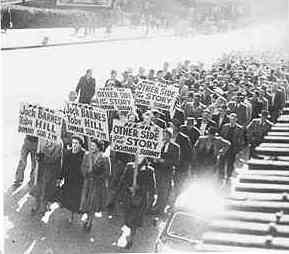
Sunday Protest Blogging: 1951 Lockout

As the Dominion Post helpfully reminded me (otherwise I wouldn't have known) this week was the 55th anniversary of the waterfront lockout.

A very brief history (because I spent too long looking at the pretty pictures while writing my last post) in the 1950s the Waterside workers were one of the most militant unioins in New Zealand, and had disaffiliated from the Federation of Labour, which was at the time ruled by Finton Patrick Walsh (he was on my list of 10 worst New Zealanders, that I never got around to finishing). The company refused to give the watersiders the increase with the latest arbitration round (for nearly 100 years New Zealand had government wage arbitration), and so the watersiders put in an over-time ban. The company responded by locking the watersiders out.

The government swung in behind the strikers invoking laws (brought in by a labour government) which allowed it to declare emergency regulations that would make supporting the strikers in any way illegal (including writing a pamphlet supporting the workers, or giving food to workers families), and government and employers together tried to starve the workers out (and the Federation of Labour helped).


Over the next 151 days the waterfront workers, and their supporters, organised to gather support and to feed themselves. But after 151 days they returned to work, they had lost, not just the battle, but the union, which had been deregistered during the strike.

They didn't win, but they lasted 151 days despite the fact that any support of them was illegal. Unlike the anti-war movement, which failed because we weren't strong enough, they failed because their opposition was too strong.

This is the best website I could find about the strike, and it was where I got my photo from.

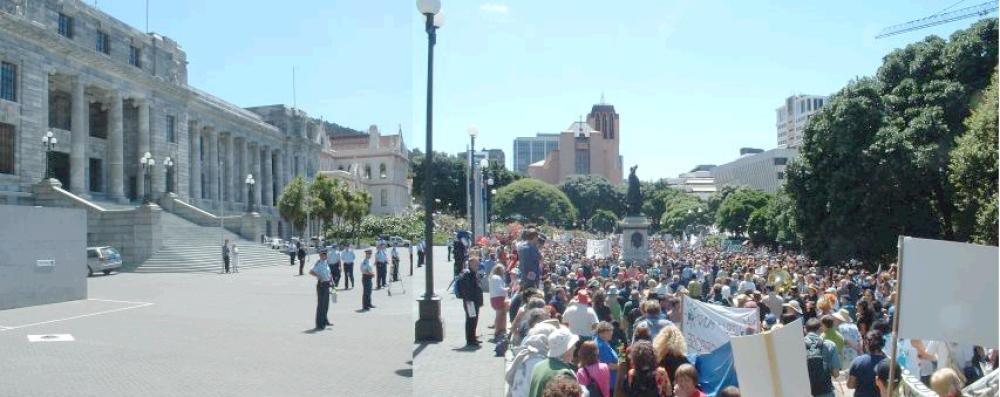
Sunday Protest Blogging: February 15 2003

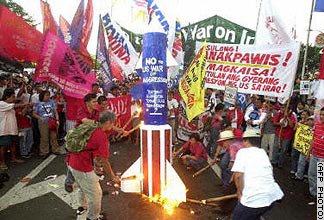
This is where I was, my friends, my family, and a whole bunch of people I don't know.

I'd been really nervous the night before - I had a dream that no-one showed up. But then as I was walking to the protest I saw people I didn't recognise at every traffic light, obviously heading in the same direction, I let myself dream it would be really big. It was bigger than that. We spilled out of the park we'd planned to start in So many people had put together signs, or painted their face - we hadn't really done anything to make it happen (although there were some really dedicated stall holders) - people were just that angry.

It was the greatest protest I've ever helped organise; it was also a bit of a disaster. We'd planned to stop in Midland Park, but we were just too big. Once we got to Parliament we had no Sound System. The program of speakers wasn't the best we've ever organised, so we missed out on a great opportunity to educate people.

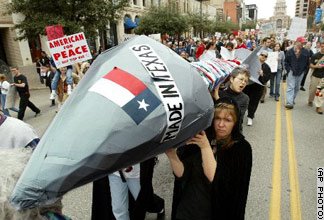
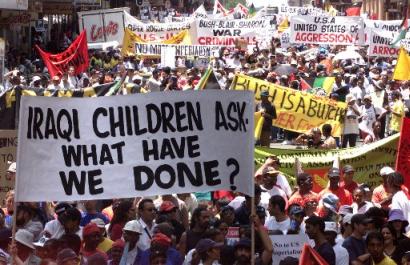
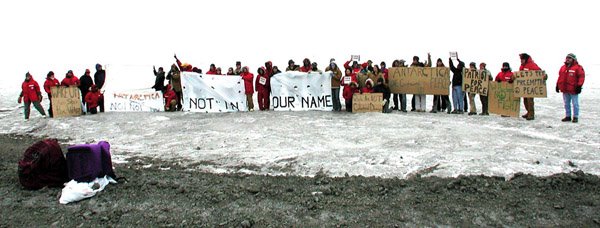
There were protests on all 7 continents that day:

Austin, Texas


London


Johannesburg


Santiago


Manila


Antarctica (all photos come from this amazing photo archive - go there I left out many great photos. I also love this book).

That was 3 years ago, the protests are smaller now, and we didn't win. But there were still 30 million of us, and we have, hopefully, learnt something, so we can keep building.

'That's terrible' said Arthur, for he was a Guardian reader

We moved from London to New Zealand when I was 5. My parents were looking to escape the economic policies and Nuclear threat of Thatcher's Britain, and, I think, family situations (2 out of 3 ain't bad).

One of the things this meant is that we subscribed to the Guardian Weekly, where you could get Steve Bell cartoons on crinkly airmail paper. I used to read the Guardian Weekly long before I could understand what was going on. When my parents lived overseas and got the Guardian Weekly and the Listener I teased them that you could tell everything you needed to know about their class, politics and geographical history (although in their defence this was when Findlay McDonald was editing the Listener not the current Pamela Stirling beauty advice central Gordon Campbell firing piece of shit).

When I got old enough I'd always read the column on the right hand side of the second page (which unfortunately got cut in a revamp) it seemed to specialise in bad news from countries I couldn't necessarily find on a map: "1,000 people died in a long running civil war", "200 died in a mine disaster". You needed to have 100s of people dead to make those columns. At the same time I'd read Notes and Queries, where people asked for silly questions and waited for silly replies, usually with enjoyable results. If you look at the online version someone asked what's the least bad ciagertte company, as if the revolution was just an ethical hair-cut away.

Which brings me to the point of this post, which is why the Guardian Weekly is not enough, in times like these. It's not just that it's liberal and lets Polly Toynbee tell her readers to vote Labour with a peg on their nose. It's that it never has much space for actual hope.

I'm very wishy-washy about how we could build a new world, I'm happy to argue with most people about why I'm not sure they're right. I do know that if we're going to do it, we're going to do it by being organised, by using the strength and power that we have together.

I realised that I don't talk about that much on my blog, I just say 'that's terrible'. I don't talk enough about protests and resistance. So I'm going to institute a new feature (we'll see how long it'll last): Sunday Protest Blogging. I'll try and skew towards successful protests, although since there were two anniversaries of important, but ultimately unsuccessful protests this week, I'm going to start with them.

Just Because You're Dressed Like This:

Doesn't mean You're a Communist.

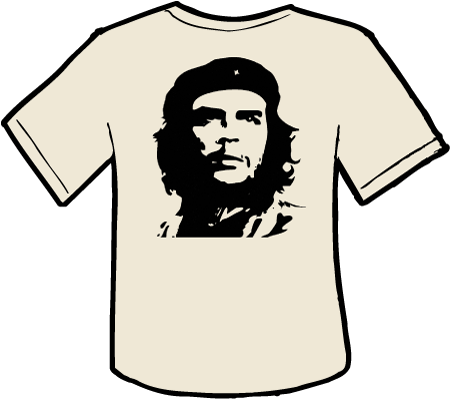
I do a lot of leafletting, and other forms of harassing passers by. I have random theories about leafletting (refusals always come in threes, your last leaflet is always the hardest to give away); I'm even quite good at it. But one of the things that sustain me while leafletting is hating people who are wearing Che Guevara T-Shirts but refusing my leaflets (which are always on things Che would support). They're a reasonably common occurance, and if you're a Che Guevara T-shirt wearer who ignores politics, you have no idea how much people curse you.

A Washington Post article about the commodification of Che as reprinted in the Dominion Post this Saturday. I really loathe the way that picture has been used, and see it as the ultimate example of style over substance. Even actual communists I know who have worn Che T-shirts haven't been able to tell me why it is Che, in particular, that they're wearing on their chest.

I think I have a solution. The picture should be licenced so that everyone who wears a Che Guevara T-Shirt has to participate in any protest an actual left-wing activist tells them to, or give a good Marxist reason why not.

Saturday, February 18, 2006

Panic

The obesity panic seems to be intensifying in New Zealand, and I feel I should be refuting this idea more. Which is ridiculous because I'm one blog with a tiny readership. But when you turn on National Radio in the afternoon (which I admit is never a good idea on week days) and they have someone saying that anyone who questions the links between BMI and health and longevity is stupid, opposition voices become important. I found Robyn Toomath's lack of grasp of history quite astounding (did you know that in the 1950s no-one lived in suburbs, and that we were all well fed in WW2 and the depression that followed because they grew their own vegetables?).

But what I wanted to talk about today, was the whole idea of childhood obesity, and the proposed solutions to it. My position is quite simple if you're worried about nutrition and exercise, worry about nutrition and exercise and leave weight out of it.

The only proposals that I've heard so far from government are to ban advertising certain foods during kids shows, to stop schools from selling junk food, and to instruct schools to include an hour physical exercise in the curriculum a day.

Only one of those proposals is a terrible idea. I actually don't think anyone should be selling food in schools, I don't think schools should be a business. I'm also all for restricting advertising during children's programmes. In fact if I had my way it'd be TV2 that would go advertisment free - I don't see why it should be the people rich enough to afford sky that get a government channel dedicated to them.

But an hour physical exercise in schools a day? Only if they completely changed the way they taught. Because I hated every second that I spent doing PE at school, except for swimming. I was hopeless at it, it made me feel hopeless, and it made me hate exercise. I think if I'd had to do it for an hour a day, I'd probably be refusing to exercise still (I'm aware this is true of many more subjects than PE, and changing of teaching methods is a wider issue). I don't think forcing kids to exercise in school will make them like exercise, and do it from choice when they leave.

But I have some much better ideas, ones that would actually work. So here's my list of proposals which would actually help kids get better nutrition:

  • Give their parents more money
  • Give their parents more time
  • Provide nutritous breakfasts and lunches in schools
  • Socialise food production and make it for nutritious value not profit
Here's my list of proposals that would help kids get more exercise:
  • Don't give them any homework, so they have time to play after school
  • Make entry to swimming pools free
  • Provide free public transport, so that kids have mobility and independence
  • Build more parks, and put wild areas for exploring in them
  • Stop trying to create panic around law and order to win elections, so people feel safe
  • Not create a whole in the ozone layer which means that it's often dangerous to be outdoors
  • Give their parents more time

Choices

Australian women should soon be able to use RU 486 to abort their pregnancies.

It feels like a funny time to be cheering for Australian women though. The changes to employment and social welfare legislation will seriously restrict women's ability to choose to have children. That they're able to terminate the pregnancy with a pill is important, but hardly a great step forward, if they're no longer able to not terminate the pregnancy.

Iran

There has been a thread on indymedia with over 40 comments, and a sensible intelligent debate. I know I almost fainted from the shock (but then I read this thread, which made me want to go out and strangle a kitten or two, and I realised that indymedia is still indymedia). The bit I wanted to respond to is this bit:

The point is not that I think that Iran is a nice place for trade unionists (see the article Dave linked to for more on the repression of the left by the mullahs), or that I think building nuclear weapons is the best use of a country's resources, but that I think that Iran has the right to pursue a nuclear programme, up to and including the building of weapons, without being subjected to sanctions, covert destabilisation, and invasion by the US and US allies like Israel.
I think Iran has a right not to be subject to sanctions, covert destabilisation, and invasion, but I actually don't think that has anything to do with the 'right' to build nuclear weapons (which I don't think anyone, or any country has).

What bothers me most about Scott's formulation, is that it implies that the only reasons Iran shouldn't be treated in the way he lists, is because they have a right to nuclear weapons. Even if Iranian politicians are doing something they have no right to do (like invading another country, or killing kittens) then that doesn't mean the US has the right to attack Iran.

My opposition to the US attack is completely independent of the pretext for that attack.

Evil?

A few weeks ago Idiot/Savant posted a pair of articles about Israel and South Africa. The first article compared the effect of policies in the two countries, and the second talked about the relationship between Israel and South Africa.

I'd meant to write about the first article when I read it; I found it fascinating how state apparatus that I usually think of being mostly benign (like town planning) can be used as a weapon:

One method of preventing further construction by Arabs in the east of the city has been to declare many open areas to be "green zones" protected from building. Bollens says about 40% of East Jerusalem is designated as a green zone, but that this is really a mechanism for land transfer. "The government calls it a green zone to stop Palestinians building homes there, and then when the government wants to develop an area [as Jewish] it lifts that green zoning miraculously and it becomes a development place."
Of course I realised that I knew town planning isn't benign even in New Zealand (no by-pass), but I just didn't think about it.

But now there's an interesting post about it on Alas, which seems to argue that people shouldn't make comparisons between South Africa and Israel, because it'll upset those who disagree with the comparison, and so they won't listen:
I'm also distressed by the Apartheid angle because Apartheid is one of our iconic images of "evil perpetuated by a state." Using such an iconic, stark image of evil to describe the Israel/Palestine conflict has the effect of covering up the extent to which some Palestinians - those that commit or support terrorism - are morally co-responsible for creating the current, appalling situation.
Even ignoring the morally co-responsible bit (which I totally reject, I don't think oppressed people who resist and morally co-responsible for their oppression), I actually think it's a problem if South African Apartheid, or any other regime is considered so awful that it must stand alone and no other regime can be compared to it. It was an actual regime, not an iconic evil. I don't think we should ring-fence anything people have done as too awful to examine, too awful to learn from.