Showing posts with label borders (open and closed). Show all posts

Tuesday, April 13, 2010

The state of a strange land

The story posted on Shakesville about a New Zealander who was deported from LAX has been getting some attention among New Zealand bloggers. It's a powerful tale:


I was taken to another room and given another search. This one (thankfully) did not put her hands anywhere near my groin, just my legs, arms and torso. And my shoes.

I was then taken back out to the main reception area, given a paper bag, and told to put all my valuables into it. Including my $2 mood ring, my $3 watch, and... my bootlaces. And anything else I was carrying of value - my wallet, my MP3 player, and the water and food that I had been given by the officers at LAX.

I didn't know why I had to put the bootlaces in the bag. I think that if I had asked, I would have been told that it was "for my safety". However, since I was only able to shuffle slowly around, I believe that it was a ploy to dehumanise the detainees further.


I recommend you read the whole thing.

But I want to point out that New Zealand has its own degrading, dehumanising, racist immigration system. I've watched a woman about to be deported saying goodbye to her boyfriend in a prison visiting room. For pacific island women visas can be contingent on negative pregnancy tests. If you were detained in a New Zealand prison prior to deportation (and people are) - the cold, the strip search, the lack of access to medication, the constant dehumanisation would be the same.

Thursday, March 19, 2009

Workers of the World Untie

Redundancies are one of the hardest things for unions to deal with. Workers have very little power, and short of taking over the factory and running it some or all of the workers are going to get screwed over.

But that is all the more reason why it's vital that workers stick together, and focus on who is making people redundant (the boss) and not each other.

I say this because over the last few days union leaders have been in the news dividing workers. The M&C union (Which is on the left of the union movement, so it's particularly disappointing):


Manufacturing and Construction Workers Union general secretary Graeme Clarke said the union had been in contact with the Government about companies continuing to employ migrant workers.

Any businesses that had imported workers through the skills-shortage list should have to "re-prove" they could not fill the positions with Kiwi workers, he said.

"Our answer has always been `yes, you can import people', but now we want it proved again that the shortage still exists."

Christchurch branch secretary Phil Yarrall said the union complained to the Labour Department about jet boat manufacturer CWF Hamilton's decision to make 28 Kiwi workers redundant while retaining 24 migrant workers on temporary contracts.

"They got the permit because there was a labour shortage. Now there's no shortage," he said.
Andrew Little from the EPMU (which isn't on the left of the union movement or a surprise):
Migrant workers had helped New Zealand through years of major skills shortages, but there were now questions over what to do when Kiwi workers were losing jobs. "Kiwi workers are obviously capable of making a long-term commitment to the business, but those on work visas are limited to a couple of years," he said.
Helen Kelly, President of the Council of Trade Unions, appeared on the Panel on National Radio yesterday (it's in the first half available here for a week or so), with a bob each way. She tries to take a stand against racism towards migrant workers, which is severely hampered by her support of racism towards migrant workers.

So to go back to unions 101, as soon as the bosses divide workers they've won. Union leaders may not have any good solutions to redundancies, but turning on migrant workers is not a substitute for a good solution. If, for example, the workers at the Hamilton company think redundancy should be based on a last on first off basis, then they should fight for that rather than targetting workers who remain on the basis of their country of origin (and if those workers aren't in the union then the responsibility for that probably lies with the union).

These are hard times for workers, hard times for unions. But that's no reason to abandon the basic tenant that underlines unions very existence.

Thursday, January 24, 2008

Freedom


Nothing I could say about Palestinians forcing open the Gaza-Eygypt border at Rafah could possibly measure up to that action's power.

Egypt is already trying to close the border. Maybe by the time I wake up tomorrow this relief will be shut off again, but maybe the Egyptian government will find it hard to shut people back in. It's the world's biggest prison break and should remind everyone of the possibility and power of resistance.

For more Raising Yosuf, brownfemipower has a great collection of links, and Al Jazeera is always good.

Monday, December 24, 2007

Merry Xmas, prison is over

I didn't watch Outrageous Fortune when it was first on. I've been catching up on DVD ever since watching the second episode. Last night I watched the Christmas special, and so I've watched everything out on DVD.

But I almost couldn't watch it - because the first ten minutes are about Cheryl's boyfriend Wayne trying to get out on bail. Partly because it was wrong. They showed Wayne using a cellphone in front of a guard at court - it doesn't work like that. Plus, Wayne would be in Auckland Central Remand Prison and I know what visiting at A-CRAP is like(I even know the prison nickname) and it's not like that.

But actually I was just upset. One day I may be able to hear stories about bail and let them be stories, but at the moment they resonate like an electric shock and take me straight back there.

Now it doesn't take much. The media reports they have every year about how they spend $4 a day feeding prisoners, and that on Christmas Day prisoners will get a mince pie dusted with icing sugar. They don't tell you that there'll be no visits on Christmas Day, because it's a public holiday. Tuesday was a visiting day for my friends every prison they were in.

Or this post, that I got from debitage:

I sat outside that cheerily bedecked detention center on a bird shit stained bench while I told a five year old that neither Santa nor God nor any of the other deities in a child's pantheon could bring his daddy home from Christmas. Daddy will be spending his fourth Christmas in immigration detention, a sentence 400% percent longer than any he served for a criminal conviction.

The child bawled. His mom hugged him and whispered endearments to him in her native language, although the son is a bilingual U.S. citizen. But then she had to send the son away to play under an ailing tree, because I needed to interrogate her about horrors she and her husband had faced in their native country. Part of the joy of litigating an asylum claim is that you have to grill everyone involved until they have PTSD from reliving their experiences. But if I'm not ruthless, the judges and government attorneys will confuse and humiliate them. Even if I do prepare them, a little of that happens anyway.
I'm not sure that I want the day to come when I can read that without physical pain. I want to hold on to the vivid reality of the prison system, because it's going to keep on being real whether or not I ignore it.

Wednesday, May 23, 2007

Must Read

I didn't link to brownfemipower's amazing post about la familia and immigration, because I wanted to say something. I wanted to argue for open borders. Then I thought that when I get round to writing about open borders then those comments should stand alone.

brownfemipower covers so much in her post including transience:

In Michigan, it’s different. Detroit, Flint or Saginaw may have established Mexican communities–but in the community I grew up in, there wasn’t one single family that had grandparents or even parents who had been born there. All of us whose families had settled in the neighborhood had multiple friends that disappeared after a year–their families moved back to Mexico or Texas or over to other farming states for work. Two of my best friends as a child left Michigan in the second grade. Only one wound up coming back to Michigan–when we were both in high school.

And as somebody who worked in the fields–I can remember falling in love with a dark-skinned, lightly muscled boy who smiled at me every time I walked past. He was there for one season and I never saw him again. A common happening in migrant work.

These disappearances were very upsetting to me, but I lived–just like I know the people who disappeared lived as well. We’re all used to it, and we’ve learned to accommodate shadow figures, shadow relationships into our lives.
Go read brownfemipower now.

Friday, January 12, 2007

Review: Children Of Men (reasonably spoiler-free)

Children of Men is a distopian movie, about a world where no woman has given birth for 18 years. It contains the most powerful scene I've ever seen on film. Kee, a young black woman is going into labour on a bus at the entrance way of a refugee camp. We're watching her fighting the contractions and out the window we see refugees being tortured by the police.

What made this sequence so powerful was not that it showed us a distopian future, but that it showed us our distopian present. The images of refugees who are selected as dangerous at the entrance to the campis deliberately evocative of photos we've all seen from Abu Grahib. The camp they then enter is Gaza with British signage. The most potent political comment, in this amazingly political film, was the message refugees heard as they entered the hell-hole of a refugee camp: "Do not support terrorism, we are here to help you."

The set, and the world-creation, is truly remarkable in its detail, and there's barely a frame that doesn't contain information about the world of the film, and criticism of our world.

What makes Children of Men's critique of our world so radical and thorough- is it takes the world that is usually hidden from those of us who live comfortably, the experiences of Iraqis, palestinians, illegal immigrants and so on, and makes it the centre-piece of Britain's future. Our government's are as racist and as brutal as the world, but at the moment they can hide it from a good portion of their population.

I did have a minor problem with the movie, and that was it's characters - or lack thereof. It is a really sign of the quality of the movie that the fact that the major characters are completely unmemorable is a minor problem rather than a reason to demand my money back. While some of the minor characters were well drawn, the main characters - particularly Theo and Kee very under-developed. This was probably a deliberate choice, which would have worked better if they hadn't given Theo a back-story from cliche hell (guess what? It involves a girl).

One of the reasons that the movie can sustain characters who don't hold your interest, is because it is incredibly well-paced. Like Theo we are taken, a little bit reluctantly, along a series of events we have no control over, and we don't know what's coming next. I get very jumpy in action movies (actually I got jumpy in Happy Feet), and my friend Betsy grabbed my hand to reassure me that it was OK. Then, once they reached the refugee camp I grabbed her hand, and it turns out that we really needed that.

Children of Men is full of horrors, but it does offer us hope. I may write more about it's politics of change. But for me, the hope didn't come from the Human Project, a For me, the hope wasn't about the group that Kee was trying to reach - an organisation we knew nothing about. The hope came from watching people who kept fighting for a better world, even though they had no reason to believe that anyone would be alive to live in it.

I do recommend this movie, it is an astonishing piece of film-making. It wouldn't have stayed with me so much, if it wasn't real. We must fight for a world where women don't have to give birth in these situations.

Friday, November 17, 2006

Justice for Janitors

More than three weeks ago now, cleaners in Houston went on strike, in an attempt to get the big cleaning companies to negotiate a union contract. Most cleaners are paid on, or close to, minimum wage and don't get sick-leave, paid vacations or health insurance.

you should Read these women's stories

I'm going to quote from Idalverta Vega, not because her story is the most dramatic, but because it is one of the least.

"The children had Medicaid but they no longer qualify," says Idalverta. She was told her husband's income is too high, but says the money they make is not enough to pay for a health plan. "When my kids get sick I don't take them to the doctor and I can't take them to a dentist either. According to them we're making 'too much' but it's not true, the money is not enough--we can barely make ends meet."

Idalverta and her husband are doing their best to make sure their kids have a brighter future. "All of my kids go to school. Sometimes they're missing some supplies but we do what we can to provide them with what they need."

Idalverta's 18-year-old son would like to go to university, but the family can't afford to send him. Like many other young men and women growing up in working-class neighborhoods, he felt he had few options. "He signed up for the Army so that he can study. But they're saying he'll be shipped off to war--it makes me very nervous," she says.

Winning a good contract would mean many things for Idalverta's family. "We'd be able to live better. Someday we'd be able to buy a house. That's one of my dreams-being able to own our home."

"Everyone comes to this country searching for a better life. Many never make it -- they die on the way in the desert," says Idalverta. "We will go out and march again if it's necessary. We have to continue the struggle."


This is a vital feminist struggle, and the cleaners of Houston need your support. Houston Jantiors page has suggestions about how to Get Involved and Labourstart has an e-mail campaign.

Monday, October 23, 2006

Free Speech

I first read about a protest against the Minutemen at Columbia on Foolish Owl's blog. For those who don't know the Minutemen are an American group, who specialise in vile anti-immigration racism and have taken it on themselves to police the Mexico-US border.* The Young Republicans at Columbia had invited . Anti-racist/immigrant rights groups got together and organised a protest outside. Some people also went inside and disrupted the speech (either by unfurling a banner, or shouting the speaker down - I wasn't there, and only have dial-up so I can't watch the video - it's irrelevant to my argument).

I absolutely support and applaud this sort of protest (I've done this sort of protest, just for the record). But what I wanted to address directly was the idea that by disrupting the event (however they did it) interupted this man's right to free speech. The Happy Feminist was reasonably vocal in her disapproval:

But no it wouldn't change my analysis. You protest outside, you write scathing editorials, and you publicize the fact that the College Republicans are basically inviting a hate group onto campus. But as a matter of both tactics and ethics, disrupting the actual speech isn't right.
and
And to be crystal clear, no, I would not agree with shouting down a pro-life speaking or anti-feminist speaker.

It's the same principle as the Jewish ACLU lawyer who defended the right of Nazis to demonstrate in Skokie. No matter how noxious and personal and awful he found what the Nazis were saying, he still defended their right to say it.
To me the principle of freedom of speech is to stop those with power limiting the speech of those without power (particularly stopping the state limit people's freedom of speech, but I think the role of companies in limiting people's speech also comes under the same analysis). The idea that respecting freedom of speech means listening in silence while someone says something you find offensive seems ridiculous to me. All freedom of speech guarantees is the ability to speak - it doesn't mean that anyone has to listen to, or respect, what you're saying.

Shouting down a speaker isn't interfering with free speech; it is free speech.

What I find just plain weird, is that this argument is generally only applied to people who are speaking in formal settings. On Saturday the neo-nazis held their annual rally and there was a reasonably large counter protest which stopped them meeting where they wanted to meet, and shouted them down (more on that in a second). Very few people jump up and down and says a counter-demonstration is interupting the nazis freedom of speech. But when someone is an invited speaker - when they have backing by some institution, some power base then somehow they have more of a right to free speech than they do on a speech corner. That seems like the wrong way round to me. Those who are in positions of power, generally need less, not more protection against their rights being infringed.

So I have absolutely no ethical qualms in holding banners, chanting, or communicating in any way, while someone I disagree with is speaking. I exercise my freedom of speech by not being silent.

That doesn't mean I think that shouting at people is always the best tactic. The counter-demonstration againstthe neo-nazis is a time where I thought the tactics were wrong. There aren't very many neo-nazis in New Zealand, but they tend to be exactly sort of violent thugs you'd expect (two years back someone vandalised the graves of jewish people, and they attack people as well as graves).

To me, the point of protesting against neo-nazis is to make it really clear that white supremacy is not welcome. I see this message as not just for the nazis themselves, but also for everyone who walks by. But there's never any purpose to the anti-fascist demonstration except to piss the nazis off. I strongly susepct being protested against makes the nazis feel cool and important, so the counter-protest ends up being counterproductive.

I do think that we need to organise to ensure that fascists don't get a hold. But we don't do that by shouting at them. Political racism has appeal for working-class people who believe that they should be better off than they are. By saying "it's the jews/immigrants/Maori who are to blame for your situation" various groups (including mainstream political parties obviously) use racism to organise and gain support. The only response to those lies is to present what we see as the truth - to show that it is capitalism that is to blame for people's economic problems, and that it can be fought.

I didn't attend Saturday's anti-fascist demonstration. I'm sick of them, sick of the macho atmosphere, and sick of activists who seem to get their kicks by playing cops and robbers with fascist groups, as if it's the most important work in the world. There's a real macho culture to these sorts of demos, that makes me very uncomfortable.

I'm really glad I didn't go, as there seems to have been a distinct lack of political analysis at the counter-protest. "More hair than brains" may be an amusing chant towards skinheads - but actually our problem isn't with their hair cut, or their intellect. Likewise a whole crowd chant of 'Ugly, Ugly, Ugly' seems to miss the point.

But most disturbing to me was that some supposedly anti-fascist protesters shoutted "cocksuckers" and "faggots" to the nazis. Now I don't want to tarnish the entire demonstration with the misogynist homophobic actions of a few. I have a lot of friends who were at the demonstration, and I know that they would neither shout that, or stand silent while someone else chanted it. But I think it shows that my fears about a macho atmosphere are not unreasonable.

* Just for a short break and disturbing story. My sister once met someone who worked for the US border patrol at a party. When asked what he did he flipped out his badge (which he'd carried with him to Wellington, presumably to impress the girls) and said "I shoot Mexicans". Just a reminder that the Minutemen are only one of the violent racist groups on the Mexican-US border.

Tuesday, October 17, 2006

A tale of one protest

This was going to be a tale of two protests - since I went on two protests today. But two protests in one day is tiring, so I only have time to write about one of them, more tomorrow.

Clean Start for Cleaners

Today is international anti-poverty day (a concept I find a little weird - today we'll have international anti-poverty day - tomorrow we'll go back to ignoring international poverty). The Clean Start for Cleaners campaign organised rallies in Australia and New Zealand today, which is appropriate because to be a cleaner is to live in poverty.

All around the world Cleaners are mostly immigrant and indigenous women. Despite the fact that cleaning needs to be done everywhere, everday and it is completely devalued. The union rate for commercial cleaners is just 70 cents an hour above minimum wage. Cleaners work two or three jobs to get their hours up and have no security of employment. Subcontracting makes it so hard for cleaners to fight for better wages and conditions, because the employer can always hire someone else.

All these points were made at the rally, of course. Plus some interesting facts I didn't know (90,000 workers got a pay increase when the minimum wage went up -60,000 of them were women - low-wages, poverty and capitalism are all feminist issues). The most powerful speakers were cleaners themselves. There is no service recognition for cleaners, so two women who had cleaned for forty years were still only getting $10.95 an hour. Another woman spoke angrily about always being blamed for being a burden on the tax-payer because she got government assistance - even though she worked over 40 hours a week - she is blamed rather than the employer who won't pay a living wage.

One of the women also talked about being involved in previous cleaning struggles, and strikes. It must be so hard to have struggled and won, but seen the victory slowly eroded over the last twenty years. Particularly as you'd know that if anything was going to get better you need to fight that fight again.

Now I have some problems with the Clean Start campaign - most notably that no-one really understands what its principles are (and last I heard these principles haven't actually been translated into the first language of many of the cleaners). But I was really glad to be at this rally, in support of the cleaners.

(Part of my good feeling towards this protest is because I left before Ruth Dyson - (minister of labour) spoke. I needed to get to the other protest, and if you've heard Ruth Dyson say once that she'd like to change things, but she can't - you've heard it once too many times).

Monday, September 18, 2006

In which I write about something else

The leaders of the opposition in both New Zealand and Australia have both been sounding exactly like racist troglodytes. Do you think it's some kind of plague? Or possibly a plot?

John Howard had suggested that all citizens had sign a pledge to uphold 'Aussie values'. This isvery similar to Don Brash's* suggestion earlier in the year. Kim Beazeley had to try with both hands to come across as more of a racist troglodyte than John Howard, but he succeeded. Responding with a presisng question - why stop with citizens? The leader of the Labour party suggested that people must agree to uphold Aussie values to even enter the country. What did he see as the core Aussie values?

Mr Beazley said among Australian values to which new arrivals should commit would be respect for people's different views in religious and political terms, as well as respect for women.

Mateship, a "gender-free" concept, should also be included, he said.
I suspect that he didn't have a hint of irony in claiming that 'respect for women' and 'mateship' were both core Aussie values. It makes me furious that these men can claim that respect for women, or equality with women are core values of either Australia or New Zealand.

In New Zealand women earn 84% of what men earn, we do the vast majority of the unpaid work, we have to pretend we're insane to get an abortion, women around the country get harrassed in their work and beaten in their homes, and those with power can rape women with impunity.

Don Brash, Kim Beazley and John Howard - they don't care - in fact they actively promote policies that would make things worse for women. But they're perfectly happy to use our lives, use our pain, as long as it's that days dog whistle.

* Don't you miss the days when most discussions about Don Brash had nothing to do with his sex life?

Sunday, August 27, 2006

Tolerance

The National party believes that the bedrock values of this country are religious and personal freedom and sexual equality.* One of their MPs, Bob Clarkson said that "Muslims who wore burqas because of deeply held beliefs should "go back to Islam or Iraq".**

Does this strike anyone else possibly a little bit problematic, maybe even slightly contradictory.

*Michelle A'Court was great on Kathryn Ryan the week after this came out - she wasn't sure that sexual equality was a bedrock value of this country given our history - rather it was a balcony added on recently when we came into a little money.

** It's a good thing that knowledge isn't one of this country's bedrock values. Leaving aside the location of 'Islam' - Iraq is hardly the epicentre of Burqa wearing.

Monday, July 17, 2006

That liver could have gone to a white person!

It was the front-page article and the headline read: Illegal immigrant gets $500,000 liver transplant and the sting said "A Pacific Island overstayer will not pay a cent towards a half-million dollar hospital bill after the government granted her permanent residency." The story is een important enough to be granted it's own logo 'Migrant Health Crisis'.*

The Sunday Star Time isn't racist you see, it's just worried:

"The money we spend on these people is money we cannot spent on New Zealand residents or citizens," Crombie said.
But lets look at the woman involved in the lead story in just a little bit more detail. She moved to New Zealand in 1998 and worked in a Tomato packhouse in South Auckland. Now my rant about employers and immigration will have to wait for anohter day, but today I'll just point out she was working here for 4 years before she got sick, and that the extent to which her employment complied with New Zealand employment and tax law was almost certainly up to her employer, rather than something she could control.

She went into liver failure while she was pregnant, but she didn't go to a doctor until she was 7 months pregnant, because she was worried about being an illegal immigrant. The liver failure was a result of undetected hepatitis B.

Did you get that - if she had gone to the doctor earlier she wouldn't have had liver failure. The reason her health care ended up costing so much money was not because we're too generous with health care to illegal immigrants, but because we're too stingy.** If this woman had had access to health care throughout the time she was working in New Zealand she wouldn't be sick now. That she was too scared to go to the doctor is an indictment on our immigration system.

I am going to write more about immigration. The current debate appears to be limited to either Winston Peters style frothing at the mouth, or defending immigration because business needs workers. There seems to be no room in the debate for those of us for who believe in immigration from a left-win, anti-racist perspective. Which makes it all the more important that those of us who hold that view speak it as loudly as we can.

* I have a kind of fascination/pity for the people who design logos for news stories. It seems to me that it'd be a truly soul-destroying job. One news channel's logo for the death of the twins in South Auckland recently was a hospital bed with two dummies on it - tasteful.

** This is obviously a problem among all poor people, not just illegal immigrants. Charging for doctor's visits in a publicly funded health service is ridiculous, and not just because I don't believe in paying for health care. Primary health care is the most effective way of spending health dollars, and yet it is the area where there is the biggest

Monday, May 15, 2006

A few links

I've written about Post Secret before. People send in their secrets on a postcard, and each week the website owner puts up new postcards (US time). They're usually beautiful, and heart-breaking, and sometimes strange. But this week was a mother's day issue, and they are even more heart-breaking than usual. There are postcards from mothers and postcards from children; there are postcards of joy and postcards of pain. They're really beautiful and they make me cry. Together they make an important and powerful statement about the reality of mothering now.

I do a lot of driving for work, so I listen to National Radio (currently undecided on Kathryn Ryan, but I like her voice and the fact that she's not a Linda Clark style middle-class liberal). Today I just happened to hear an amazing interview on Checkpoint. Susan Burdett was raped a murdered a dozen a year ago. The inteview was with her brother. He talks about how he stopped seeking revenge. I'm not even religious and I'm praying that nothing like that ever happens to anyone I love, but if they did I hope that I can find a similar sort of peace.

Lastly a link from Interesting Times - I'm so happy to see another New Zealand feminist blogger. She ties together a whole lot of fascinating threads on the way immigration laws affect women.

The first thing this topic made me think of though was the Sri Lankan teenager (unnamed in the media) who sought asylum in New Zealand with her grandmother after suffering sexual abuse at the hands of several relatives. There were a series of scandal and screw-ups around the case, including the immigration minister obtaining - and publicising - legally priviliged information and losing her job. She ended up being deported. What I can honestly say was one of the most harrowing images I've seen was her been pushed in a wheelchair across the airport, sedated and handcuffed. She was, of course, vindicated.

There isn't really a conclusion to this post; obviously immigration controls reinforce the status quo, and that works against women. I'm not sure whether immigration controls are by definition sexist - though in practice that is definitely how they work out. I can say, though, with complete confidence, that women can only be liberated in a world where everyone has freedom - and that includes freedom of movement.
Go read the whole thing.

Wednesday, May 03, 2006

Ningun Ser Humano es Ilegal


Wow, Wow, Wow, Wow.

I've been busy the last couple of days, and only just had time to find out what happened on May Day. I'm out of town at the moment, and I'm sitting in an internet cafe going through the indymedia protests, looking at photos, and almost crying over how unbelievably amazing the American Mayday immigrant right protests were.

That photo is from San Francisco, and those links each go to a different indymedia sites. You can also find out more information, here, here, here and here.

What really got to me (and made me all emotional) was the solidarity. Immigration is a workers issue, and it doesn't just affect illegal immigrants. The photos from Chicago, which had the biggest protests, showed that people understood that. As a history geek, I was particularly excited the Chicago. May day marks the campaign for the 8 hour day, and the Haymarket riots, and the state murder that followed. The people who fought for the eight hour day were mostly immigrants and those organising now are continuing that fight.

This photo is from Chicago, near Haymarket:


PS I stole the title from a banner; I don't speak spanish. I hope it's not too hideously wrong.

Wednesday, April 26, 2006

A few thoughts on the immigration proposals

I've been meaning to write about the immigration review ever since it came out, but I was a little bit distracted. Ever since then I've been rather intimidated by it. Tze Ming and Idiot/Savant have absolutely rocked the party when it came to the details of the policy and the pernicious implications of the department's suggestions. They're both going to post more, make sure you don't miss it. Their posts made me realise that the reason I didn't know what to write was because I don't know that much about immigration policy.

I've started reading the policy document and it reads exactly like any other policy document put out to consultation. Lots of meaningless drivel and making sure that the topic is so carefully defined that you get the answers you want.

They helpfully define the aims of New Zealand immigration right up the front and one of them is "ensure that New Zealand's interests are protected and advanced".

I do wonder how a country can have interests. Are they talking about the New Zealand state? Are they saying that all New Zealand citizens have the same interests when it comes to immigration? Are they identifying the interests of a certain sector of society with the interests of the country as a whole? (my money is on the last, but more about that later).

They don't explain how a country can have interests, but they do say what New Zealand's interests are when it comes to immigration policy, which is helpful:

* maintaining the safety and security of New Zealand
* generating sustainable economic growth
* establishing strong communities
* fulfilling New Zealand’s role as a good international citizen, and
* promoting international cooperation.
So lets start with those principles, and see what they actually mean

maintaining the safety and security of New Zealand
Now obviously the main thing this means is that they should be able to deport and lock-up anyone they want to deport and lock-up and never tell them why. No meddling kids should have got in the way of sending Ahmed Zaoui somewhere else.

But it's actually more of a power grab than that. They want to amend New Zealand's immigration legislation so that it states of everyone who comes here is of good health and character. They justify that desire under this clause: "Safety and security includes ensuring that non-citizens are of good health and character." So our security is guaranteed by ensuring that only people who are of good character are allowed in. If we allowed people who were only of mediocre character in then New Zealand would become insecure.

But seriously 'good character' is pretty vague, and a lot of the examples they give are discriminatory, and this is when they're trying to sell the idea. The idea is actually even more pernicious than that (yes I have used that word twice in two posts, Joana Burke used it in the talk I heard last night, and I decided I liked it):
The term “health” in immigration policy is used not only in reference to the absence of disease and the protection of public health, but also to ensure that non-citizens do not impose excessive costs through disability.
Immigration legislation is, by its existance racist, but never underestimate it's ability to discriminate and treat like shit anyone and everyone who doesn't have power. The idea that it would damage our safety and security to have people with disabilities in the country is offensive.

generating sustainable economic growth
Now this is where we get to start looking at whose interests are defined as "New Zealand's interests". The reason the immigration debate is so frustrating is that it is often argued between people who are saying "I don't want brown people here because I'm racist" and people who are saying "I may want immigration, I may not, it all depends on what's going on with my reserve army of labour."

There is very rarely a voice which looks at immigration from the point of view of people, and links the interests of workers, where ever they are, and points out that these are not the same as the interests of bosses.

establishing strong communities
If anyone can explain what they could possibly mean by this that isn't racist then they get a cookie.

The other two criteria seem mainly to be about ensuring that we don't treat refugees any worse than everyone else, and making sure New Zealanders can travel where we want to travel.

I'd quite like to know which principle sending rape survivors back to be further traumatised comes under.

My point in this rather scatter gun critique of immigration principles, is that immigration laws are set in the interests of those with power. In particular, they're there to help ensure capitalism runs smoothly. Those of us who aren't that fond of capitalism need to reject immigration laws, and recognise that we have more in common with people in other lands than we do with business owners in our own.

Monday, March 27, 2006

People should be freer than capital

I wanted to write a little bit more about my position on immigration, because I think it's an issue that doesn't receive enough attention.

One commenter on my post wrote:

But I have been surprised that many of the people that are vehemently against corporations outsourcing jobs to India and China have no problem with domestic outsourcing to illegal immigrants driving down wages for many Americans.
This sort of rhetoric on immigration is really dangerous, because it drives a wedge between those with work permits and illegal immigrants, and it's wrong. The reason illegal immigration can drive down wages and conditions has nothing to do with the fact that people come from some country with bornwer skin, in fact it has nothing to do with the immigrants at all, it's because the employers use the power they have over illegal immigrants. If all illegal immigrants were allowed to work legally then their wages and conditions would go up, because they could utilise labour legislation, and it would be easier to organise.

I don't actually care about American jobs any more than New Zealand jobs, or Chinese jobs and Indian jobs. No borders isn't just rhetoric about immigration - it has to be a commitment not to priviledge one group of workers above another.

I also oppose tarriff reduction regimes for different reasons than this commenters. While the arguments about relationships between tarriff changes in the first world and job losses (and not just in the first world, but that's a longer post) are important. The real reason I oppose tarriff reductions is that they give companies more power. The more free companies are to move around, the more they can leverage from different localities to move where they are. Improved transport has meant that manufacturing can reasonably easily be moved from one location to another. This has given manufacturers the power to leverage zones where no labour legislation, or most other forms of legislation, apply to them. It's this power, not the job losses, that I object to.

I don't actually believe that 'no borders' could be achieved under capitalism, neither could women's liberation, but steps in that direction are worth fighting for.

Also posted on Alas

Sunday Protest Blogging: Open Borders Edition


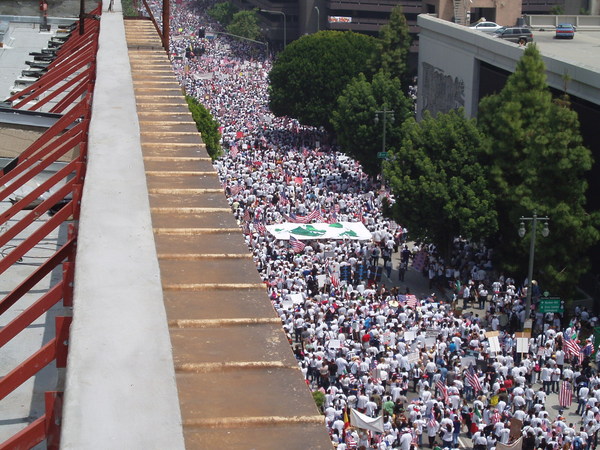
Los Angeles saw one of it's biggest protests ever yesterday when between half a million and a million people marched against anti-immigration laws. The laws would make it a felony to be an illegal immigrant, and calls for walls to be built along the border. I understand they're due to be debated in the Senate on Tuesday.

The mobilisation against this legislation all over America exceeded media expectations (although the organisers seem to have known how important it was to people). I'd like to pay tribute to everyone who atteneded those protests, and particularly those who put in the organising work to make it happen.

I think it's easy to get complacent about this issue in New Zealand, to assume that just because it's difficult for illegal immigrants to get here, immigration is less of an important political issue here. We get the occasional high profile refugee case. The most famouse is Ahmed Zaoui, an Algerian who was detained for a number of years, after he was given refugee status, because the SIS didn't like him. Or when the government sedated a 16 year old girl in order to deport her back to Sri Lanka where she had been repeatedly raped by her family and feared the repercussions (she has since been given refugee status, and is going to Canada). But although dawn raids to get rid of illegal immigrants still happen, more people probably know the band than the practice.

Businesses exploit illegal immigrants, and it is the immigrants who are punished if the businesses are caught. Last year one bakery was caught paying one of their employee's below the minimum wage and not providing him with holidays for 8 years. He was deported, they were fined $2,000. Employers have huge amounts of power over illegal immigrants, and the only way to change that is to say that those workers should be entitled to live here under the same conditions as everyone else.

I think it's fantastic that it is a people's issue in America, although I imagine it's not for good reasons. My sister met a US border guard at a party (he had brought his border guard badge with him to New Zealand, which was probably the first sign of trouble), he said his job was to shoot Mexicans.

In New Zealand at the moment, the only people who talk about immigration, are people who want it restricted, or businesses who want workers. It's obviously different in America, you don't get hundreds of thousands of people on the streets to promote business interests. I think it's really important to draw a line between people who support a more open immigration policy to suit the needs with business, are confused with people who think that immigration policy should suit the needs of people (so there should be no limits on immigraton)From the Guardian:

Bush sides with business leaders who want to let some of the estimated 12 million undocumented immigrants stay in the country and work for a set period of time. Others, including Senate Majority Leader Bill Frist, say national security concerns should drive immigration reform.
By making immigration a tap that gets turned on and off to suit the labour market, employers can try and drive down wages and conditions by treating workers in other countries as a reserve army of labour.

So all power to the protesters, and I'm sure they'll continue to draw a line between those who put people first, and those who put business first, as well as fighting the racist fucks who put up legislation like that up in the first place.

If you live in America and didn't make those protests you get another chance, there's a national day of action on April 10, you can find out more at the immigrant solidarity network.

Also posted on my blog