Sunday, November 19, 2006

Isn't it good we have men to tell us what to do?

Sailorman (who occasionally comments on Alas) has an interesting new argument. He believes that the only way anyone should use the word 'rape' is to reflect the exact legal definition of where they live:

Anyone who frequents feminist blogs has seen similar claims, and more. Sometimes the claims are much more explicit: "drunk people cannot legally consent." "Any pressure means it's rape." "If you didn't want to have sex, it's rape."

In many states, those are all lies. And it's doing no favors to those women who hear them.


If only members of the women's liberation movement had had Sailorman's wisdom, imagine how much stronger we would have been there. Obviously the feminists who started discussing 'marital rape' weren't doing women any favours. Legally once , and feminists who implied otherwise were treating women like children and telling them what you think they "want to" or "should" hear " (to paraphrase the oh so wise Sailorman words).

Because it is all our fault (sorry if you've heard that before):

If a woman knew, really knew, that a threat of trying to get you fired would not support a rape conviction, would she still give in to the threat? If she knew that scared silence gives much less support for a conviction than a shouted "no!" would she still remain silent?


I actually have no words to express my anger at the first example Sailorman comes up with. I sincerely doubt that a single person who has ever been raped by her boss has considered what the rape laws in her state when she decided how hard she could resist.

I believe that a woman is raped if she's drunk, if she withdraws her consent party way through sex, or if she wanted to have sex with someone else. The law doesn't agree with me. I've already written about why I define rape in the way I do:
I define rape in the way I do to support the women who are naming their experiences, and reiterate the idea they have the right to say no to sex.

I also define rape in the way I do as a protection against men who have sex with women who don't want to have sex with them. I believe that one of the few forms of protection women have against rape is gossip - passing on information that we know about men who hurt women.

Women need to know who the men are who don't notice, or don't care, that the women they're sleeping with don't want to have sex with them. Calling those acts rape is both protection and resistance.


I still believe that, my definition about rape is about women's experiences, which is more important to me than the law.

Friday, November 17, 2006

Justice for Janitors

More than three weeks ago now, cleaners in Houston went on strike, in an attempt to get the big cleaning companies to negotiate a union contract. Most cleaners are paid on, or close to, minimum wage and don't get sick-leave, paid vacations or health insurance.

you should Read these women's stories

I'm going to quote from Idalverta Vega, not because her story is the most dramatic, but because it is one of the least.

"The children had Medicaid but they no longer qualify," says Idalverta. She was told her husband's income is too high, but says the money they make is not enough to pay for a health plan. "When my kids get sick I don't take them to the doctor and I can't take them to a dentist either. According to them we're making 'too much' but it's not true, the money is not enough--we can barely make ends meet."

Idalverta and her husband are doing their best to make sure their kids have a brighter future. "All of my kids go to school. Sometimes they're missing some supplies but we do what we can to provide them with what they need."

Idalverta's 18-year-old son would like to go to university, but the family can't afford to send him. Like many other young men and women growing up in working-class neighborhoods, he felt he had few options. "He signed up for the Army so that he can study. But they're saying he'll be shipped off to war--it makes me very nervous," she says.

Winning a good contract would mean many things for Idalverta's family. "We'd be able to live better. Someday we'd be able to buy a house. That's one of my dreams-being able to own our home."

"Everyone comes to this country searching for a better life. Many never make it -- they die on the way in the desert," says Idalverta. "We will go out and march again if it's necessary. We have to continue the struggle."


This is a vital feminist struggle, and the cleaners of Houston need your support. Houston Jantiors page has suggestions about how to Get Involved and Labourstart has an e-mail campaign.

Wednesday, November 15, 2006

Man-hating

I have been wanting to write about male violence within activist scenes for a number of weeks. I haven't known where to start. So I thought I'd talk a little bit about my personal experience

I feel very hesitant about these snapshots. This blog is semi-anonymous, but I am not - most people in my life know about this blog. There would be few left-wing activists in the country who couldn't find out who I was if really they wanted to. If I wrote seriously about my experience of male violence against women within the activist scenes then a lot of other people would be identifiable as well.

I'm anonyminising this up as best as I can.

*************

New Zealand is small - travel is easy - you can have a national weekend or conference for almost anything - and we do. This weekend was one of many that I've spent in similar circumstances, speeches, workshops, and all the most interesting conversations happening in their corridors.

I was hosting a whole bunch of people in my house, because I had some space. I was working on my thesis at the time, so I didn't go out with them on the Saturday night.

I knew before I woke up that something was wrong - the house had been noisy at the wrong times and quiet at the wrong times. A man had told one of the women who was staying with me that he had no place to stay. He did have a place to stay, and he'd deliberately not been billeted with any women - but I didn't know that, and neither did the woman who invited him back. When back at my house he had tried to rape a woman who had already gone to bed.

One man heard her, got up and beat the shit out of the rapist - I've never felt more grateful to anyone in my entire life.

**********

A friend wanted me to come to a feminist meeting, I didn't really know the people so I didn't want to come, but I did. It was being held in a woman's house - I couldn't put a face to the woman's name, but when I met her I knew that I'd seen her around.

She had two black eyes - her boyfriend had hit her. She said that they'd been play fighting and he didn't know his own strength. She said he felt terrible.

She hadn't left the house since it happened. She wanted to spend the meeting talking about the abuse we'd suffered at the hands of men.

Whenver I think of this story, often when I think of him, I feel my failure like a weight. We did what she asked that night, we talked about male violence against women. But I didn't offer her anything more. It's a kind of arrogance, to think it would have made a difference - that something I said could changed her reality.

Still I wonder what else I could have done.

**********

Right at the time I met that woman, her boyfriend was busy using his position within the political scene to defend a rapist.

I wish I could say the two stories I have told are the only times I have had to deal with a male violence and abuse within activist scenes, but they're not. I have known too many men who claim to be fighting oppression, but exclude the women they're abusing from that fight.

I think it's fantastic whenever a woman can talk about the abuse she has experienced. But whenever it does happen a bit inside of my sinks, and feels a lot like a bowl of petunias. Because I've seen too much to expect anything, but to be disappointed by the reactions of men.

It's not the rapists, abusers, or men, that make you despair of men as a group. I know that violent men exist, and they're not all cops, or other unsavory types. I've learned, I guess every woman learns, that they may be people I know.

What leads me to despair, is the men who support, cover up, minimise and defend abusive and violent men. I've known so many men who have choosen an abusive man over the woman he abused.

I'm left with this deep sense of disease and distrust. Because too many men hear tales of abuse and rape and automatically put themselves in the place of the abuser. Everytime a man does that I feel a little bit less safe around him, I wonder a little more about his past.

Our standards are so ridiculously low, but men fail again and again. If a man who has been abusive acknowledged what he did was wrong (ideally before he was outted, but I'm beyond hoping for that), took action to change that, and didn't talk trash about the woman involved, then I'd be so shocked I'd probably stop being angry.

From men who have never abused a woman all I want right now is that they will choose a woman who has been abused over a man who abused her.

It doesn't seem like asking much, but it seems impossible to get, and what little we do get needs to be constantly fought for. So while hate is too strong, I do distrust men. I wish I didn't have to, but there's only so many times you can be surprised.

I am probably going to try and write more posts inspired by my recent experiences. It's difficult to do so without being too vague to be useful, but I've got some things to say.

Comment Moderating: If I doubt your sincere commitment to eliminating male violence against women and creating a free and equal society then I will delete your post and ban you from my blog.

Saturday, November 11, 2006

Eleventh hour of the eleventh day of the eleventh month

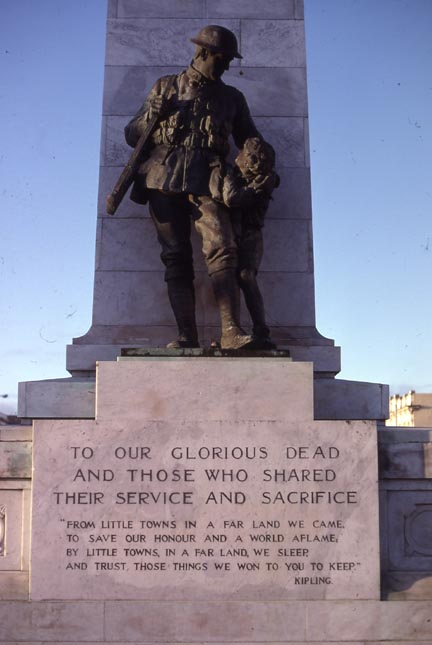
I was driving the South Island last week, which meant I saw a lot of small towns. Small towns may have lost a lot over the last few decades, but the one thing you can be sure to find is a war memorial:


Exactly who the glorious dead would have been was made clear to me when I reached my destination. I was heading to Dunedin to pick up my sister from university, and when I got there I met all these 18 year old boys, one of them looked acted very much like my brother. I am reasonably certain that none of them will be sent to war. They will not be told lies about the glorious empire to get them to sign up; they will not conscripted into uniform; and it seems unlikely that poverty will drive them to their army. But their grandfathers and great-grandfathers weren't so lucky, and those men would have been just as funny, just as silly, just as obnoxious, just as young.

Theirs war was not the war to end all wars, and never could have been. So I'll mark this armistice day with a song from another war, a song I can rarely listen to without crying:

Dig in boys for an extended stay
Those were the final orders to come down that day
Waiting to be saved in the Philippines
You'll wait forever for the young Marines

Now I believe to be here is right
But I have to say I'm scared tonight
Crouching in this hole with a mouth full of sand
What comes first the country or the man

Look at those slanted eyes coming up over the hill
Catching us by surprise, it's time to kill or be killed

Over here, over there, it's the same everywhere
A boy cries out for his mama before he dies for his home


If only we'd meant it when we'd said "Lest We Forget"

Thursday, November 09, 2006

It's our fault - for being ignorant

The Labour government is obviously committed to doing something about the wage-gap between men and women - they've released a study. This study compares the wages in male dominated industries, such a building and painting, with wages in female dominated areas, like hairdressers and caregivers. This research does show that wages in male dominated industries and female dominated industries tend to have similar start rates, but after five years workers in male dominated industries earn over 45% more. However, the conclusion the Minister of Women's Affairs comes to is ridiculous:

I have a theory that if women knew more about the potential earnings and career opportunities in some of these trades more traditionally occupied by men, their choices might be different. We quickly realised however that there was a dearth of information about what young people earn in different trades and occupations. So the Ministry commissioned a piece of research on ‘Wages & Training Costs in Male- and Female-dominated Trade-related Occupations’ and I thought this was a good opportunity to release the findings, because I think they are relevant to any young woman making decisions about her career, something that has always been a priority for the YWCA.


If only women had realised there was a wage gape earlier sooner then we would have solved it long ago!

There are some structural reasons women don't go into male dominated industries. It's not like girls and boys emerge fully formed at 18 to decide what to do with their life. My all-girls school did not have a wood-work department or a metal-work department - there was nowhere within the school was there anywhere where you could learn these sorts of skills.

Being the only women in a male dominated situation is often an extremely unpleasant experience. One of the way men have continued to dominate the male dominated trades is to act in a hostile way to any woman who enters. I haven't personally organised in male dominated trades, but I know women who have, and women who know the female apprentices. Not everyone has a hard time of it - not every male-dominated worksite has a misogynist atmosphere, but enough do that it's not easy - and for many women the risk may not be worth the pay-out.

Knowledge is the last problem that needs to be solved. But even asking the question "why aren't more women painters?" ignores the more pressing question "why aren't caregivers paid more?". If we're going to look at the wage-gap we have to look at the low-wages

For the government to tut-tut about women only being 8% of the modern apprentices is hypocritical. When they set up the modern apprenticeship scheme it didn't cover hair-dressing, or any other traditional female trade. They could have included female trades in modern apprenticeships, but they didn't - that's the reason this scheme is male dominated.

But the bit about that speech that most enraged me is that they studied caregivers. The government is probably the funder for at least 80% of caregivers employed in this country. If they wanted to do something about the wage gap, then getting pay-equity for caregivers would actually be a really good start.

The wage-gap is complicated, I'm aware that I've only covered a few of the many ways in which sexism, misogyny, and capitalism work together to screw women over, but I'm fairly sure I've got a better grasp on it than Lianne Dalziel does.

Note on comments: I'd like the comments to focus on the reasons we don't have pay-equity and how to achieve it.

Well it worked

The jury found the former police officer not guilty of all charges.

Wednesday, November 08, 2006

I love other people's elections

Other people's elections have two important elements that make them better than my own, first my emotional detachment and my intellectual detachment match. In NZ elections I know Labour sucks, and I know it's not going to matter that much, but I still end up caring, and I find that frustrating. The other thing is that other people have first past the post voting systems, which while fundamentally undemocratic, are really fun to watch.

I think it's basically the geek in me that likes elections. I suspect the part of me that decided that all X-files episodes that began with the letter 'P' were of superior quality (this was back in Season three, I make no claism f), is exactly the same part of me that loves knowing that the thing to do is watch New Hampshire 2.

Of course an election is no fun if you can't support a team. I find if you look there's always something to care about: in Britain it was the fate of Plaid Cymru,* in America it was the ballot measures, and knowing if the Democrats took back the house no-one will be able to do anything for two years.

According to CNN all states that had minimum wage increases on the ballots succeeded (often with large margins), that's far more than any New Zealand election has done. Plus the news on the abortion rights front is all good - two parental notification clauses knocked out, and the South Dakota abortion ban overturned. If they can't ban abortion in South Dakota, then that has to be a good sign.

The rest is less fun (although go Arizona for being the first state not legislate Homophobia), also I'm not sure that I believe CNN, when it says that it's covering the key ballot initiatives. I read somewhere that some state voted to investigate bringing in the death penalty. I think that's key and I don't even know what state it is.

As for the actual results, I'm generally fond of the US government not being able to do anything, really I am. I might even have the desire to kind of hope that the Democrats take the remaining two Senate seats, if I thought they might use them not to confirm people, but I don't.**

It's not that I wouldn't vote. The thing I like best about my own elections is voting. I'm reasonably pragmatic about voting, and I love making really complicated theories about the best way to use my vote (or really complicated theories about how to answer polling questions - once I was supposed to say that I was going to vote for NZ First, I can't remember why).*** It's just that they're the Democrats; they suck beyond the telling of it. There are probably even occasions where I'd vote for a Democrat in a national race (although I think in the unlikely event that I moved to America I'd make sure I lived somewhere like Mississippi or Massachusetts, so I'd never be tempted to vote for president). I can also think of circumstances that I'd be glad they won. But none of this makes them an fraction more left-wing, or an ounce less of a corporate party. I don't think it's elections that bring about meaningful change, but organising.

This election has reminded me everything I find weird about American elections. Top of the list is the fact that you use a different voting system in each part of the country, and it's elected officials who decide on the voting system.

But second is the fact that Americans vote for everything. In New Zealand all the power is totally centralised and the only thing we vote for is central government (we do occasionally vote for local government but they don't control any of the most important services such as education).

So I have a question for everyone there whose just voted for the Secretary of State in California, or their local DA or the Insurance Comptroller (what on earth is that?), what difference do you think it makes that these positions are . I imagine that mostly it wouldn't make a difference, but when would it would mean that . NZ has pretty much the same level of violent, racist, rapist cops across the country. Somewhere you have to elect the sheriff, there would be places where that would encourage violent, racist, rapist cops, and other places where it might not stop it, but it might curb it. Is that people's experience?

* Chalk that up to things you didn't know about me - I'm enough Welsh to support the Plaid (if not Welsh to reliably pronounce it).

** It sounds like the Virginia Senate race actually resembles the Tauranga Electorate race - which my friend Larry described as sexism beating racism on the day (although it sounds like racism is going to beat sexism in Virginia - isn't that special).

*** My favourite was that friends who were too principled to vote for Labour or the Greens, but wanted Winston Peters out of a job should vote for the Maori party, on the grounds that the Maori party would have an overhang so voting for then would mean that they wouldn't get any extra seats, but would make it less likely that NZ first would reach the 5% threshold. Then it was pointed out to me that voting for the Libertarianz would achieve the same result, and I was sad, because that was a really complicated bit of logic out the window.

Tuesday, November 07, 2006

A remedial lesson in consent

I've already mentioned that a police officer is on trial for rape. The defence has an interesting new definition of consent:

Mr Gotlieb told a jury in Auckland District Court today that five defence witnesses would be called. He said one witness, Les Gardener, was expected to tell the court the woman suggested sex with him earlier in the evening, before she was allegedly raped by the policeman.


What is the judge doing? Why is that evidenence?

For the judges and defence lawyers out there, any woman can say no to sex. A woman can say no to sex with one man after suggesting sex with another man. I know that's a hard concept to grasp - but if you have trouble with it I'm sure I could provide a mallet.

Monday, November 06, 2006

Feminism and other stuff

I was travelling last week, and I didn't get to write about a whole lot of stuff I meant to write about. So I thought I'd put together my first link post. It's not a link farm, because I don't have that many links. Think of it more as a link lifestyle block, without the hard work of an actual farm link lifetyle blocks are in privileged areas (no this metahpor doesn't work).

First of all you should just go and read brownfemipower. She has written some amazing stuff recently, and I want to quote whole posts. But I will just content myself with two snippets, from a poem in there somewhere

a thing i’ve noticed as i’ve been shifting through pictures of oaxaca and palestine is how many women bring their purses to rallies and protests. and not just a little purse they can hook over their head and forget about, but huge ass mama purses that you know the kitchen sink is in.

and every time i see a picture of some fierce mama facing down a tank or running away from bullets, clinging to her big ass purse, i want to cry. what is in that purse? did she pack extra tylenol in case somebody needed it? are their baby wipes (cuz they come in so handy, even when the kids aren’t around!)? is there a couple of extra bottles of water (in case one of the children lost their’s?)?
Also from Why feminists must stand against government repression in Mexico:
All feminists MUST pay attention to what is happening in Oaxaca. Indigenous women are leading the way to female liberation–which means that just as their demands for access to birth control carry the same weight in their actions that their demands for access to community radio do, they are also taking the brunt of the violence liberation often brings. But thier entire community recognizes that they will never have liberation (aka community health, freedom from poverty, clean air to breath, workers rights, sexual freedom, control of the land etc) as long as the nation/state has ultimate control over what happens to their bodies and souls–or as long as violence against women is acceptable in any form.


To some good news
PARIS, Nov 3, 2006 (AFP) - Unions at Paris's main airport said Friday they plan to call for a strike over the withdrawal of security badges from scores of airport workers, mostly Muslims, denouncing it as discrimination.
This is an awesome display of solidarity from France's airport. All credit to the workers involved, but there's also a lot to be said for the constitutional right to strike.

While I was away Sophia from At the Bay wrote an excellent post about an article written by Anjum Rahman, a member of the Islamic Women's Council. The article isn't on-line so I'm quoting Sophia's transcript:

Yet that seems to me to be a circular argument. It again relates sexual violence to women's behaviour (ie their clothing - too much or too little) rather than men's behaviour. It's the same as the argument that covering up allows men to beat women without the results being visible. If that were the case, then women who dress scantily would suffer much less from domestic violence.

[...] To put hijab (covering) in the context of rape prevention is to negate its power. In reality, that is why the sheik's comments are so destructive and harmful, and why they make me so angry. For me, hijab is a position of strength, but he turns it into a position of weakness and oppression. For me, it's a personal statement of my relationship with God, but he makes it a statement about my relationship to man."


BitchPhD has an excellent about feminism, the division of labour, and a whole bunch of other things:
The second story is smaller, but bigger. In my Spanish class, there was an older woman who was returning to school. Over the course of the semester, we found things out about her: her husband was a doctor and she'd been a homemaker. He'd agreed to "let" her go to college as long as--she emphasized this--nothing changed at home. She was to continue to do all the housework and all the childcare (if memory serves, they had two school-age children) and could take classes and do homework in her spare time. I thought, of course, that this was fucking horrible, and although it was clear to me that her husband was a jerk, there was part of me that wondered why the hell she'd married him, and why she stayed married to him.

I don't remember what prompted her outburst one afternoon, but I do remember her saying, passionately and seemingly on the verge of tears, "you young girls look at me and you all think you can have it all. You think that you won't end up like me. But I'm telling you, you can't have it all. Just wait. You'll get married, and you'll think you're marrying someone who loves and supports and respects you, but that's not how it works. I know you look at me and you think I'm crazy, or you feel sorry for me, but I'm telling you: look at me and realize that this is where you'll be in twenty years."
My Mum has said that she didn't understand feminism until she had me (see I have magic powers). Although I have no children myself my feminist analysis is centred around reproduction, as much as it's centred around control of women's sexuality. I love reading personal blogs by feminist women who have children (my favourite is Raising WEG), because to me individual stories often speak really powerfully to the wider issues.

While I'm posting links I don't think I've ever linked to my favourite post ever. When I first read this I said to a friend "I want to give this to everyone I know - no I want to turn it into a protective bubble around myself so that everyone who came within 50 metres had to read and understand it." It starts with the absolutely awesome phrase "the crazy maze of eating while female" and is mostly about the problem of not replicating (and reinventing) negative attitudes towards food within supposedly feminist groups. After careful consideration I've decided this is my favourite paragraph
At the very least, I think we need some new ways of approaching the issue of food in groups, so it becomes less about the fear of food and fat, less about our personal responsibility for our health, and more about encouraging women to feel strong in our ability to make food choices with integrity.


But I really do recommend you go read the whole thing

Sunday, November 05, 2006

Get Better Work Stories

The New Zealand Police have launched a new campaign Get Better Work Stories. The thrust of this campaign is that your life is boring and a waste of time at the moment and you should rectify this by joining the police. The stories themselves are noble stories of fighting with young people, and having things thrown at you by protesters.

But they seem to have missed a few. Here are some of the 'real work stories' from the police this week:

Pepper Spray
I was called out to a party and there was a guy there we were supposed to arrest. He was coming towards me and I told him he was under arrest but he just kept walking. I thought 'no-one gets to walk past me' so I pepper sprayed him. I love this job, normal people don't get to use pepper spray when they want to be violent.

Handcuffed
So I was called out to this party in South Auckland, and I thought to myself I haven't been able to beat up any brown people for a while, this seems like a good opportunity. So I arrested the owner of the house, handcuffed him, and beat the shit out of him in the back of the car on the way back to the police station. It was awesome, made me feel like a real man, I even got to knock him unconcious.

Four on One
I thought it was going to be a normal night - not doing anything particularly exciting. But then a mate brought someone in for driving while diqualified. We decided the only way to protect the public from people who commit this terrible time was to beat him up. Two of my friends did the actual beating up part and I got to use pepper spray - I love pepper spray.

Other uses for Handcuffs
The police force can give you great opportunities even if you're not working. I'd left my wife at home to look after the kids and was at the local, totally off my face and looking to score. I failed a couple of times, but then I pressured this woman to give me a lift home. I was obviously too drunk to drive and was all "I'm a police officer" - which worked. So I got her to the police station, hand-cuffed her and raped her, and then I did it a few more times. The best bit was my buddies covered it up for me for years.

These are just the stories that have made the news in hte last week or so. They're just the cases where police officers actions have been made public and are considered unaceptable to the police force. I've watched four police oficers jump on top of someone who wasn't resisting with one person kneeling on his head. I've seen plain-clothes police officers pull pepper spray on people without identifying themselves. I've had a police officer say to a group of women "If you get robbed attacked or raped, don't call us because we won't come." I've seen police use unreasonable force at least half the time I've seen them arrest someone. There were no serious consequences for any of the police officers I've mentioned.

I'm a political activist - when I deal with the police there are always other people around me, watching. We know the nuumbers and names of all the human rights lawyers in Wellington and all the media outlets. The police know this, and they treat us accordingly. What I've seen is nothing compared to how poor Pacific Island kids from Porirua are treated every day.

Wednesday, November 01, 2006

Entitlement

I've become convinced that I will know the last person on the unemployment benefit in Wellington. Over the previous few years, as they've been tightening up access to the unmployment benefit, the main effect is that people have got better about sharing tips. Political activists generally have the resources and the inclination to fight bureaucracy. I've also done union education to union members, it is clear that most people have neither the information or the energy.

Tightening up access to benefits doesn't mean that only the deserving gets them. It makes sure only those who are prepared to fight get them.

Lets look at an example of this - one of the many changes the government is currently proposing to our benefit system:

Sixteen and 17 year olds are able to access Domestic Purposes Benefit for the Care of the Sick and Infirm (DPB:CSI). In terms of long term outcomes it is preferable for young people to be engaged in education or training. The eligibility criteria will be tightened so that for 16 and 17 year olds DPB:CSI is only available when there is no other carer after consideration has been given to alternative arrangements and family circumstances.
This sounds perfectly reasonable. I'd hate the idea of a 16 or 17 year old giving full-time care to a relative, they're too young for it.

But lets see what it would mean for a 16 or 17 year old who was the only person available to care for her mother who has

The first thing that'll happen is they'll ring the contact centre, who will give them at least one piece of inaccurate information.* Then they'll get an appointment with a case manager who will either tell them that there's no problem, of course they can have the DPB, and not to worry about anything, or that there's no way that they can have the DPB because they're sixteen.

When (and if) she gets told that she can only get the DPB if she is the only person available then she will have to meet Work and Income's test. Obviously this hoop isn't set yet, but given the way most Work and Income systems work lets assume that it'll involve the discretion of the case-manager, and some documentation. We'll cut her a break here and assume that her family circumstances aren't painful - that she's OK disclosing the reason that she's the only person available to care for her mother to a perfect stranger. But she will have to find that documentation, she will have to find someone to care for her mother while she does this, she probably doesn't drive, so this all happens on public transport, and it may not be cheap.

Remember this is just the additional hoop. Even to get this point she will have had to get a medical certificate saying that her mother needs full-time care. She probably won't know about this requirement until she talks to WINZ, so that's an additional trip to the doctor (who knows where that money is coming from).

All this so a 16 year old can look after her parent full time for $175 a week.

* This (and other comments about WINZ workers) isn't supposed to be a comment on the workers at the contact centre, who have a very stressful job, but instead on the training they are provided.

Tuesday, October 31, 2006

Which Side Are You On?

One question that I've never resolved to my satisfaction, is why I write a blog. When I started I saw it as an opportunity to do some writing. I didn't have any grand ideas for my blog and I don't see it as political action in itself.

Ever since I've started I've been feeling obligated to write about certain topics - to write about topics that don't get covered in the mainstream media. To use this odd little platform I have, to raise issues that are important.

I generally haven't been able to do that, because I generally don't have anything to say about those topics. There's a limit to the number of times you can say "This happened; it was awful", or (more rarely) "this happened; it was awesome'.

But there are exceptions, and the situation is Oaxaca is one of them. I would have written about it sooner, but I've been away from home, and it's taken me a while to get a handle on what was going on.

Resistance

From Democracy Now:

Over the past four months, the residents of Oaxaca - sparked by a teachers strike - had turned the city into an autonomous zone. The police and official government had been kicked out - in its place the protesters formed the Popular Assembly of the People of Oaxaca or APPO.

For months entire families have been camping outside to oversee barricades protecting the city. The protesters have been demanding the resignation of the state's governor Ulises Ruiz and the formation of a more representative government.


From La Luchita: Paz, Justicia y Libertad:

This all started as a routine labor strike by Section 22 of the Mexican teachers union (often referred to in Spanish language press as "el magisterio") escalated into a state-wide revolt after state police tried to violently evict the encampment of striking teachers on June 14.

The teachers union and the newly formed Popular Assembly of the Peoples of Oaxaca made the ouster of unpopular governor Ulises Ruiz Ortiz, widely considered to have won the election by fraud, their primary demand. As violence by police, paramilitaries and mercenaries escalated, the protesters began barracading their neighborhoods in self-defense. For example, after the Radio Universidad radio station used by the teachers union was attacked, protesters responded with a wave of radio station takeovers. But the protesters also began organizing to put their demand into action, declaring Gov. Ulises "banned" from Oaxaca, seizing government buildings and chasing out politicians from the local and state governments.

Violent attacks had for months been escalating against protesters, in what protesters said was part of Gov. Ulises Ruiz Ortiz's repressive Operation Iron ("Plan Hierro"). Brad Will himself documented this with an article a week ago called "Death in Oaxaca". With the murder of the indigenous teacher Panfilo Hernandez, the death toll was at 9 for the protesters. Meanwhile, political parties and the commerical Mexican media were reporting that the protesters were killing people, often without saying the name of the supposed victim or the time and place of the supposed killing. The killing of dissident teacher Jaime René Calvo Aragón, (who argued for the teachers to return to classes) was blamed by the government on protesters, while protesters blamed the government or paramilitary mercenaries of the PRI of killing the teacher as a pretext to repress the protestors, as reported by La Jornada.


I only wish I'd paid enough attention to learn enough to write about the autonomous zone when it was still an autonomous zone.

Reaction

On Sunday Mexican Federal Preventative Police entered the city. I don't think I can give a good summary of events so I recommend the following sites:

Narco News
La Luchita: Paz, Justicia y Libertad
Infoshop
Indymedia Oaxaca (if you speak Spanish - I'm sure there are many many other great Spanish sites about this conflict, it's just I can't find them).

Three people died in the assault, and the fight is still on-going.

What Next

The Zapatistas are supporting the Popular Assembly of the People of Oaxaca:

The EZLN announced that “for the entire day on November 1, 2006, the highways and roads that cross territories where the EZLN are present in the Southeast of Chiapas will be closed."


The battle isn't over.

Why this is important

I'm not writing this as a call for support. I think it's fairly clear that the people of Mexico are doing a far better job of organising and resisting than almost anyone in the first world.

I'm writing this because I want people to know that resistance is met by repression. Efforts to organise and liberate ourselves do threaten the interests of those with power, and will be met with force. To the extent that that doesn't happen to you, is the extent that your priviledge and/or powerlessness prevents you from threatening society.

Thanks to brownfemipower andVegankid for most of the links.

Note for the comment thread: I'm not prepared to host comments attacking the people of Oaxaca or their resistance (disagreeing with me is OK though).

Also posted on Alas.

Monday, October 30, 2006

A Story of Struggle and Hope

I've written before about the experience of waiting for news. In New Zealand waiting for news generally means listening to the National Radio news bulletin every hour on the hour. There are six pips and then they tell you what's happened in the last hour. Usually it's OK if you miss some, usually not that much happens between one hour and the next. But, sometimes, when you really care about what happened it matters desperately and you never miss a bulletin.

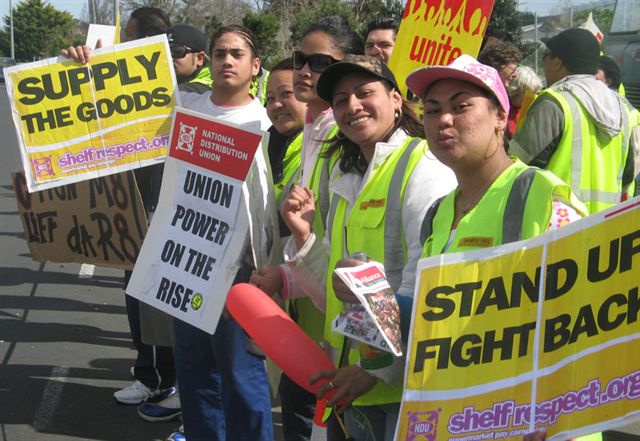
From the 28th August to the 21st September 600 workers were locked-out of their jobs. I listened to the news so obsessively that when the lock-out ended I realised I'd forgotten how to listen the news with mild curiosity. I am going to write a brief history of that struggle, because I think remembering that we can win if we work together is an important part of the battle.

There are 600 workers who run the distribution centres for Progressive Enterprises. Progressive run three separate supermarket chains, so the distribution centres receive goods from the suppliers and distribute them to the different supermarkets. In 2003 Progressive Enterprises closed down their Auckland and Christchurch distribution centres, made all the workers redundant, and then reopened in another location, rehiring the workers on lower pay. They weren't able to do that at the third distribution centre (in Palmerston North), because they either weren't able to find a new site, or weren't able to get rid of the lease. So workers in three different locations, doing exactly the same work, were paid three different rates. Workers were paid $2 an less in Christchurch than they were in Palmerston North, for doing exactly the same job.


This picture comes from Friday 25 August, the workers at the three distribution centres went on strike in support of their claim for a single collective agreement and one rate of pay. I was only vaguely aware of it at the time. I'm a unionist - I support striking workers - so I was excited . But I didn't pay that much more attention than I'm currently paying to the workers at TVNZ who are currently taking industrial action.

That all changed on the Monday (28 August). Progressive Enterprises responded by locking the workers out. All the workers were locked out (without pay), unless they dropped the claim for a single collective agreement. The company started putting out ridiculous lies - they said the union was demanding a 30% payrise. Lock-

At the start it was about Woolworths distribution, going into the second week it was about New Zealand workers in general, there was a lot of members of the public that saw that, and rallied behind us.
That's from Shane Cooper, a worker at the Palmerston North distribution centre.

That was my experience as well, although I was paying attention during the first week of the lock-out I still saw it as an issue for that site. When the company and the union went into mediation later in that week I haunted the radio (and peppered anyone who might tell me what was going on with text messages asking if there was any progress), because being locked-out is an awful experience.

The families who were locked out were facing an indefinate time without wages. For the first week, before substantial funds came in, the union couldn't give out money. It just paid the most urgent bills people had, provided food (many donations of kind came in - but it cost $1000 a day just for food on the Auckland picket line), and tried to defer the rest (all the major banks gave mortgage holidays). The stress that that uncertainty puts on people is hard to imagine. Most people can't afford to be without work for weeks at a time, particularly not knowing when that time will end. There were some families where the locked-out workers was the only wage-earner, other families where both parents worked in the distribution centres.

It was frustrating, being in Wellington as that first week came to an end. We were desperate to help, but didn't know how. We had no distribution centre near by (Palmerston North was two hours drive away). We went to a picket outside one of the Supermarkets (the retail workers at those supermarkets were also negotiating for a wage increase, but they weren't locked out).

After a week of closed distriubtion centres the supermarket shelves started emptying. It was really exciting to go in there and see a sign say "We apologise if your favourite product is out of stock." The situation was really odd as well. The one product the supermarkets had in abudance was budget toilet paper. The managers had obviously been told that they didn't want the shelves to look empty, so everywhere they were short the shelves were filled with toilet paper. You'd be looking at the biscuit aisle and in between the Tim-tams and the Shrewsberries there'd be Toilet Paper.

The second week things started to get serious, both on their side and on ours. In New Zealand if workers are on strike, or locked-out, it's illegal to hire or contract any one else to do their work. Progressive were breaking this law in two ways, one they were getting suppliers to deliver supplies directly,* and two they had hired Linfox, a supply chain company, to distribute the goods in the meantime. Christchurch and Auckland workers were 100% union, and stayed strong throughout the lock-out. However, Palmerston North was less than 100% union, and also had the least to gain from a settlement, since they were already on the highest rates.**

At the beginning of the second week workers in Palmerston North started resigning the union and going back. The only way the company would let them back to work was if they resigned from the union, and therefore renounced their claim for a single collective agreement. By Tuesday 5 September (just over a week after the lock-out began) enough workers went back that the company could reopen the Palmerston North distribution centre with scab trucks. They did this with the aid of the police - who once again made it clear which side they were on in industrial disputes.

By this time the fight was for all New Zealand workers, and it was clear that the company was out to destroy the union. Progressive enterprises is an Australian based company that is Australasia's largest private sector employer. It's cheif executive Roger Corbett earns $8.5 million a year (Australian), the claim the workers were seeking would have cost a fraction of that. Australia has recently passed extremely anti-worker employment legislation, and it seemed they were testing their tactics in New Zealand. Progressive and Walmart seem to have a friendly relationship, and have had management exchanges, so they can learn how to screw over workers together.

The intractability of the company made it a union-wide issue. If they could break such a well organised site, they could break anyone So many times over the next few weeks someone would say to me "thanks for what you're doing" and I'd say "it's just we have to win this you know?" and they'd nod.

You see the New Zealand union movement hasn't been known for fighting for a number of years. In 1991 the National government introduced extremely anti-worker legislation. Despite a mandate from around the country the central union organisation the Council of Trade Unions wouldn't call a general strike. The next decade saw stagnation and decreases on wages, attacks on unions, and workers and unions to afraid to stand up for themselves. Just now, 15 years later, the union movement is starting to fight again.

Laila Harre, the current secretary of the National Distribution Union (the main union in the distribution centre) challenged the incumbent and won in that rare thing, a contested union election.*** She was personally attacked during the lock-out and one newspaper editorial blaming the whole thing on her personal ambition to lead the CTU (quite how she'd have the power to make the company lock-out the workers is unclear). She didn't drive the workers to the picket lines, the actual story does her a lot more credit. When, after the first 24 hours on strike the workers decided not to go back, she recognised that this was their decision to make and her job to work to make that decision work.

In terms of union leadership this was a huge step forward. I believe that if we'd lost this the union movement wouldn't have fought for anything, and that would have been the death blow (union movement's are always much stronger when they fight).

I only got up to the Palmerston North picket-line once, on my way somewhere else. The camp was amazing and it was great to meet the workers. I came about lunch-time and they offered me lunch, I demurred - I hadn't had lunch, but I didn't want to take food that was meant for someone without an income. They insisted and one guy said to me "We can't stop the trucks going in, and we can't stop the trucks coming out, but we can give you hospitality, and cook good food"

Those workers couldn't stay out alone - the union movement came in behind almost immediately, giving substantial amounts of money to the lock-out fund (over a hundred thousand of dollars). That was great, but the public reaction was something else. The only thing we could really do in Wellington was collect money, so we threw ourselves into it and got to see, first hand, the level of support out there for the locked out workers.

We were just out there on the street, rattling our buckets, and the response was amazing. People would go to get money out so they could give it to us; people would empty their wallets into the buckets; after a couple of hours our buckets were heavy with coins and we'd raised over a thousand dollars. It was really clear to me that the people of Wellington understood that this was a fight for all New Zealanders. The street collecting was just one way people were contributing, there was a 0900 phone line, and a bank account people could put money into. Ordinary workers gave over a hundred thousand dollars to the lock-out fund.
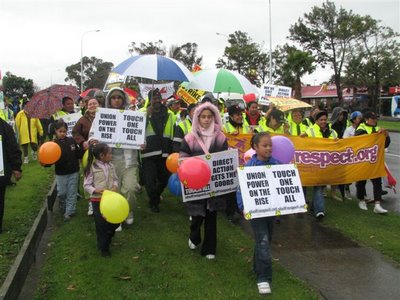


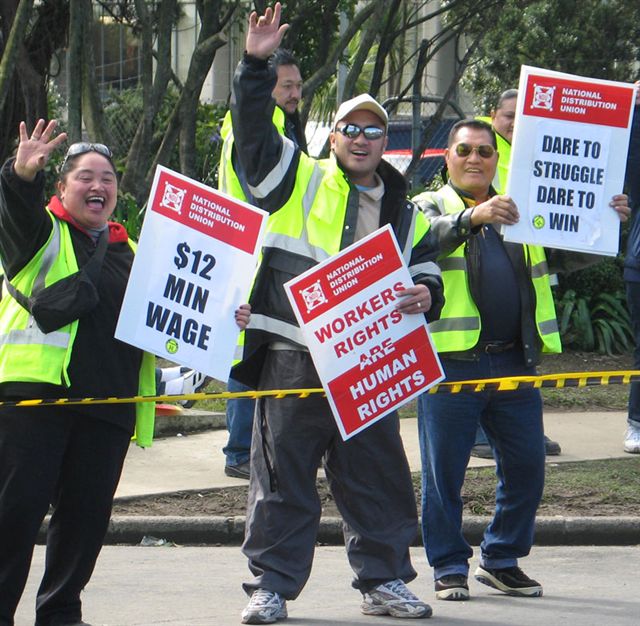
This picture comes from the Auckland rally to support the locked-out workers, there were rallies like this all over the country.

I had my first 'We're going to Win' moment on Friday 8 September two weeks into the lock-out.**** The Council of Trade Union called a special meeting to decide what the union movement could do to help. As well as contributing substantially more money, people began to talk about solidarity action (which is illegal in New Zealdand). The Maritime Union of New Zealand and the Maritime Union of Australia, both started talking about refusing to work on Progressive cargo, that would have broken the company. Just the possibility made us feel so much stronger. Unions were starting to pledge serious funds. The richer workers, from well organised workplaces, agreed to pay $20 a week for the duration (that's how I began to think and talk, everything was for the duration). These were work places with thousands of workers, so it would be $20,000-$40,000 a week.

It was also becoming clearer and clearer that the company was breaking the law and the union was going to be able to sue.****** There was even the possibility that the whole lock out was illegal. By the third week I really did believe we were going to win, with the legal options and the industrial options, we were strong and the company wasn't going to break us. It was just a question of how long, because those workers were hurting. Although we'd raised a lot, it doesn't go very far when it was split 600 ways.

These cases were due to go to court Tuesday 19 September, they didn't - because the company blinked. They agreed to go back into bargaining and post-pone the court date. Then, for the first time, the company actually agreed to negotiate. It took all day and all night (negotiations finished sometime between 3.30am and 4.30am the next morning), but they pieced together a deal. It was a three year deal for three seperate collective agreement, but the rates were aligned so by the end of two years the workers would have pay parity.

Two days later, on the 21st of September the workers voted to ratify this deal, and the day after that the lock-out formally ended and the workers returned to work.

To fight and win, is the most amazing experience. The union didn't choose the fight, the company did, which made it even sweeter that we won. I say we, but I don't work in the distribution centre, and while this was a victory for everyone, it's the workers who did the hard work.


My favourite story from the strike came from the partner of a worker in Palmerston North. She had recently been made redundant, so they were in a particularly difficult position. Her 7 year old daughter went to visit her grandmother (who worked in a nearby factory) during the grandmother's afternoon smoko. The little girl was standing on the pavement asking, and her grandmother asked what she was doing. She replied "I'm on strike, I'll wave at them and they'll toot at me, because they agree."

So with the risk of sounding like a placard - dare to struggle, dare to win:

*They had legal advice that said something along the lines of in order to keep this legal avoid talking about payment until after the lock-out is ended.

**In New Zealand you can't close a shop, so people join the union on an individual basis not a worksite basis.

***As one official put it "Democracy has broken out in the union movement."

****Yes this is a Buffy reference, sorry about that.

******Yes I have a problem with the company breaking the law and don't have a problem with the union breaking the law. It's not because I'm a hypocrite, it's because I've picked a side - deal with it.

For those who doubted it was a systemic problem

Another former police officer is currently standing trial for historical rape charges. In 1988 he handcuffed a woman who was giving him a lift home, took her into the police station and raped her multiple times.

I know there are many more women who have been raped by police officers. I know because they've told me. By e-mail, in comment threads, and in person. I only wish women who had been raped by police officers could count on people believing them.

I know that only the tiniest fraction of the women who were raped by police officers will ever get to tell their story. An even smaller fraction will have it believed. That women are prepared to come forward, after the way Louise Nicholas was treated, is an amazing testament for their courage, and their fight for justice.

There is one note in all this that gives me hope. It is the defence, not the prosecution, who is reminding the jury to put the trial of Bob Schollum, Brad Shipton, and Clint Rickards out of their mind. Those men were found of not guilty of the charges. The defence lawyer wants exactly the same result as their lawyers achieved, but he thinks that he will only achieve that if they

People believe that Clint Rickards, Bob Schollum and Brad Shipton are guilty; they believe Louise Nicholas. Defence lawyers think that the trial that became 'the Louise Nicholas' trial will make juries more likely to believe women and convict rapists.

That's a huge step forward.

Also published on Alas

Review: In Our Time: Memoir of a Revolution

I was really excited about reading Susan Brownmiller's In Our Time: Memoirs of a Revolution. My sister had brought it back from America (I don't envy much about living in America, but I would love your bookstores, particularly their low prices). I was really disappointed; think I got to about page 20, before I had a biro in my hands at all times to make furious scribbles in the margin. You could call it a stylistic problem: I could not handle the way she described the women she was working with:

"Kathie [Sarachild] had close-cropped, honey-colored hair and a voice that was small and tenacious."

"Carol Hanisch, an Iowa farmer's daughter, red-haired and freckled.."

"Like her namesake in Little Women, Jo [Freeman] was a stubborn, coltish, no-nonsense doer."

"At five feet one inch tall, she gazed at all comers through owlish glasses, tossing the mane of dark hair that cascaded below her shoulders."

The last one refers to Shulamith Firestone. This is only the beginning other women are described in just the same way: bubbly, titian hair, frizzy hair, big soulful eyes, hair that falls below her shoulders, open-faced and bespectacled. She describes Bernadine Dohrn as a siren.*

Partly it's the descriptions themselves, which read exactly like the sort of descriptions that journalists never give men - trying to make a point about who a woman is by the way she loosk. But partly the focus on physical experience is part of a wider lack of respect she seems to have for other women in the movement. She casually mentions serious personal problems prominent women were going through in a way that is almost gossipy.

Other things that frustrated me when I read the book, bother me less now. As I wrote in my review of Against Our Will, I now understand Susan Brownmiller's aversion to anything that resembles left-wing economic analysis. But it certainly doesn't make the book any stronger:

The SWP's passion for marches and rallies added another dimension to the abortion struggle. Worried that legalized abortion might be employed a form of population control by "the state", the activists carefully appended "No Forced Sterilization" to every WONAAC poster and flyer. At first WONAAC championed the provocative slogal "Free Abortion on Demand." Later it excised the "free" part as ultra-left and unrealistic. WONAAC's effectiveness was seriously undercut by its ties to the SWP.


Red-baiting is not adequate political analysis.

Those are the small issues I had with it. The big issues are larger:

I watched the battered women's movement from a sisterly distance, and was deeply impressed even as I developed philosophic differences with some of its tenets. The larger women's movement had begun to lump rape and battery under the general rubric of 'violence against women,' and I thougth that was sloppy thinking. Rape was a one-time event, whether it happened in the context of a date or was committed by a stranger or strangers, unknown to the victim. Battery was systemic violence within an intimate, ongoing emotionally complex relationship. Any woman could become a victim of rape, but a pattern of physical abuse in a long-standing relationship begged for further interpretation.


I find it staggering that the person who literally wrote the book on rape, would categorically state that rape was a one time thing. I don't know if she's missed the fact that women get raped in abusive relationship many more times than just once. Or she blames women who are raped in the same way she blames women who are in abusive relationships, but either way I'd expect better.

The fundamental problem I have isn't that I disagree with her. I'm probably going to disagree with any feminist about some issues. It's that she's not clear what sort of history she's attempting to write.

She calls it a memoir, but she doesn't attempt to tell her own story. She starts as the feminist movement began, with very little background. You get very little idea of what was going on in her life, and how she became the person she was. She doesn't owe us that, she has no obligation to write her story. But the book becomes a personal tale when she wants it to. Early on in the book she appears to summarise inter-feminist struggles in two different ways, in one part other feminists with power were trying to shut her out, in another part she was unfairly cut down because people were jealous of her power. She appears to be presenting very similar situation differently depending on what position she was in.

I understand that she would feel that way (I've felt that way), but that's not a historical analysis. That's not the story of what happened in the women's liberation movement.

Part of my frustration was about the fact that I'm a big historical geek. Right at the beginning Susan Brownmiller credits "SNCC Position Paper (Women in the Movement)" to Mary King and Casey Hayden, but this just isn't true. The paper was written by larger group of women in SNCC. It's not a huge mistake, but it shows how easy it is for hearsay to creep in. Because she doesn't footnote most of her statements we don't know whether her accounts come from the fact that she was there, the fact that she's talked to people who were there, the fact that she's talked to people who talked to people who were there or the fact that she's read stuff about what happened. It's incredibly frustrating to read all sorts of interesting bits of information and not know where it comes from, and no way of judging their reliability.

But even if you're not a geek, even if you're not filing pieces of information away in your mind, the difference between memoir and history is important.

I believe memoirs - people telling their own stories, how they experienced the world, what it was like for them - are incredibly important. But if you try to tell your story under cover of a general story, then you're going to end up being dishonest. You need to be clear what's your experience and what's other people's.

If you want a good memoir of the feminist movement I can't recommend Roxanne Dunbar Oritz's Outlaw Woman enough, Ruth Rosen's The World Split Open is a good history.

*I find this particularly frustrating because I've read many accounts of the history of SDS which cast Bernadine Dohrn as an Eve character - sexually tempting the New Left to a fall - to violence and the underground. There is no excuse for women to go aorund with the same offensive idea.

Sunday, October 29, 2006

Meat

When I was at University a young Act support called Nick Archer wrote a letter to Salient (the student newspaper). I don't remember what the context was, I don't remember what he was responding to. But I remember the letter itself very clearly. Because Nick Archer compared women to pieces of meat. He said that men were lions trying to get women, and if women wore too few clothes then they were responsible for men's response.

I once ran into Nick Archer walking down a long and isolated road wearing a tight singlet - which was a very stressful experience.

I introduce this to point out that misogynists obviously have quite a limited imagination. Sheik Taj Din al-Hilali, the Australian Mufti whose statements about rape, appears to have developed Nick Archer's thesis a bit more thoroughly before . But they cover exactly the same ground. Because the Sheik has claimed he has been misrepresented I have provided the section in full. While it is possible that he was mistranslated, his reference to being sentanced to jail appears to make it clear that he is referring to non-consensual sex. This translation is from the The Australian:

But in the event of adultery, the responsibility falls 90 per cent of the time with women. Why? Because the woman possesses the weapon of seduction. She is the one who takes her clothes off, cuts them short, acts flirtatious, puts on make-up and powder, and goes on the streets dallying. She is the one wearing a short dress, lifting it up, lowering it down, then a look, then a smile, then a word, then a greeting, then a chat, then a date, then a meeting, then a crime, then Long Bay Jail, then comes a merciless judge who gives you 65years.

But the whole disaster, who started it? The Al-Rafihi scholar says in one of his literary works, he says: If I come across a crime of rape - kidnap and violation of honour - I would discipline the man and teach him a lesson in morals, and I would order the woman be arrested and jailed for life.

Why, Rafihi? He says, because if she hadn't left the meat uncovered, the cat wouldn't have snatched it. If you take a kilo of meat, and you don't put it in the fridge, or in the pot, or in the kitchen, but you put in on a plate and placed it outside in the yard. Then you have a fight with the neighbour because his cats ate the meat. Then (inaudible). Right or not?

If one puts uncovered meat out in the street, or on the footpath, or in the garden, or in the park, or in the backyard without a cover, then the cats come and eat it, is it the fault of the cat or the uncovered meat? The uncovered meat is the problem! If it was covered the cat wouldn't have. It would have circled around it and circled around it, then given up and gone.

If she was in her room, in her house, wearing her hijab, being chaste, the disasters wouldn't have happened. The woman possesses the weapon of seduction and temptation. That's why Satan says about the woman, "You are half a soldier. You are my messenger to achieve my needs. You are the last weapon I would use to smash the head of the finest of men. There are a few men that I use a lot of things with, but they never heed me. But you? Oh, you are my best weapon."


I only wish Nick Archer's comments had received the same level of outrage as this man's did. It's not particularly reassuring to know that men will defend women's right not to be treated as objects only when they can use women's rights to attack other men (hence missing the women not being objects target anyway).

Also posted on Alas

A Review of Against Our Will (first half)

I've been meaning to write a review of Susan Brownmiller's In Our Time: Memoir of a Revolution. But since she discusses the reaction to Agaisnt Our Will I decided I needed to read that before I could write my review.* Then, once I'd read her chapter about race, I realised that I needed to review Against our Will before I could review In Our Time, because some of my thoughts about Against Our Will were too long for a footnote.

If that isn't enough of a precursor I then lost my copy of Against Our Will, so I haven't finished it. But since I'm reviewing a 30 year old book, just to make some points so my review of another book makes slightly more sense, I don't think it'll matter if I'm only actually talking about half the book. So here goes...

My first reaction to Against Our Will is just how amazing it is that it exists. The women's liberation movement invented feminism as we know it. Rape, domestic violence, body image, even abortion - haven't always been defined as political issues. It is a testament to the amazing analysing, educating and organising of the women's liberation movement that we no longer see these things as individual problems.

So I have to start by giving credit to Susan Brownmiller for the work that she did. Also to point out that she didn't work alone. It was as women talked together about their experiences of rape that they realised that rape wasn't just an individual issue. Susan Brownmiller articulated that important understanding, but it was because of the work of many conciousness raising groups that she came to this conclusion in the first place (a debt she fully acknowledges).

The Red Menace
One of the most puzzling things to me about In Our Time was its weird semi-red-baiting. She dismissed any economic argument out of hand, and seemed to think that calling someone red was enough to discredit their point of view.

Having read Against Our Will Susan Brownmiller's position no longer puzzled me. This is an excerpt from a signed article in the Daily Worker:

Was it not a fact that she had been promised $5?
Was it not a fact that she accepted this offer?
Was it not a fact that she had dates in the past with one of the men?


This is completely reprehensible. To imply that if a woman is a prostitute she automatically consents to sex, or if she dates a man she is consenting to sex ever after - that is to condone, if not actively promote, men raping women.

The Communist Party of America did good and important work defending black men against a racist court system. But they didn't need to trash women to do so, they didn't need to reinforce rape myths to do so.

So I can understand Susan Brownmiller's anger at the Old Left - for not just repeating these lies, but believing them. I understand her anger at the New Left that proposed a 'rape-in' against congressmen's wives as political action; used women as a reward for politically right on men: "Girls Say Yes, To Guys Who Say No"; and embraced Eldridge Cleaver. I would say fury is the only appropriate response to these things. I do think that this fury blinded her to some ideas that were too important to be dismissed just because those who espoused them were misogynist assholes, but I understand why it did.

A Question of Race

The most controversial part of Against Our Will was always Susan Brownmiller’s discussion of race. In a way I feel it is foolish for me to comment on it. I’ve read a bit about American history, but I’m not American, I know enough to know that I don’t know enough – and that this is a difficult topic. But I’m feeling stupid today, so here goes.

This was the article of her book that I read first, the controversy – so I wanted to see what she’d said for herself, so I could better judge how she'd reported on the conflict.

For about the first half of the chapter, I thought she was making a lot of sense. She pointed out that white men were using white women to punish black men, and often the white women were merely pawns. The Scottsboro Boys, which is one of the most famous cases, is a good example of this. The rumour that they had been raped was not started by the two white women who were riding on the same train as the Scottsboro boys. The police arrested these women and told them that they'd be charged with prostitution unless they gave evidence.

I think it was an interesting point, and - like I've already said - I agreed with most of the points about how those organising the defence chose to frame these cases. She also has some really good figures about the frequency of inter-racial rape, and the actual reasons black men were lynched (it was more likely to be for owning property, than for accusations of inter-racial relationships).

But the chapter, and her argument, got completely unhinged near the end. It starts with Susan Brownmiller's discussion of the Wille McGee case - a black man who was executed because he was accused of raping a white woman. Towards the end of the appeals process Willie McGee's wife came forward and said that her husband had been having an affair with the white woman, and it was when he was caught that the white woman accused him of rape. It seems to really matter to Susan Brownmiller that the white woman is telling the truth and Willie McGee's wife (who was black) is lying. I think it's always dangerous history (and even more dangerous politics) for the facts of an individual case to matter that much. If you need everyone on your side (in whatever sense you have a side) to have always been worthy and pure, then you're not on particularly solid ground.

If Susan Brownmiller's argument depends on no white woman ever using the agency and power she did have maliciously, then her argument is invalid. That Susan Brownmiller needed to believe the white woman over the black woman, is a sign of her racism.

It doesn't get any better from there on in, and by the end of the chapter it seems that she's suggesting that the reason left-wing people criticise the prison system is because they don't take rape seriously, and don't care about women.**

The need to be specific

The racism in her book isn’t only in her chapter on race, although it comes across most strongly there. While she acknowledges that black men were killed because they were accused of raping white women, she doesn't seem to accept that this means that you have to have a different analysis of rape in the white south, than you would where these circumstances were not present. Over and over again she refuses to see see any other dynamic but a gendered one, and to look at colonial and slavery-era America solely through the point of view of gender.

The only exception, the only time she acknowledges that men don't always rape is the fact that the Viet Cong, and other guerilla armies, don't rape (because they can't, as their military strategy requires the support of the people around them). I guess her background meant that she believed that, when people told her. But she rushed over this point, having spent an entire chapter talking about why men always rape women in times of war.

As well as being hugely racist, I think this is just plain bad scholarship, and bad feminism. Her analysis that men always have raped women in exactly the same way, with exactly the same meaning, throughout recorded time - offers no hope, no subtlety and no possibility of change.

If I'm going to live in this world I have to believe that it doesn't have to be like this. I have to believe that men rape women because of specific historical circumstances, and that we can change these circumstances.

* No I hadn't read Against Our Will before now, I'm a bad feminist. I've also tried to read The Female Eunuch about half a dozen times, but it never seems to make any sense. But I'm not entirely convinced that's a problem with me.

** She was mostly talking about Jessica Mitford (and I'll happily admit that I'm biased when it comes to Jessica Mitford - because her books played a large part in me becoming a political activist) and her critique of prisons. While I'd admit that Jessica Mitford's letters indicate that she her political analysis of rape was only slightly more advanced than Stephen Erber's - I'm fairly sure that her criticism of prisons was based on a thorough understanding of the prison-industrial complex - and is the only reasonable position to take in the face of that knowledge.

Also posted on Alas.

Sickness, injury, disability or pregnancy

I haven’t had an opportunity to look at the government's benefit proposals in detail (I plan to do that tomorrow – it's even sadder when you know I’m on holiday), but I want to start by discussing the, much publicized, announcement that WINZ will focus more on getting people on the Sickness or Invalid's benefit into work. I don’t know the details; in his interview with Kathryn Ryan the Minister of Social Welfare was very vague on how much this would be voluntary, and how much it will be compulsory. His favourite phrase was 'nothing will be compulsory at the moment' (which strongly implies that it will be compulsory in the future). So rather than discussing the particulars, I want to talk more generally about disability, sickness, and employment.

The sickness benefit is available for people who are unable to work due to sickness, injury, disability or pregnancy. The invalids benefit is available for people who are permanently and severely restricted in their capacity for work because of a sickness, injury or disability (why the difference? I don't know. Although it's made even more pointed by the fact that the Invalids benefit is paid more. I'm lying I do know that it's a nasty sort of moralistic division between really deserving, and possibly shirking poor).

The 'services' currently provided by WINZ focus on teaching people how to look for a job and matching up people and jobs (I'm being very generous with my description here). By making such a big deal of offering these services to people on the sickness and invalid’s benefits (and later forcing people to use them) the government is saying that they think the main things people on the Invalid’s and Sickness benefits need to get into jobs is access to these services.

I say bullshit.* I'm going to explore the actual barriers that stop people who are sick, injured, disabled and pregant from getting a job.

The most obvious barrier is the sickness, injury, disability, or pregnancy. To get on the sickness or invalids benefit you have to have a doctor sign off saying that you are unable to work, so it's not just a barrier - it's a medically certified barrier.

There are all sorts of things that the government as a whole could do to ensure that people who are sick, injured, disabled or pregnant can participate fully in society. For example, many health conditions are exacerbated by living in low-quality housing that isn't properly heated (read most NZ houses). The government could do something about this, both by providing more, warmer, state houses, and by instituting better building standards.

What about stress? Many (most?) chornic healthy conditions are exacerbated by stress. Poverty is stressful (and anyone who is on these benefits is poor). Dealing with WINZ is stressful (I've known people suffer from serious health relapses due to the stress of trying to deal with WINZ). There are many thing that the government as a whole, and WINZ in particular could do to improve the health of many people who are sick, injured or disabled. Why aren't they starting there?

Lets move away from the sickness, injury, disability or pregnancy for a bit. After all to focus on those is still to imply that it's a problem with the person that they are not currently employed, and that's not what I believe. There is a huge amount of unreasonable prejudice against hiring people who are sick, disabled, or injured. Everyone I know who has fitted in those categories has had a much harder time finding a job than similarly qualified and capable people who don't. Why not start by working on the people with the prejudice, rather than ask people who are discriminated against to jump through more hoops?

That's only the start though, because it's not just the unreasonable prejudice that is the problem, it's the prejudice that is considered totally reasonable. For example, if someone had a chronic health condition that didn't stop them working a forty hour week most of the time, but that flared up a few times a year and the worker required a couple of weeks off a time, then it would be considered perfectly reasonable not to hire them. Or if someone had a full-time job and then developed a health condition which meant that they could only work three days a week, it'd be perfectly legal to fire them.

WINZ is obsessed with work as the be all and end all of people's contribution to society. But we only get to contribute to society on employer's times. Employers don't have to (and generally don't) take on workers whose health allows them to work some of the time.

This is ridiculous. Why do we let our economic system dictate our participation in society, rather than organise an economic system that allows everyone to participate? Almost everyone can do some useful and meaningful work, if they're allowed to do it on their terms. The fact that it doesn't work like that, that we aren't all able to contribute according to our ability is not the problem of individual people, who have sicknesses, injuries, or disabilities, which don't fit employer's wants.

* For the sake of clarity I also want to emphasise that these ‘services’ are generally not what unemployed people need to get jobs either. I think changing the Reserve Bank Act would do more to lower unemployment than all the 'work4u' seminars in the universe.

Monday, October 23, 2006

Free Speech

I first read about a protest against the Minutemen at Columbia on Foolish Owl's blog. For those who don't know the Minutemen are an American group, who specialise in vile anti-immigration racism and have taken it on themselves to police the Mexico-US border.* The Young Republicans at Columbia had invited . Anti-racist/immigrant rights groups got together and organised a protest outside. Some people also went inside and disrupted the speech (either by unfurling a banner, or shouting the speaker down - I wasn't there, and only have dial-up so I can't watch the video - it's irrelevant to my argument).

I absolutely support and applaud this sort of protest (I've done this sort of protest, just for the record). But what I wanted to address directly was the idea that by disrupting the event (however they did it) interupted this man's right to free speech. The Happy Feminist was reasonably vocal in her disapproval:

But no it wouldn't change my analysis. You protest outside, you write scathing editorials, and you publicize the fact that the College Republicans are basically inviting a hate group onto campus. But as a matter of both tactics and ethics, disrupting the actual speech isn't right.
and
And to be crystal clear, no, I would not agree with shouting down a pro-life speaking or anti-feminist speaker.

It's the same principle as the Jewish ACLU lawyer who defended the right of Nazis to demonstrate in Skokie. No matter how noxious and personal and awful he found what the Nazis were saying, he still defended their right to say it.
To me the principle of freedom of speech is to stop those with power limiting the speech of those without power (particularly stopping the state limit people's freedom of speech, but I think the role of companies in limiting people's speech also comes under the same analysis). The idea that respecting freedom of speech means listening in silence while someone says something you find offensive seems ridiculous to me. All freedom of speech guarantees is the ability to speak - it doesn't mean that anyone has to listen to, or respect, what you're saying.

Shouting down a speaker isn't interfering with free speech; it is free speech.

What I find just plain weird, is that this argument is generally only applied to people who are speaking in formal settings. On Saturday the neo-nazis held their annual rally and there was a reasonably large counter protest which stopped them meeting where they wanted to meet, and shouted them down (more on that in a second). Very few people jump up and down and says a counter-demonstration is interupting the nazis freedom of speech. But when someone is an invited speaker - when they have backing by some institution, some power base then somehow they have more of a right to free speech than they do on a speech corner. That seems like the wrong way round to me. Those who are in positions of power, generally need less, not more protection against their rights being infringed.

So I have absolutely no ethical qualms in holding banners, chanting, or communicating in any way, while someone I disagree with is speaking. I exercise my freedom of speech by not being silent.

That doesn't mean I think that shouting at people is always the best tactic. The counter-demonstration againstthe neo-nazis is a time where I thought the tactics were wrong. There aren't very many neo-nazis in New Zealand, but they tend to be exactly sort of violent thugs you'd expect (two years back someone vandalised the graves of jewish people, and they attack people as well as graves).

To me, the point of protesting against neo-nazis is to make it really clear that white supremacy is not welcome. I see this message as not just for the nazis themselves, but also for everyone who walks by. But there's never any purpose to the anti-fascist demonstration except to piss the nazis off. I strongly susepct being protested against makes the nazis feel cool and important, so the counter-protest ends up being counterproductive.

I do think that we need to organise to ensure that fascists don't get a hold. But we don't do that by shouting at them. Political racism has appeal for working-class people who believe that they should be better off than they are. By saying "it's the jews/immigrants/Maori who are to blame for your situation" various groups (including mainstream political parties obviously) use racism to organise and gain support. The only response to those lies is to present what we see as the truth - to show that it is capitalism that is to blame for people's economic problems, and that it can be fought.

I didn't attend Saturday's anti-fascist demonstration. I'm sick of them, sick of the macho atmosphere, and sick of activists who seem to get their kicks by playing cops and robbers with fascist groups, as if it's the most important work in the world. There's a real macho culture to these sorts of demos, that makes me very uncomfortable.

I'm really glad I didn't go, as there seems to have been a distinct lack of political analysis at the counter-protest. "More hair than brains" may be an amusing chant towards skinheads - but actually our problem isn't with their hair cut, or their intellect. Likewise a whole crowd chant of 'Ugly, Ugly, Ugly' seems to miss the point.

But most disturbing to me was that some supposedly anti-fascist protesters shoutted "cocksuckers" and "faggots" to the nazis. Now I don't want to tarnish the entire demonstration with the misogynist homophobic actions of a few. I have a lot of friends who were at the demonstration, and I know that they would neither shout that, or stand silent while someone else chanted it. But I think it shows that my fears about a macho atmosphere are not unreasonable.

* Just for a short break and disturbing story. My sister once met someone who worked for the US border patrol at a party. When asked what he did he flipped out his badge (which he'd carried with him to Wellington, presumably to impress the girls) and said "I shoot Mexicans". Just a reminder that the Minutemen are only one of the violent racist groups on the Mexican-US border.

Saturday, October 21, 2006

Feminist? Feminine?

Easily the best post I've read this month is Winter's How do I look? Thoughts on feminism and white middle-class femininity. I was really pleased to see that both Hugo and Rachel used the post as . They both focused on Winter's starting point:

My experience with feminine beauty practices has been oppressive. You can read about it here if you’re interested, but now I realise that when I wrote about my experiences, I should have paid a lot more attention to the fact that my own attitudes to feminine practices are deeply class-based. I have not been talking about “femininity,” I have been talking about the specifically white middle-class femininity that affects my life, and which often seems to be taken for granted as a universal experience for all women when white middle-class women speak on the subject. Hence the accusations of class privilege: white middle-class people are all too used to getting to speak for everyone.
I agree with this entirely. I'm not going to attempt to parse the discussion about the relationship between feminity and feminism, but there was an assumption that feminity had a set meaning, and covered a reasonably stable set of behaviours. As Winter points out this just isn't true. The gendered behaviour expected of a woman depends on the time and place, culture and class that that woman lives in. Her ability not to conform to those expectations often also depends on her culture and class.

That's not to say that middle-class white women shouldn't analyse the experiences they have of being middle-class white women. The problem is not that these discussions happen, but that they become a stand in for all women.

Winter went on to make an even more interesting point. Appearance and feminity is generally something that is left up to women to police (certainly among middle-class white women, my understanding is it true for a wider group of people, feel free to jump in if you have a different experience). In particular within white middle-class women part of conforming to standard ideas of feminity is not looking like you're trying.

Therefore, feminist discussions about appearance and supposedly feminine behaviours can fit right in a white-middle class discourse about women's bodies. Feminist critiques of shaving/waxing/make-up and so on, all fit into the idea that women shouldn't appear, and women critiqueing other women's appearance is how the whole system is maintained in the first place.

I think that analysis explains why it's very difficult to discuss these issues in a way that doesn't come across as policing policing. It also explains why discussion gets so fraught so quickly, as most women have good reason to get defensive when they feel other women are policing their appearance and behaviour. It's not just on-line either. I've been part of in person discussions that have gone badly wrong, and no-one really knew why.

But go and read Winter's whole post - I think her laying it out there like that was an awesome starting point.